A Chief Compliance Officer is designing a review cycle for the organization's corporate compliance policies and procedures. What is the primary purpose of establishing a process for regular, periodic updates to these documents?
Select an answer to reveal the explanation.
Short Explanation and Infographic
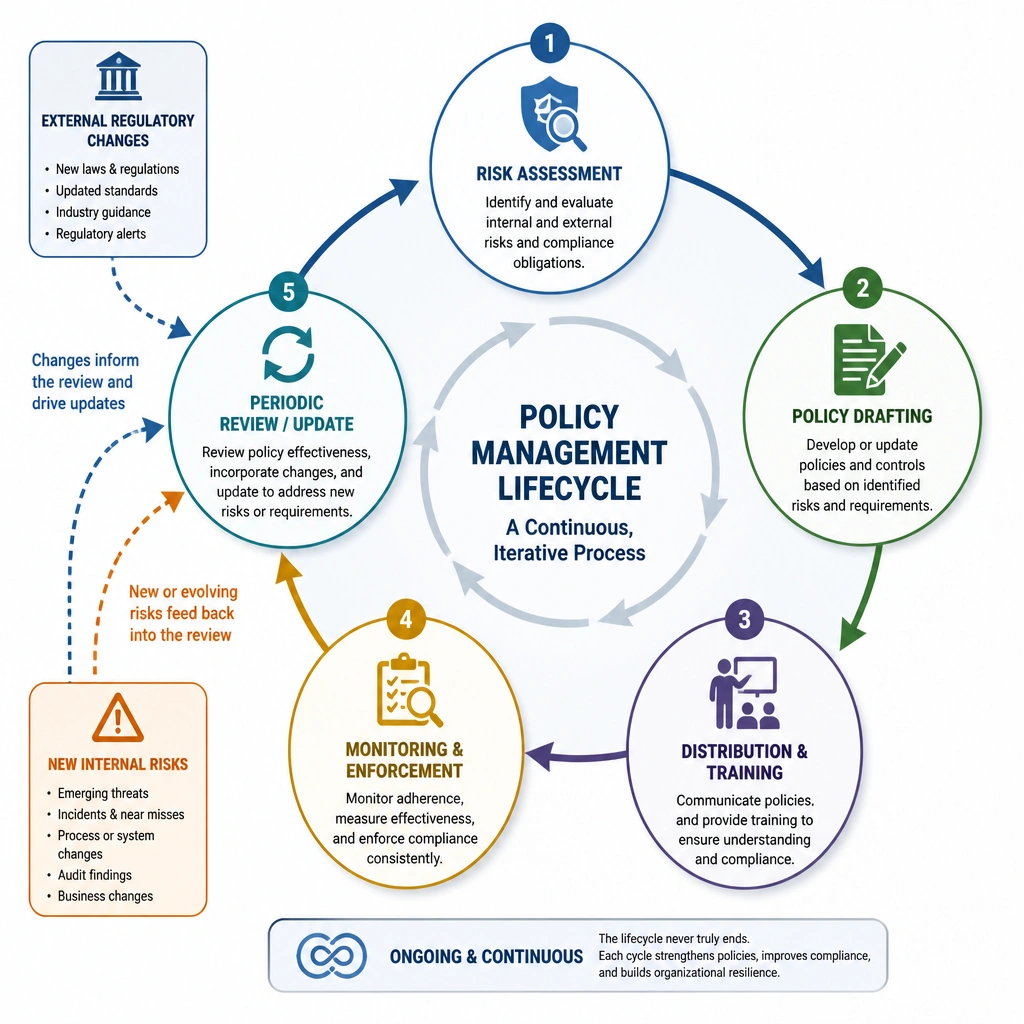
Think of your company's policy manual like the firmware on your network's core switches. If you just configure it once and walk away for three years, you're going to get hacked, right? The threat landscape changes, new vulnerabilities pop up, and suddenly that old config is completely useless. It's the exact same deal with compliance policies. You can't just write them, stick them on a shelf, and call it a day. Regulations change, your business expands into new markets, and new risks emerge. If your policies don't evolve to meet those new risks, they aren't worth the paper they're printed on. Trust me, I've seen organizations get absolutely hammered because their guidelines were written for a business model they abandoned years ago. Keep them fresh, keep them relevant, and keep your organization protected. Got it? Sweet. Let's keep rolling.
Full explanation below image
Full Explanation
In the field of corporate compliance, policies and procedures serve as the operational controls designed to mitigate identified risks. However, the internal and external environments of any business are constantly shifting. External factors such as new legislation, regulatory changes, and evolving industry standards directly affect what constitutes compliant behavior. Internally, mergers, acquisitions, new product launches, and technological adoptions alter the company's operational footprint and risk profile. Therefore, the primary purpose of regularly reviewing and updating policies and procedures is to ensure they remain aligned with the current regulatory environment and responsive to new or emerging risks.
Let's evaluate the incorrect choices to understand why they fail to meet this standard: - Option A is incorrect because compliance is an ongoing operational reality, not a static achievement. Simply updating policies on paper does not prove compliance; the organization must also demonstrate that those policies are actively implemented, monitored, and enforced. - Option B is incorrect because effective instructional design and compliance principles dictate that policies should be as concise and clear as possible. Making them longer and more complex actually decreases employee comprehension and compliance rates, creating a higher risk of policy violations. - Option D is incorrect because updating policies is a core duty of the compliance function, not a mechanism to replace it. A compliance officer or department is still required to oversee the policy lifecycle, monitor adherence, and manage the broader compliance program.
By implementing a systematic policy review cycle, an organization ensures that its internal rules remain dynamic, legally accurate, and protective against the latest threats.