When establishing a robust risk assessment framework within an international organization, which characteristic is absolutely critical to ensure its long-term viability and effectiveness?
Select an answer to reveal the explanation.
Short Explanation and Infographic
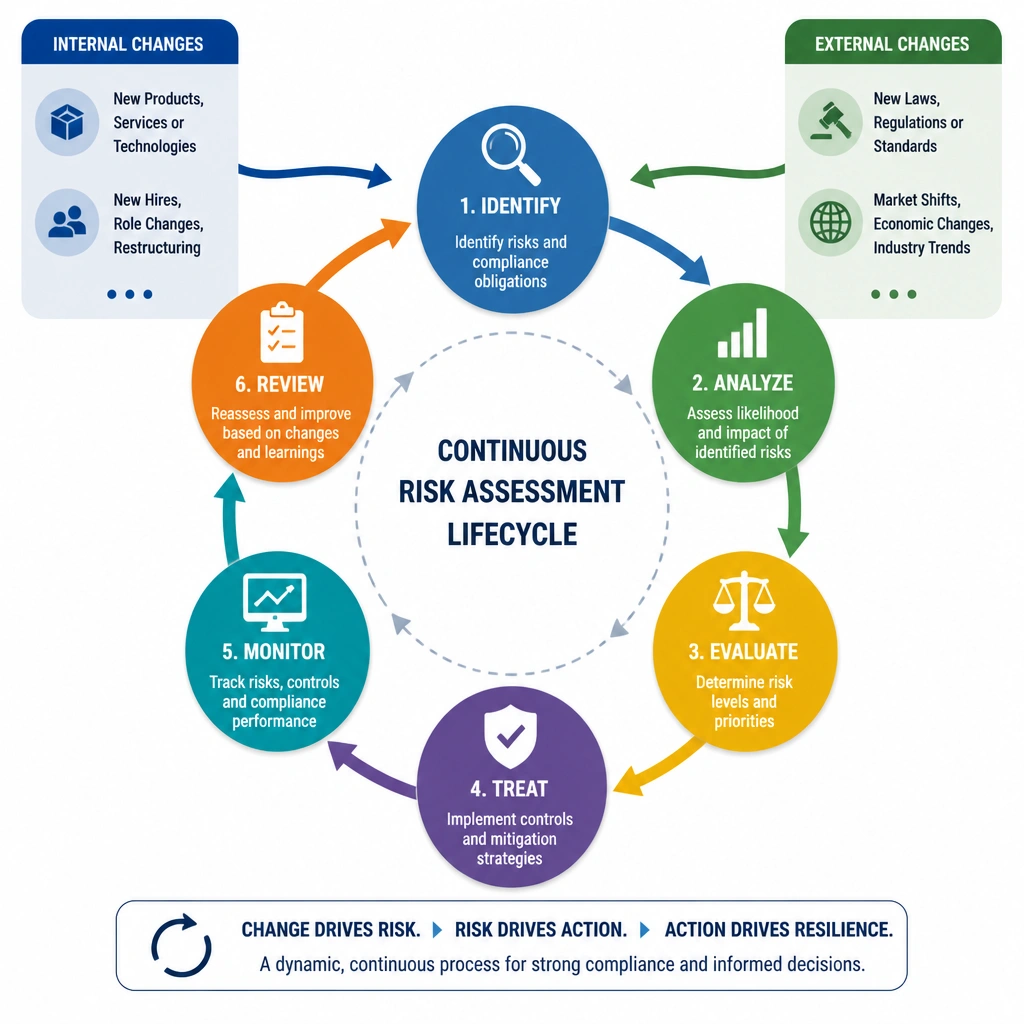
Here's the deal: some folks think a risk assessment is like a check-the-box exercise. You hire a consultant, they write a fancy report, you stick it in a binder, and everyone goes back to sleep. Trust me on this—that is a recipe for disaster in the real world! Your business changes, laws change, and bad actors get smarter. If your risk assessment isn't a living, breathing, continuous process that adapts to new software, new offices, and new regulations, you are driving a car with your eyes closed. You've got to keep monitoring, keep updating, and keep adapting. That's why the right answer is all about continuous evaluation. Got it? Sweet. Let's keep rolling.
Full explanation below image
Full Explanation
In the field of compliance and risk management, an effective risk assessment must be a continuous and dynamic process rather than a static, one-time event. Organizations operate in highly fluid environments where internal variables (such as expansion into new markets, launching new products, or changing personnel) and external variables (such as new legislation, geopolitical shifts, or emerging security threats) constantly evolve. A static assessment quickly becomes obsolete, leaving the organization exposed to undetected vulnerabilities.
Let's evaluate the choices: - Option C is correct because it correctly identifies the necessity of a continuous, iterative cycle. This alignment is supported by major compliance frameworks, including the COSO Enterprise Risk Management framework and guidelines from the U.S. Department of Justice (DOJ), which emphasize that risk assessments must be updated periodically and dynamically to respond to change. - Option A is incorrect because while external audits provide valuable independent verification, relying exclusively on them prevents the internal compliance team from developing the deep, day-to-day operational understanding needed to manage risks proactively. - Option B is incorrect because a rigid, static template fails to capture emerging risks. While baseline comparisons are useful, they should not come at the expense of ignoring new, critical risk factors. - Option D is incorrect because limiting the scope to financial liabilities ignores regulatory, operational, reputational, and strategic risks, which can often be far more damaging to an organization's survival.