A manufacturing company is preparing for a regulatory audit. The compliance officer compiles data on policy training completion rates, hotline call response times, and audit resolution speeds. What is the main reason for tracking these metrics and KPIs?
Select an answer to reveal the explanation.
Short Explanation and Infographic
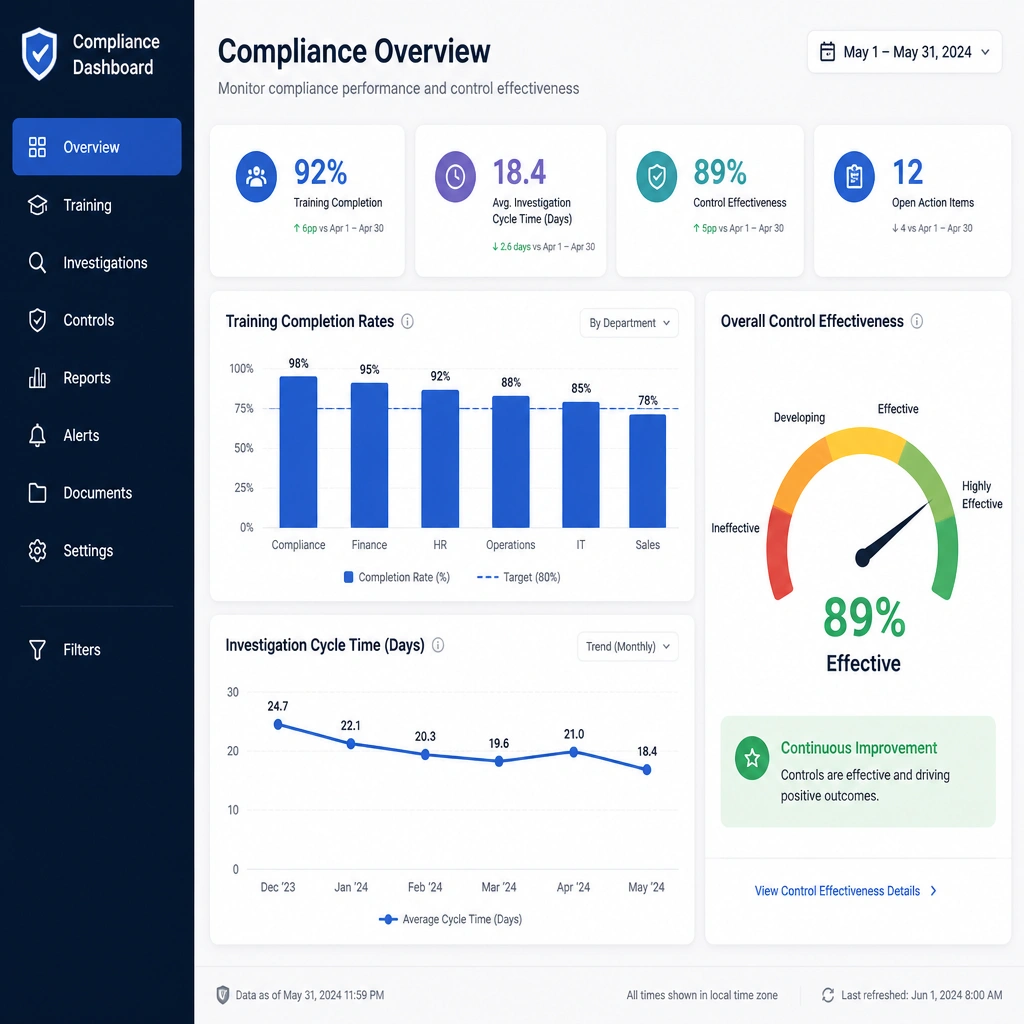
Check this out: in compliance, you can't just say, "Trust me, we're doing great." You need data to prove it. That's where metrics and KPIs come in. If the board asks how the compliance program is working, you don't guess—you show them training completion rates, audit turnaround times, and policy updates. It's about showing that the program actually works and finding the weak spots where you need to beef up security. Distractors like using metrics to publicly shame people or calculating net profit margins are way off target. Use data to build a stronger program. Got it? Let's keep moving.
Full explanation below image
Full Explanation
Measuring compliance program performance using structured metrics and Key Performance Indicators (KPIs) is critical for demonstrating that a program is not just a "paper program" but is active and effective. Regulatory agencies, such as the US Department of Justice (DOJ), emphasize the importance of data-driven compliance programs that continuously evaluate their own performance. Tracking specific metrics—such as the time it takes to investigate a report, training completion rates, or policy review cycles—provides concrete evidence to the board and executive management that the compliance program is operating successfully. Furthermore, analyzing these trends allows the compliance officer to identify bottlenecks, weaknesses, or emerging risk areas, allowing the organization to proactively allocate resources and improve controls. In summary, KPIs serve as a diagnostic tool that guides operational enhancements rather than a punitive tool, reinforcing the program's credibility with both employees and external regulators. Using compliance metrics to publicly shame employees is counterproductive, damages organizational culture, and discourages employees from reporting concerns. Compliance programs are cost centers designed to mitigate risk rather than generate direct financial profit, making quarterly profit calculation irrelevant to compliance KPIs. Finally, compliance metrics are designed to evaluate system performance and direct risk mitigation, not to serve as the sole mechanism for general employee bonus structures.