A mid-sized global logistics firm has limited budget and staff for its compliance department. The Chief Compliance Officer (CCO) decides to implement a "risk-based" approach rather than treating all departments and processes identically. What is the primary justification for designing the program this way?
Select an answer to reveal the explanation.
Short Explanation and Infographic
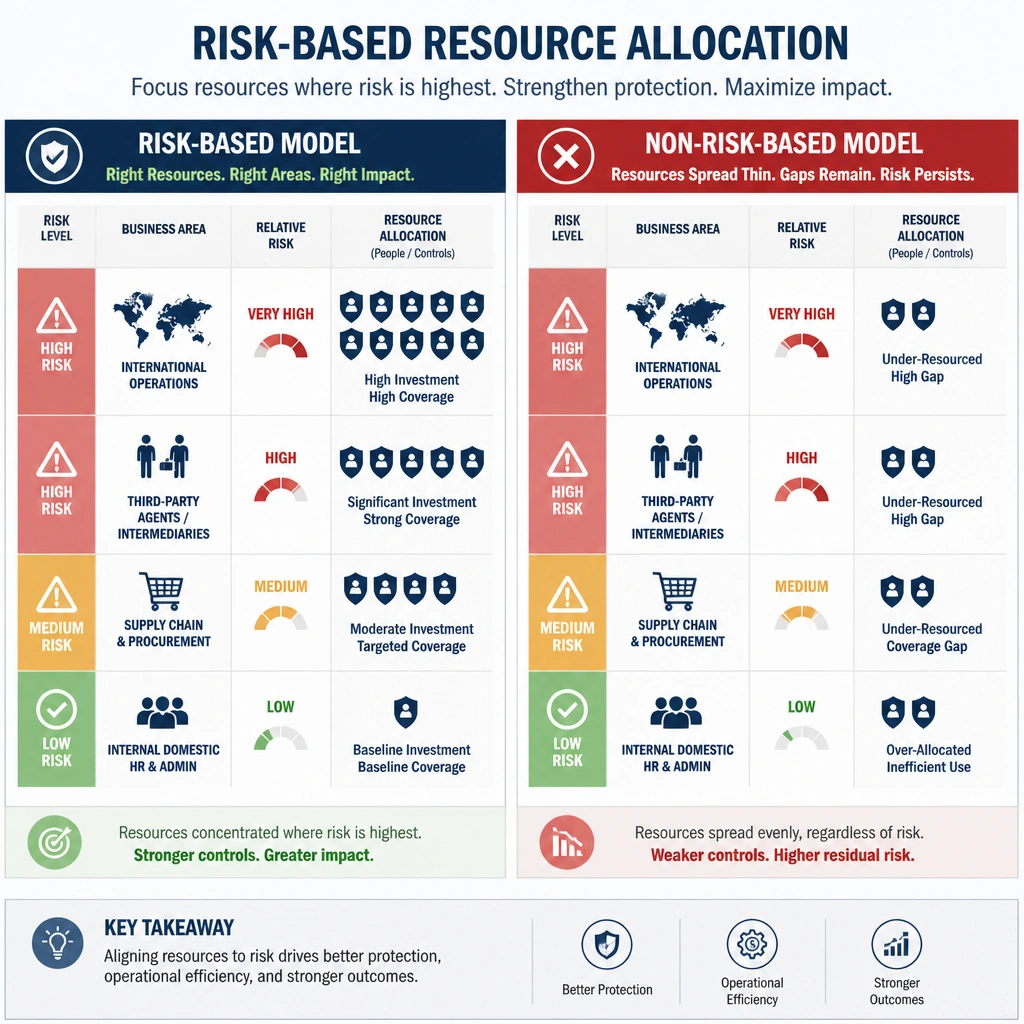
Check this out: in the real world, you can't be everywhere at once. If you try to guard every single door with the same amount of security, you'll run out of resources fast and get blindsided where it hurts most. That's why a compliance program has to be risk-based. You find where the high-voltage risks are hiding—like international customs or third-party agents—and dump your budget and focus right there. Distractors like trying to get a perfect dollar amount on every risk or scaling by revenue just miss the point. Trust me, it's all about putting your guards where the real threats are. Got it? Let's keep rolling.
Full explanation below image
Full Explanation
An effective compliance program must be risk-based because organizations face real-world constraints on time, budget, and personnel. Rather than applying a one-size-fits-all approach that treats low-risk activities with the same level of scrutiny as high-risk operations, a risk-based model systematically identifies, assesses, and prioritizes organizational vulnerabilities. This structured approach ensures that the compliance team can allocate its limited resources efficiently to mitigate the most significant threats to the company's legal and regulatory standing. Focusing resources on areas with the highest risk of non-compliance ensures that the company's controls are strongest where a violation is most likely to occur or cause severe damage. This methodology is a core expectation of global regulatory bodies, such as the US Department of Justice (DOJ) and the Securities and Exchange Commission (SEC), which evaluate whether a compliance program is well-designed, tailored to the company's specific risk profile, and actually implemented in good faith. In contrast, the other choices represent common misconceptions about risk-based compliance. A risk-based approach does not mean completely ignoring or eliminating monitoring for low-risk areas; rather, it means applying scaled, less intensive controls to them to maintain basic oversight. Additionally, compliance risk does not always correlate directly with department revenue; a low-revenue department dealing with foreign officials might present extremely high compliance risks under anti-bribery laws, whereas a high-revenue department with automated domestic transactions might be relatively low risk. Finally, calculating the exact financial cost of all enterprise risks is practically impossible and is not the primary operational objective of a risk-based compliance framework, which focuses on prevention, detection, and mitigation of compliance breaches.