
A compliance professional is explaining the control structure of a compliance program to senior leadership. How should they describe the fundamental difference between "monitoring" and "auditing"?
Select an answer to reveal the explanation.
Short Explanation
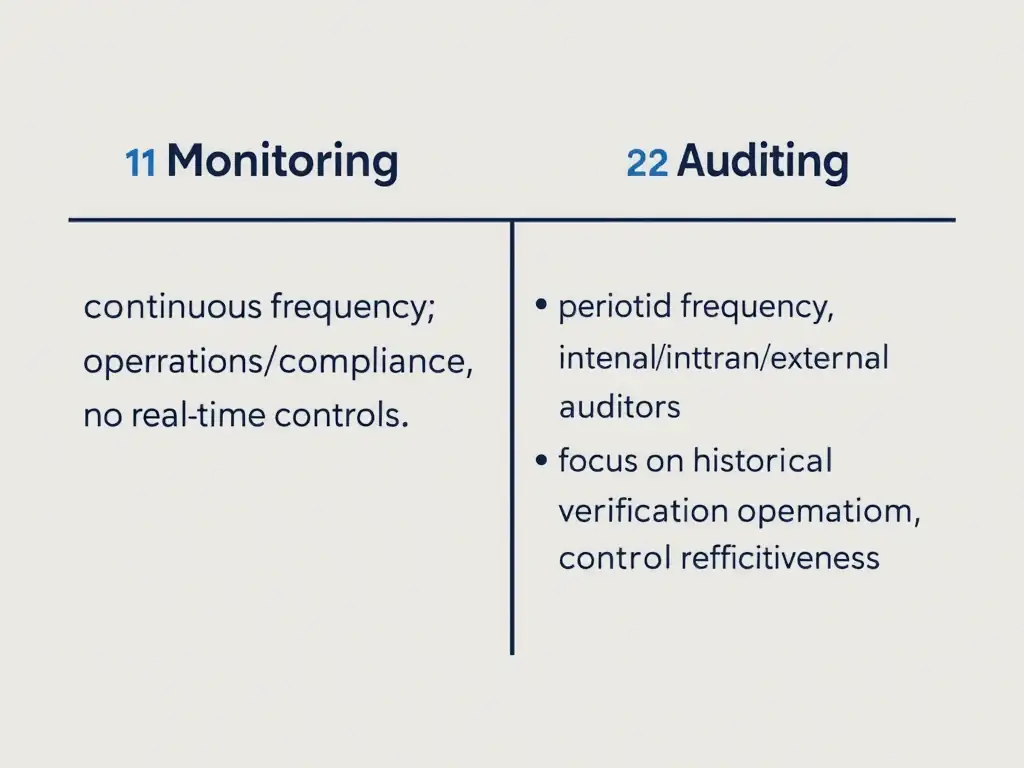
Pay close attention here, because people mix these up all the time. Monitoring is the ongoing, real-time check run by operations, while auditing is the periodic, independent review that tests whether those controls actually work. Don't let the other descriptions fool you.
Full Explanation
The correct choice is the description that says monitoring is an ongoing, real-time process managed by operations, whereas auditing is a periodic, independent review designed to evaluate control effectiveness. Although monitoring and auditing are both essential components of compliance oversight, they serve distinct operational functions. Monitoring is an ongoing, management-led process designed to ensure that compliance controls are operating effectively on a day-to-day basis. It occurs in real time or near-real time as part of normal operations, such as automated transaction screenings, supervisor reviews, or system logs. Auditing, conversely, is a periodic, formal, and objective review conducted by an independent party, such as internal audit or external inspectors, to verify that the compliance controls and the monitoring processes themselves are functioning as intended.
The description that frames monitoring as a reactive response to identified violations and auditing as a proactive method of prevention is incorrect because monitoring is proactive, helping managers identify and correct errors in real time before they escalate. Auditing can be both proactive, when evaluating systemic design, and reactive, when investigating historical data, but neither is strictly one or the other.
The description that says monitoring must be performed exclusively by external consultants, whereas auditing is conducted solely by internal staff, is incorrect because monitoring is typically performed internally by operational staff and compliance teams, while auditing can be performed either internally by an independent internal audit department or externally by third-party auditors.
The description that treats the terms as functionally identical and interchangeable is incorrect because doing so is a fundamental misunderstanding of internal controls and governance frameworks, such as the COSO framework.
Regulators look for evidence of both ongoing monitoring, to show active oversight, and periodic auditing, to show independent validation of the program's health.