
A manufacturing corporation discovers that one of its sales executives has been participating in a price-fixing scheme. Under the U.S. Sentencing Guidelines for Organizations (USSGO), how can the company best mitigate its potential criminal liability and reduce its culpability score?
Select an answer to reveal the explanation.
Short Explanation
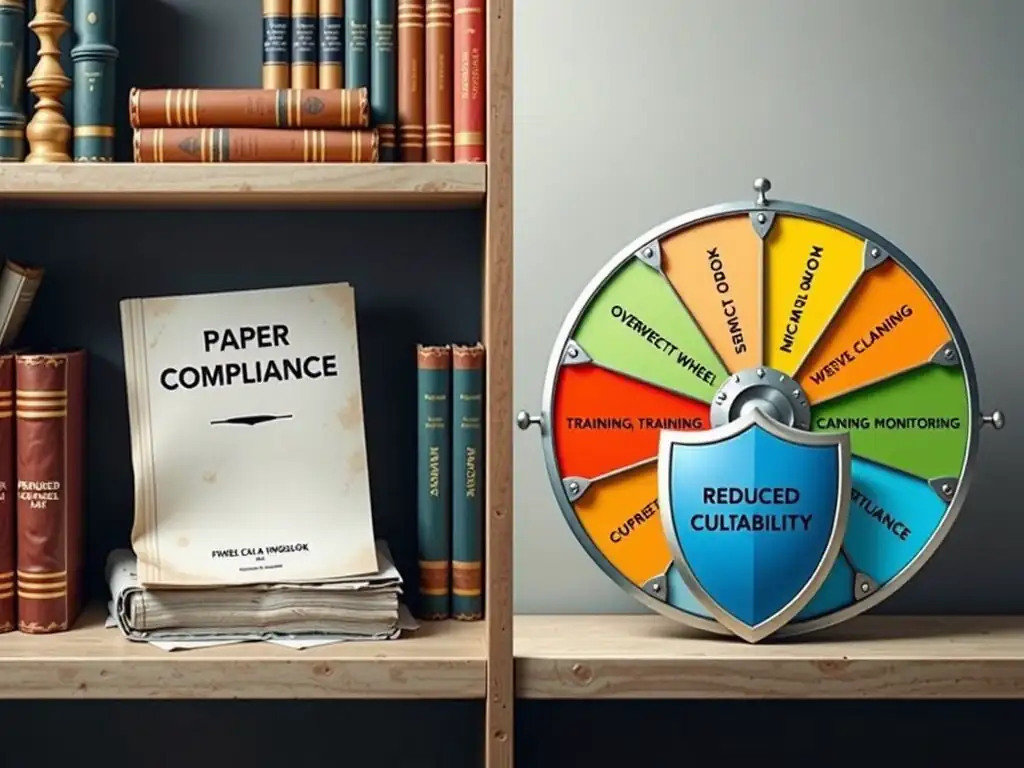
Check this out: if your company gets caught in a pickle, the court can slash fines when you prove you had an effective compliance and ethics program running. Don't just park a handbook on a shelf or count compliance heads; show you actually walk the walk.
Full Explanation
The U.S. Sentencing Guidelines for Organizations (USSGO) were established in 1991 to bring consistency to the federal sentencing of organizational defendants. Rather than focusing solely on punitive measures, the Guidelines introduced a carrot-and-stick approach designed to incentivize organizations to prevent and detect criminal conduct. The core mechanism is the culpability score, which determines the multiplier applied to a base fine. An organization can significantly reduce this score—and thus reduce its financial penalties—by demonstrating it has established and maintained an effective compliance and ethics program prior to the offense. Proving that the company has implemented and maintained an effective compliance and ethics program is correct because the primary intent of the Guidelines is to encourage organizations to proactively build robust programs. An effective program requires seven key elements, including oversight by high-level personnel, standards and procedures, training, monitoring, and appropriate disciplinary and corrective responses. Relying on a basic written code of conduct without active enforcement or training is incorrect because merely adopting a written code of conduct does not grant legal immunity. A compliance program must be active and integrated into the organization's culture; paper-only programs, often called paper compliance, are routinely dismissed by prosecutors and courts. Arguing that the compliance department meets the minimum staff size required by federal law is incorrect because the Guidelines do not dictate specific compliance department staffing sizes or ratios. Instead, they mandate that the program be adequately resourced and empowered based on the organization's size, industry, and risk profile. Requesting automatic immunity because the board of directors was unaware of the misconduct is incorrect because the board's lack of knowledge does not grant automatic immunity. In fact, if high-level personnel are involved in or look the other way during the misconduct, the culpability score is increased, not decreased.