To remain effective and relevant over time, how should an organization manage and maintain its Code of Conduct?
Select an answer to reveal the explanation.
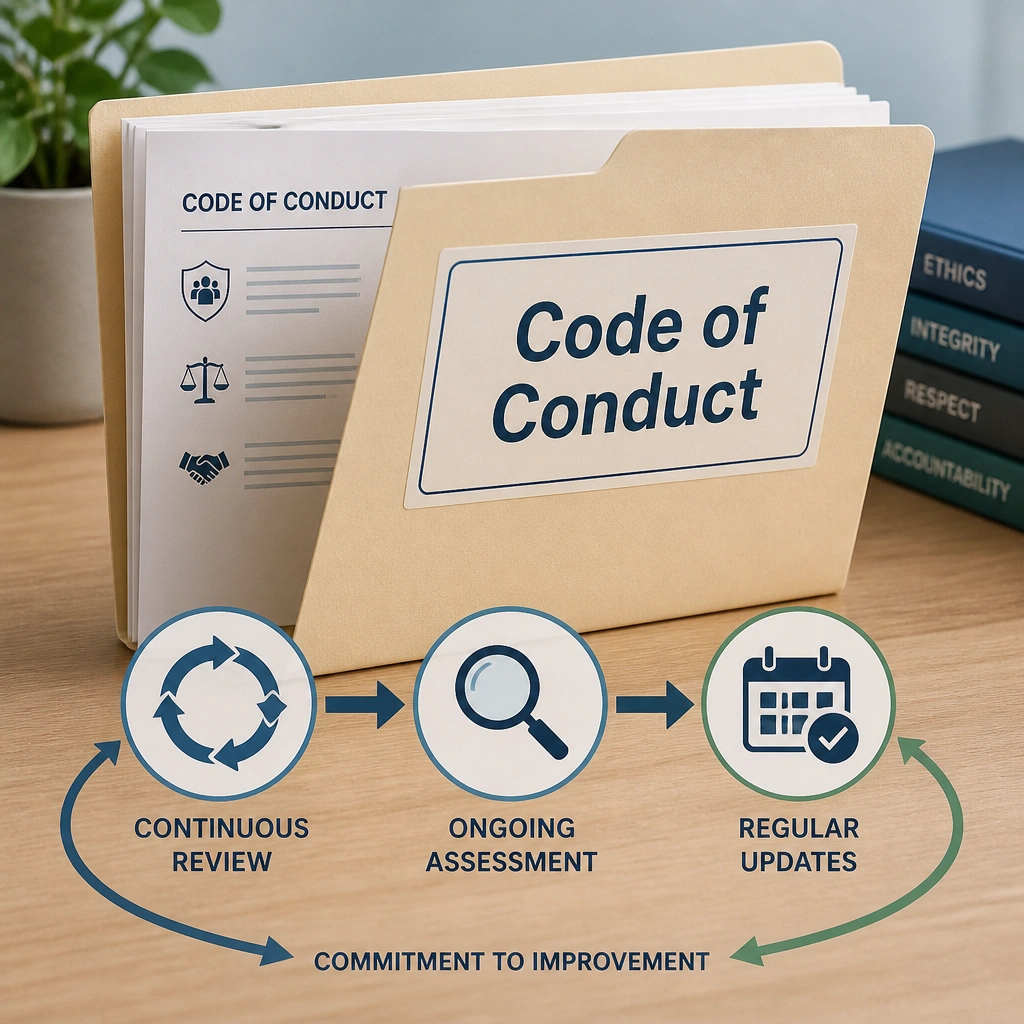
Short Explanation and Infographic
Here's the deal: the business world changes fast. New technologies emerge, laws get updated, and your company might enter new markets. If your Code of Conduct is a static document gathering dust on a shelf (Option A), it's useless. It needs to be a living document. That means you review it regularly, update it when things change, and make sure every single employee can easily read and understand it. The correct answer is C. If you write it in incomprehensible legalese (Option D) or hide it away in an executive safe (Option B), you're failing your team. Keep it fresh, keep it readable, and keep it accessible!
Full explanation below image
Full Explanation
The correct answer is C. A Code of Conduct should never be a static, check-the-box document. As business environments, regulatory landscapes, and internal operations evolve, new risks emerge (e.g., cybersecurity threats, remote work challenges, or new international trade laws). Therefore, the Code must be treated as a living document. It should undergo periodic reviews and updates to remain relevant. Furthermore, these updates must be accompanied by training and clear communication to ensure all employees understand the expectations.
Let's examine why the distractors are incorrect: - Option A is incorrect because a static, unchanging document quickly becomes obsolete, failing to address new legal requirements or organizational realities. - Option B is incorrect because a Code of Conduct is intended to guide the behavior of all employees. Restricting access to leadership defeats its primary purpose of establishing organization-wide ethical standards. - Option D is incorrect because readability is key to compliance. If a code is written in complex legalese, employees will not understand how to apply it in their daily work, which undermines the program's effectiveness.
Regulators look for evidence that an organization's Code is actively integrated into its operations and updated to address current compliance risks. Periodic revisions ensure that the Code remains aligned with best practices, industry standards, and the company's specific risk profile.