
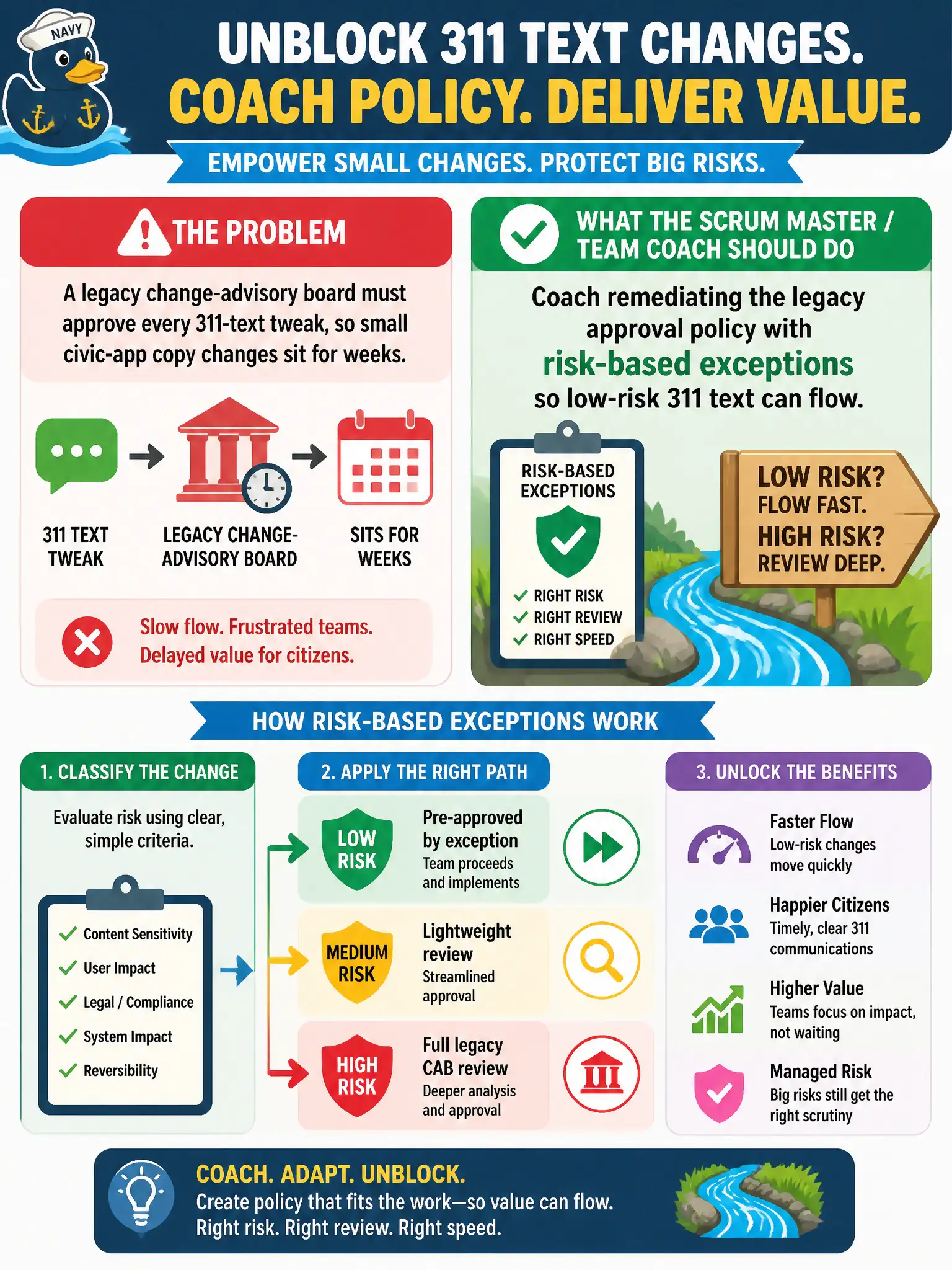
A legacy change-advisory board must approve every 311-text tweak, so small civic-app copy changes sit for weeks. What should the Scrum Master/Team Coach do?
Select an answer to reveal the explanation.
Short Explanation
A CAB that signs every 311 comma is a brick on the firehose. Low-risk copy should not wait like a data-center cutover. Change the policy with a risk lens, do not sneak around it or write longer permission essays.
Full Explanation
Legacy policies that treat every change like a high-risk cutover destroy flow. A change-advisory board that must approve every 311-text tweak parks low-risk civic copy for weeks. The Scrum Master/Team Coach should coach remediating the approval policy with risk-based exceptions so low-risk 311 text can flow while higher-risk changes keep appropriate controls—policy improvement, not theater.
Keeping the board for every tweak and coaching longer justifications fails by concept: more paperwork on low-risk work still blocks resident-facing messaging. Routing 311-text changes through a side channel fails by concept because it leaves the harmful policy untouched and creates shadow process risk. Waiting until Inspect and Adapt to mention the delay and then continuing the same policy fails by concept: I&A without remediation is complaint without improvement.
Exam caveat: SAFe coaches remediating impediments and improving the system of delivery; working around governance silently is not the advanced Scrum Master pattern. Risk-based exceptions should be explicit, auditable, and agreed with stakeholders—not informal exceptions that vanish under audit.
Operational check: classify recent 311-text changes by risk, propose a documented fast-path for low-risk copy with CAB/stakeholders, measure approval wait time before and after the exception path, and escalate remaining high-risk items through the heavier gate only when warranted.