
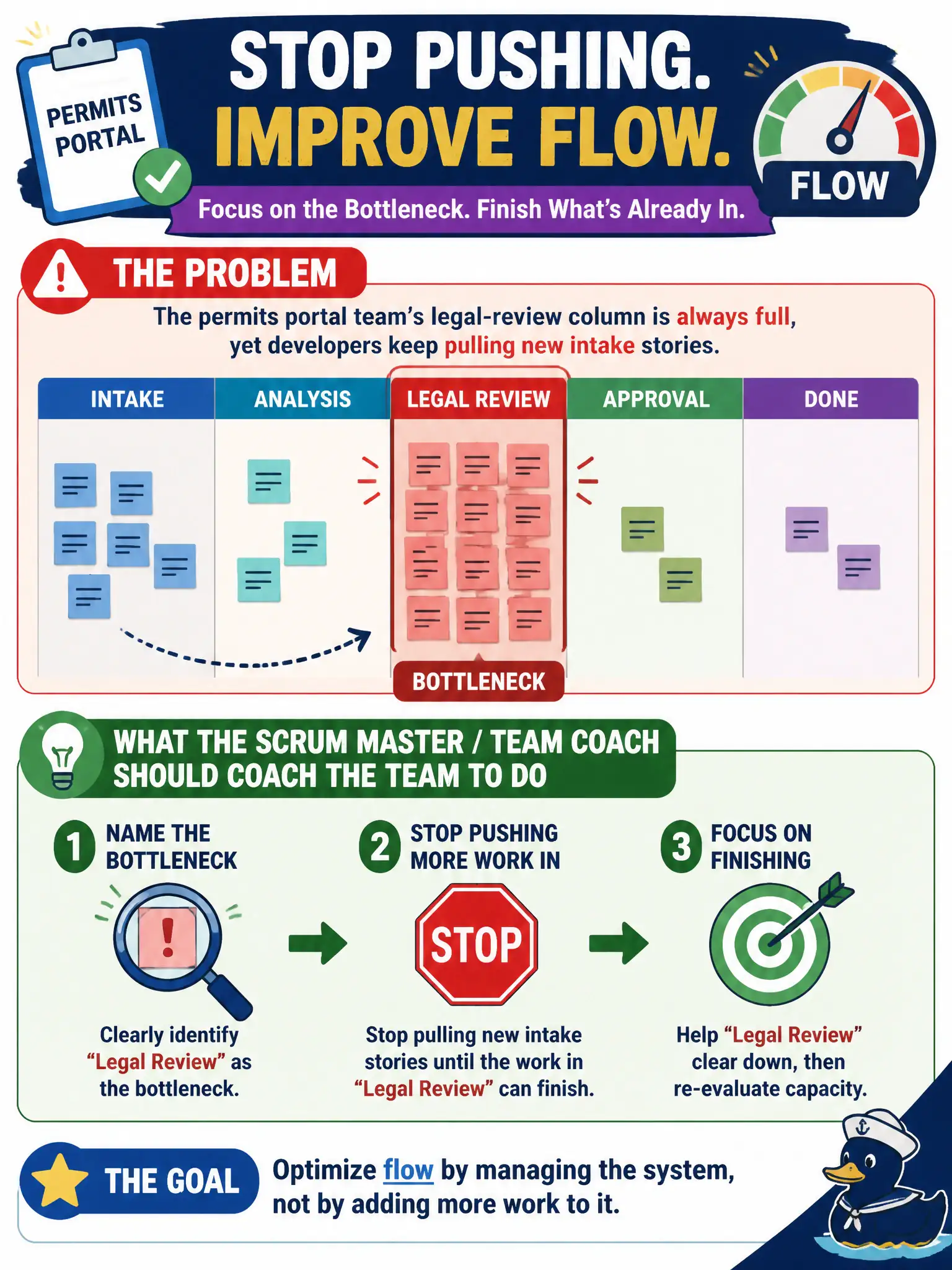
The permits portal team's legal-review column is always full, yet developers keep pulling new intake stories. What should the Scrum Master/Team Coach coach the team to do?
Select an answer to reveal the explanation.
Short Explanation
Think of the city permit window: if legal review is the jammed counter, shoving more folders at the front just makes a taller pile. Name the stuck step and stop feeding it. Throughput is set by the bottleneck, not by how busy intake looks.
Full Explanation
In Theory of Constraints terms that SAFe flow coaching uses, throughput is governed by the constrained step. On the permits portal team, a perpetually full legal-review column while developers keep starting intake work means the system is flooding the bottleneck. The Scrum Master/Team Coach should name legal review as the constraint and stop pushing more work upstream until that step can finish—exactly like pausing new folders at a jammed city permit window so clerks can clear the counter that actually serves residents.
Starting more intake so legal review never starves fails by concept: overfeeding a bottleneck grows queues, lengthens flow time, and burns developer energy on work that cannot complete. Hiding the legal-review column fails by concept because it optimizes appearances for leadership while destroying visibility of the public-service delay. Raising the legal-review WIP limit until the pile is officially allowed fails by concept: it legitimizes overload instead of protecting flow through the constraint.
Exam caveat: identifying a bottleneck is not the same as permanently idling the whole ART; the coaching move is to subordinate non-bottleneck starts to the constrained step’s capacity, then improve the bottleneck. Multi-tasking around the constraint usually worsens flow time for citizen-facing permit work.
Operational check: make legal-review WIP and aging visible on the board, halt new intake pulls until legal WIP is within an agreed limit, pair with legal stakeholders on smaller review batches, and re-measure flow time for stories that exit legal review after the policy change.