
A DMV-appointment team’s active time on a request is 4 hours inside a 20-day wait. Which measure should the SM/TC use to make that contrast visible?
Select an answer to reveal the explanation.
Short Explanation
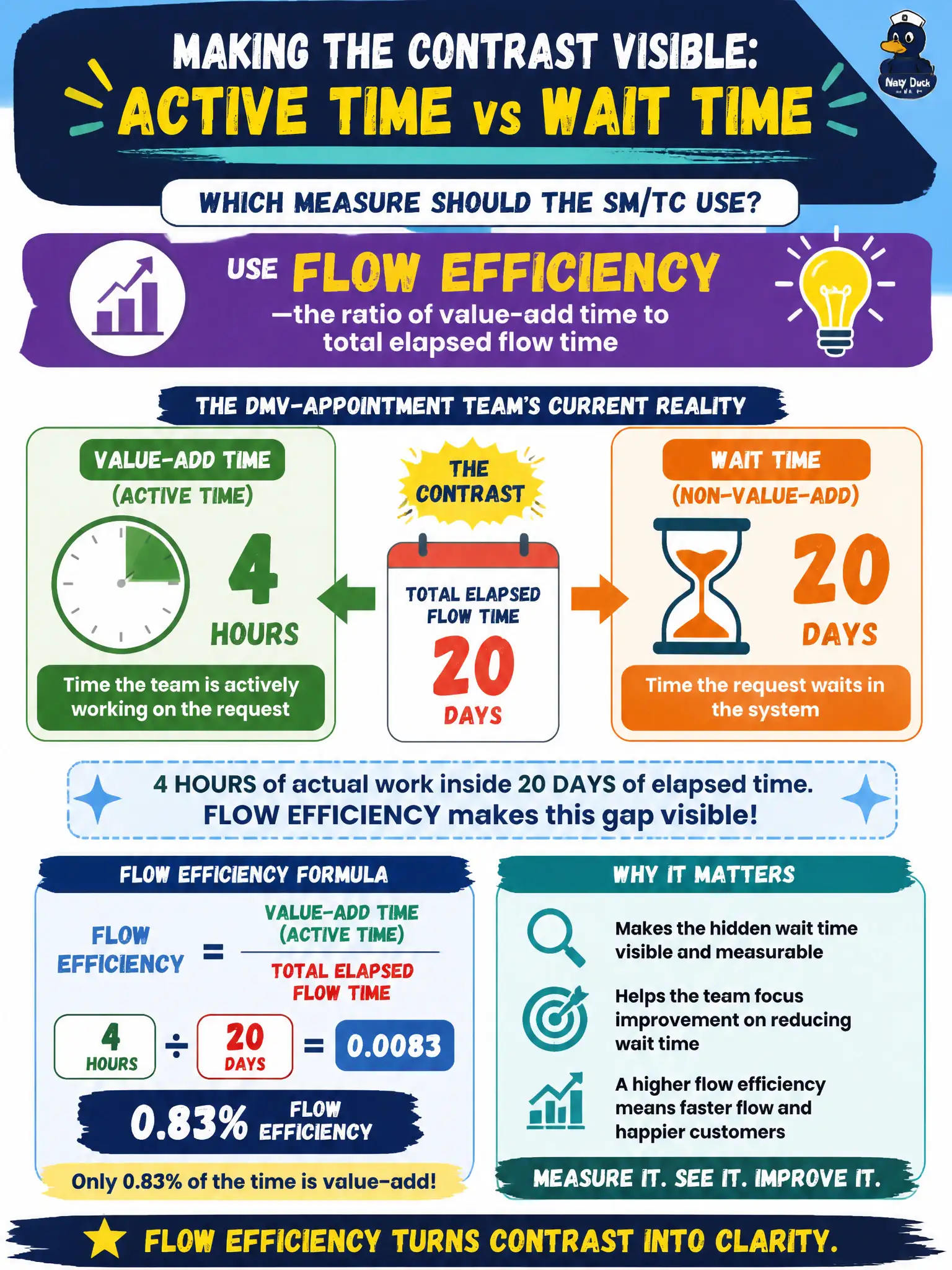
Four hours of real work inside a 20-day wait is a two-minute oil change with a three-week parking lot. Flow efficiency is that ratio. It points at waiting, not typing speed.
Full Explanation
A DMV-appointment request with 4 hours of active time inside a 20-day wait should be made visible with flow efficiency—the ratio of value-add time to total elapsed flow time. Four hours of real work inside a 20-day wait is a two-minute oil change with a three-week parking lot. Efficiency points at waiting, not at typing speed, which is what residents feel.
Story-point velocity for the 4 hours of typing fails because points do not expose the wait-to-work ratio. Utilization of clerks during the 20 days fails because busy clerks can still leave citizens waiting in queue. Flow load counted only on the last day fails because a single-day WIP snapshot does not show efficiency across the request's life.
Exam caveat: flow efficiency directs improvement toward queues and handoffs rather than accelerating already-short active work. Operational check: measure active versus wait time for appointment requests, publish efficiency with flow time, attack the dominant waits (handoffs, approvals, batching), and avoid celebrating utilization or points while efficiency stays tiny. Flow efficiency is often the metric that finally makes DMV and licensing leaders fund queue reduction instead of typing training.