
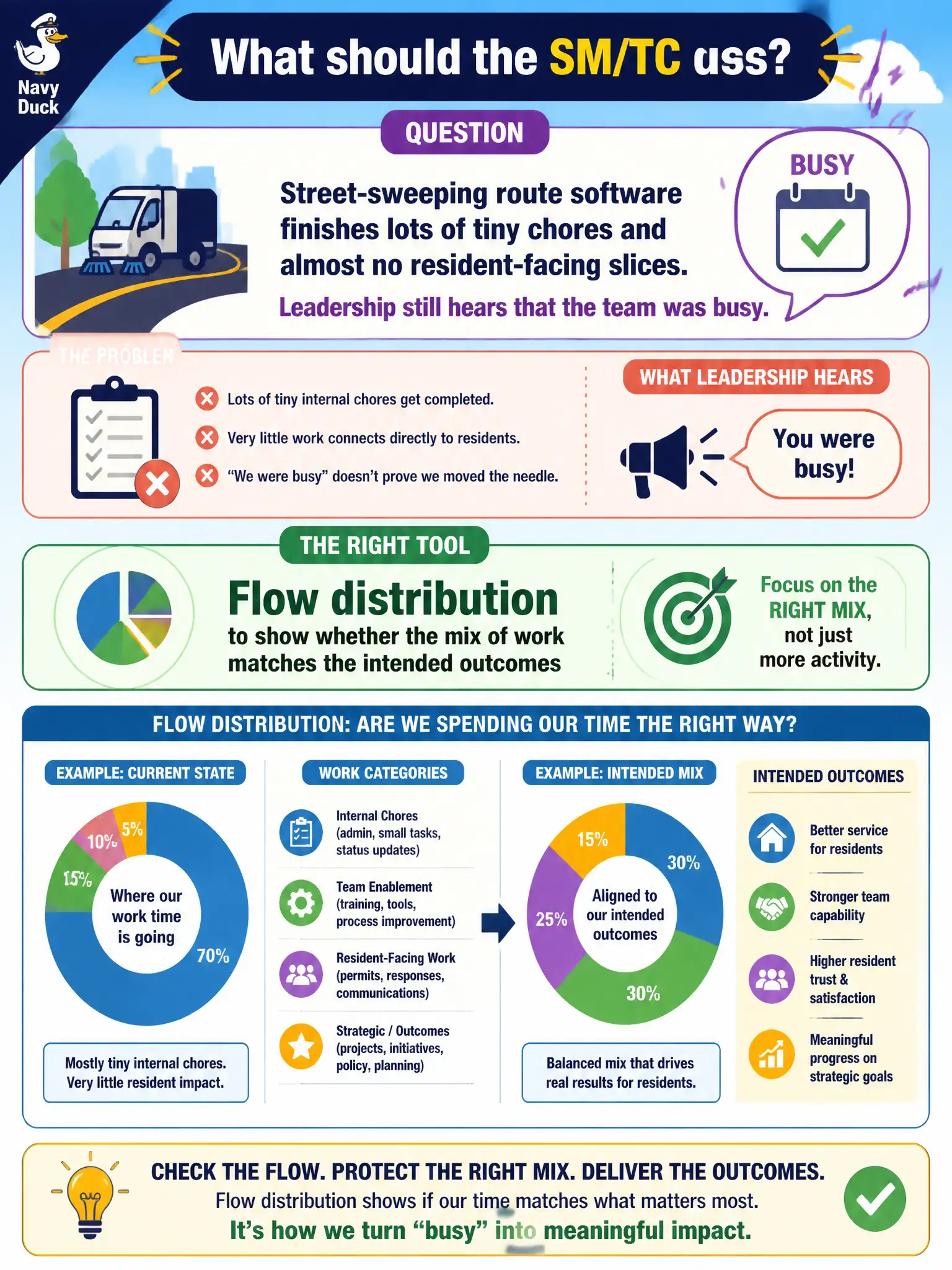
Street-sweeping route software finishes lots of tiny chores and almost no resident-facing slices. Leadership still hears that the team was busy. What should the SM/TC use?
Select an answer to reveal the explanation.
Short Explanation
Busy is not the same as sweeping the streets residents care about. Flow distribution is the pie chart of what actually finished. If the pie is all chores, the outcome mix is off.
Full Explanation
When teams are busy but residents do not see the outcomes they care about, use flow distribution to show whether the mix of work matches the intended outcomes. Busy is not the same as sweeping the streets residents care about. Distribution is the pie chart of what actually finished—features, defects, debt, chores—and whether that mix serves civic intent.
Story-point velocity alone as proof of value fails because points do not say what kind of work moved. A utilization report of hours spent on chores fails because hours prove activity, not outcome mix. A count of commits as a proxy for resident impact fails because commit volume ignores whether the right work finished.
Exam caveat: flow distribution complements time and load metrics to judge value mix. Operational check: categorize finished work types each iteration, compare the mix to Product Owner and ART intent for street or service outcomes, adjust intake and WIP policies when chores crowd out intended value, and present distribution—not only velocity—to stakeholders. Outcome-oriented distribution conversations keep ARTs aligned to resident-facing goals instead of chore throughput. Outcome-oriented distribution conversations keep ARTs aligned to resident-facing goals instead of chore throughput.