
Transit-fare testers cannot tell which stories are ready to pull from Dev. What should the SM/TC add?
Select an answer to reveal the explanation.
Short Explanation
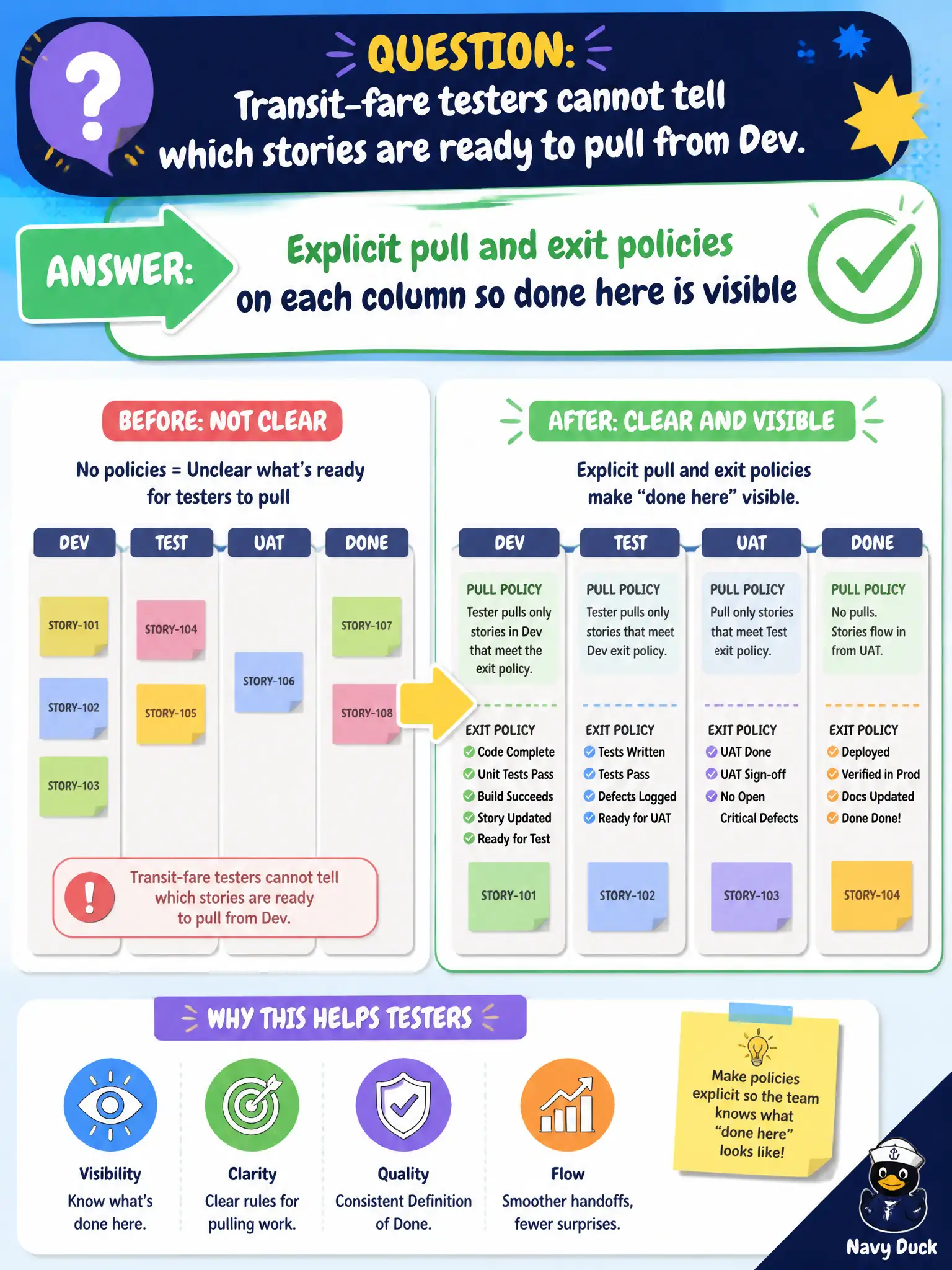
Without an exit policy, Dev is a doorway with no sign. Testers should not guess which fare stories are actually ready. Write what done means on the column and pull gets easy.
Full Explanation
Without explicit pull and exit policies on each column, testers and partners guess which fare, case, or permit stories are actually ready. The SM/TC should establish explicit pull and exit policies so "done here" is visible. Dev without an exit policy is a doorway with no sign, and civic quality suffers when handoffs are ambiguous.
A daily email listing whatever developers feel is done fails because informal feeling is not a policy. A rule that testers start every Dev card at 4 p.m. fails because clock-based batching ignores readiness and creates thrashing. A second hidden board just for testers fails because split visualization recreates inbox opacity.
Exam caveat: policies make pull safe and repeatable across roles. Operational check: write entry/exit criteria for each column, make them visible on the board, coach the fare team to pull only when exit policies are met, and retire email-or-hidden-board substitutes for readiness. Exit policies reduce rework between developers and testers and keep fare or case handoffs respectful of downstream capacity. Exit policies reduce rework between developers and testers and keep fare or case handoffs respectful of downstream capacity. Exit policies reduce rework between developers and testers and keep fare or case handoffs respectful of downstream capacity.