
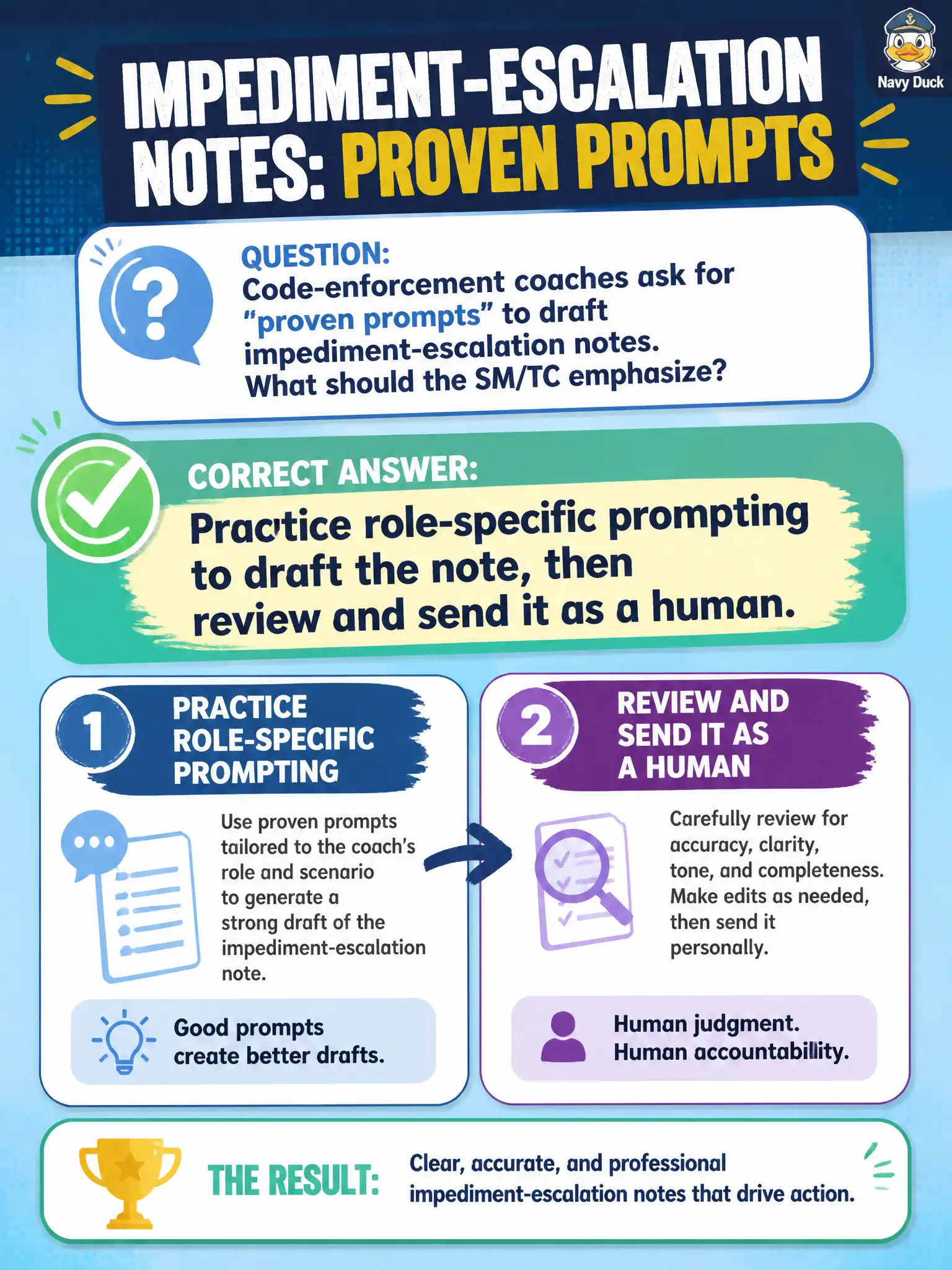
Code-enforcement coaches ask for “proven prompts” to draft impediment-escalation notes. What should the SM/TC emphasize?
Select an answer to reveal the explanation.
Short Explanation
Wanting a magic code-enforcement spell book is understandable, and it is still the wrong skill. Learn to prompt like an SM/TC — context, ask, constraints — then read the draft and hit send yourself. The model does not escalate; the coach does.
Full Explanation
Code-enforcement coaches who want "proven prompts" for impediment-escalation notes should practice role-specific prompting to draft the note, then review and send it as humans. Empowering teams with AI for SM/TC work is skill, not memorizing a vendor spell book. The model drafts; the coach still owns the wording, judgment, and escalation accountability to clear barriers for inspectors and residents.
Memorizing a vendor prompt pack and pasting it unchanged into every escalation fails because context-free paste is not role-specific prompting skill and often misstates the impediment. Letting the model send the note so coaches never own the wording fails because unsupervised transmission removes human accountability. Waiting for the RTE to publish a train-wide prompt catalog before drafting anything fails because local coaching ownership should not freeze on a missing catalog.
Exam caveat: admin drafting is a fair AI use; unsupervised escalation is not. Operational check: teach context-ask-constraints prompting for escalation drafts, require human review before send, keep the coach as the accountable communicator, and improve prompts from real code-enforcement outcomes rather than vendor lore alone.