
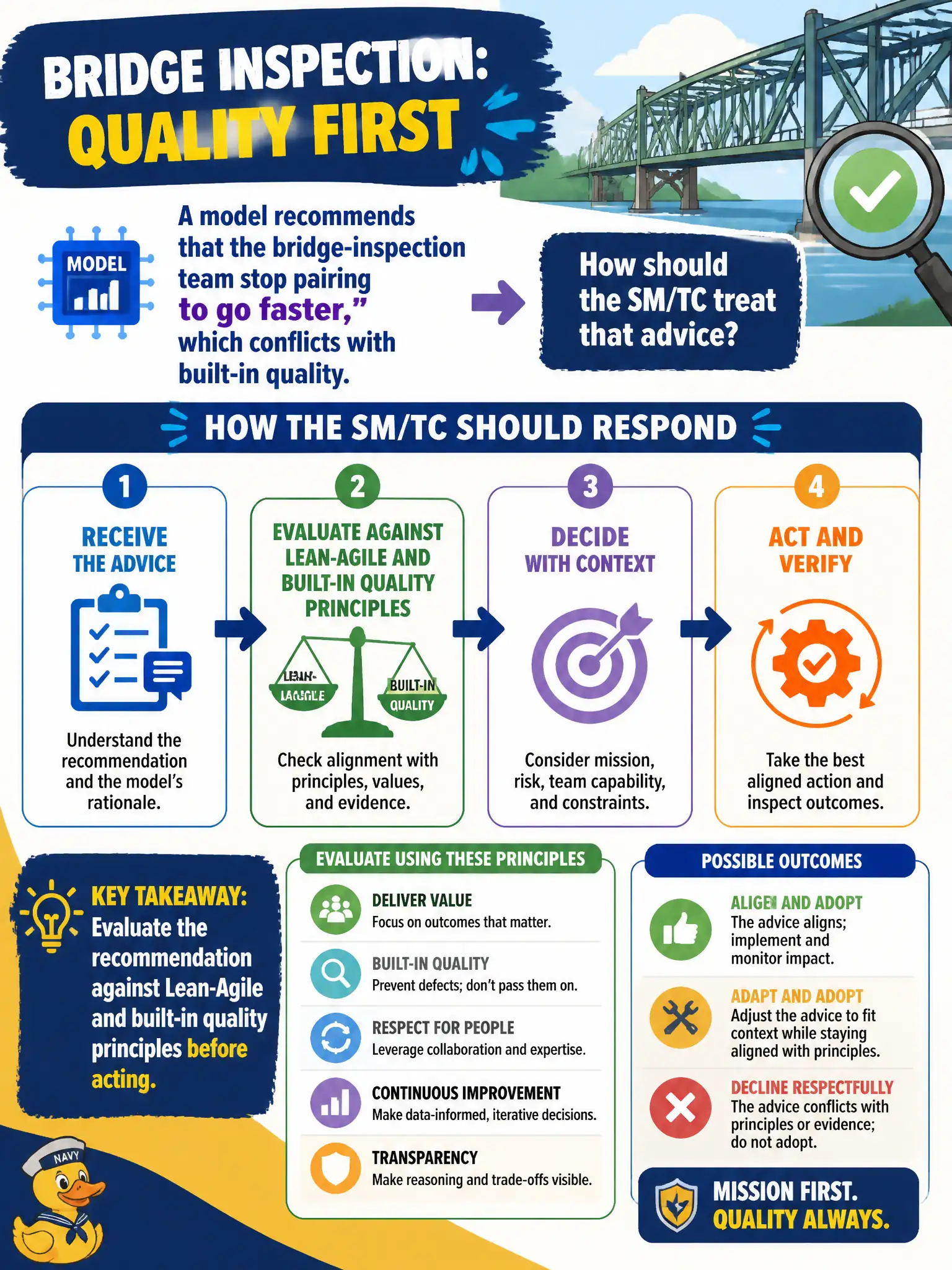
A model recommends that the bridge-inspection team stop pairing “to go faster,” which conflicts with built-in quality. How should the SM/TC treat that advice?
Select an answer to reveal the explanation.
Short Explanation
If a GPS says 'drive through the river, it is shorter,' the inspector still looks at the bridge. AI speed advice that kills pairing is a quality smell, not an order. Check it against built-in quality, then coach.
Full Explanation
When a model recommends that a bridge-inspection team stop pairing "to go faster," the SM/TC must evaluate that recommendation against Lean-Agile and built-in quality principles before acting. Human-in-the-loop means speed advice that kills pairing is a quality smell, not an order. Faster local coding that increases defects and knowledge silos is not flow for public infrastructure inspection work.
Stopping pairing immediately because the model optimized for speed fails because the evaluation step against built-in quality never happened. Escalating the pairing debate to the RTE as an ART-level architecture issue fails because pairing and collective ownership are team-level quality practices the coach should address locally. Treating pairing as a people-manager policy the SM/TC cannot coach fails because built-in quality coaching is squarely in the Team Coach lane.
Exam caveat: AI recommendations are inputs to coaching judgment, not automatic process changes. Operational check: compare the "stop pairing" advice to the team's quality and knowledge-spread needs, facilitate a team decision grounded in built-in quality, keep the RTE out of routine pairing policy, and watch defect and review signals after any change.