
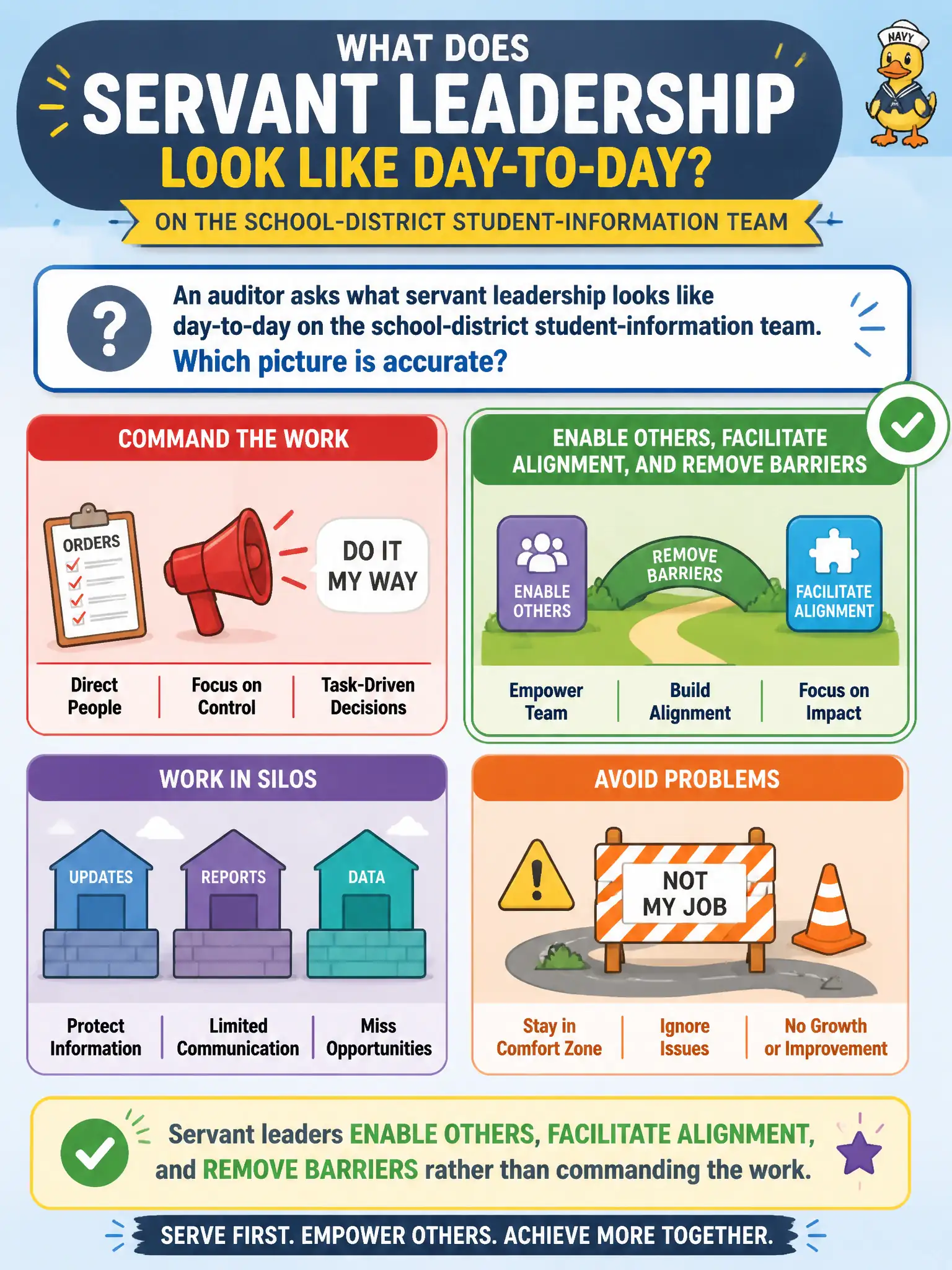
An auditor asks what servant leadership looks like day-to-day on the school-district student-information team. Which picture is accurate?
Select an answer to reveal the explanation.
Short Explanation
Servant leadership is not a nicer way to give orders. On the student-information team it looks like enabling people, lining up the work, and moving barriers. Task lists, time sheets, and stealing the Product Owner's seat are the opposite picture.
Full Explanation
Servant leadership on a school-district student-information team looks like enabling others, facilitating alignment, and removing barriers rather than commanding the work. That day-to-day picture is what an auditor should see from an advanced Scrum Master / Team Coach: coaching conversations, cleared impediments, and alignment across clerks and developers—not a softer costume for traditional management.
Issuing daily task orders so every clerk knows who owns each student-record defect fails because commanding task ownership is people-management, not servant leadership. Signing time sheets and writing annual performance ratings fails because those are people-manager duties outside the SM/TC servant-leader definition. Replacing the Product Owner at refinement fails because a single decision-maker theater collapses content leadership into the coach and misleads the auditor about SAFe roles.
Exam caveat: accountability for coaching outcomes is real; it is not expressed as hierarchical tasking or HR authority over the student-information team. Operational check: replace daily task orders with facilitated planning and visible boards, route HR/performance work to actual people managers, keep the PO in refinement, and show the auditor barrier-removal examples tied to student-record flow improvements.