
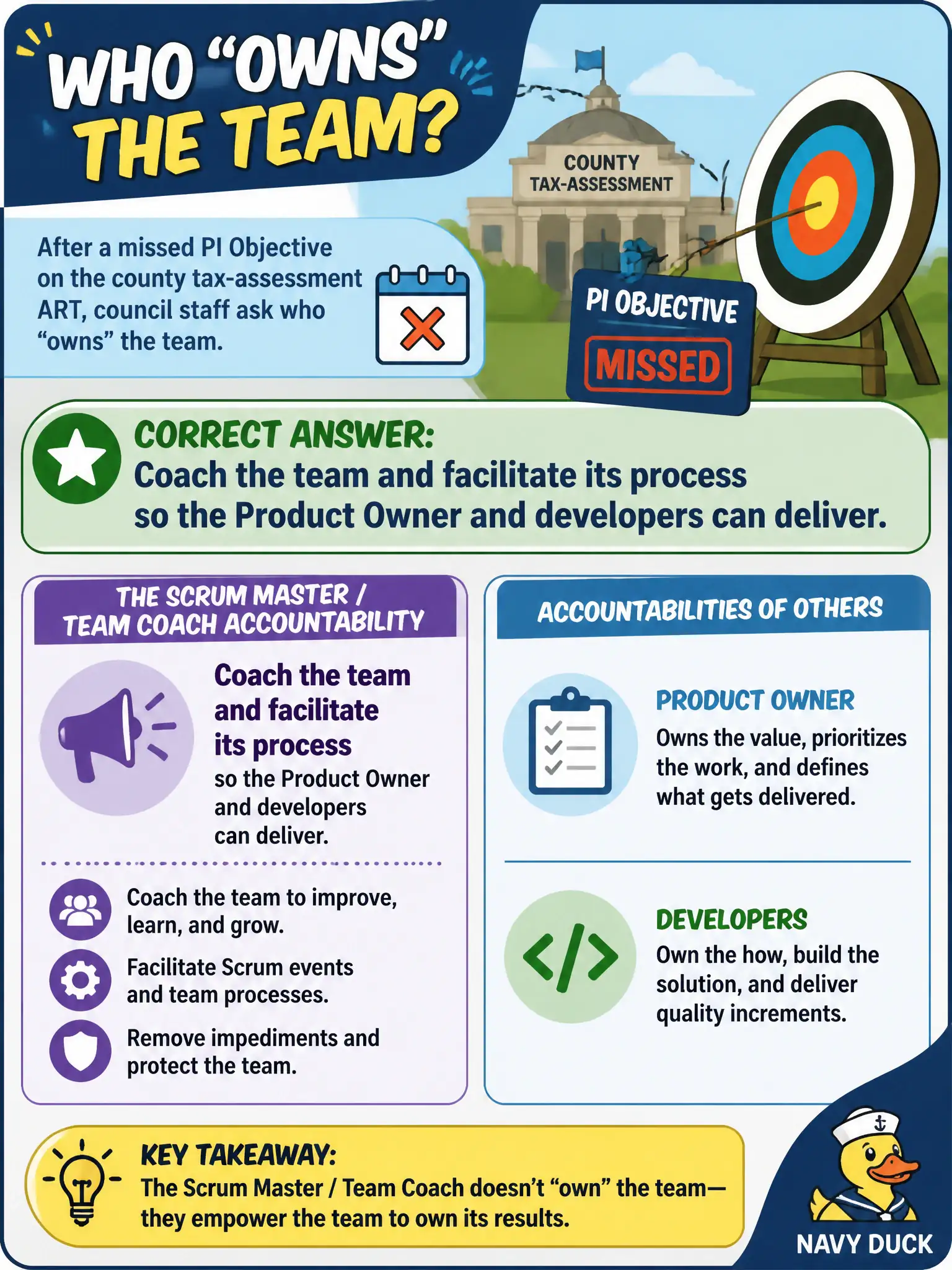
After a missed PI Objective on the county tax-assessment ART, council staff ask who “owns” the team. Which accountability belongs to the Scrum Master / Team Coach?
Select an answer to reveal the explanation.
Short Explanation
When a PI slips, people hunt for a boss. The Team Coach is not the tax-assessment Product Owner and is not the RTE running the train. The job is to coach the team and keep its process healthy so the people who do own content and delivery can actually deliver.
Full Explanation
After a missed Team PI Objective on a county tax-assessment ART, council staff often hunt for a single boss who "owns" the team. The Scrum Master / Team Coach's accountability is to coach the team and facilitate its process so the Product Owner and developers can deliver assessment value—not to absorb every neighboring role. Keeping that lane clear is how the coach still serves public delivery when a PI objective slips.
Owning the assessment backlog and accepting or rejecting stories fails because backlog content and acceptance belong to the Product Owner. Facilitating PI Planning for the entire ART in place of the Release Train Engineer fails because ART-level train facilitation is the RTE's job, not a promotion path for the Team Coach after a miss. Personally recoding missed assessment stories fails because the coach is not the named engineering delivery owner; hero coding does not discharge SM/TC accountability and weakens team ownership.
Exam caveat: missing a PI Objective raises legitimate stakeholder questions, but collapsing Product Owner, RTE, and developer accountabilities into the Team Coach is not the SAFe answer. Operational check: facilitate a transparent inspection of why the tax-assessment objective slipped, coach improvements to the team's process, leave backlog decisions with the PO and train facilitation with the RTE, and report recovery progress without claiming ownership of content or code.