
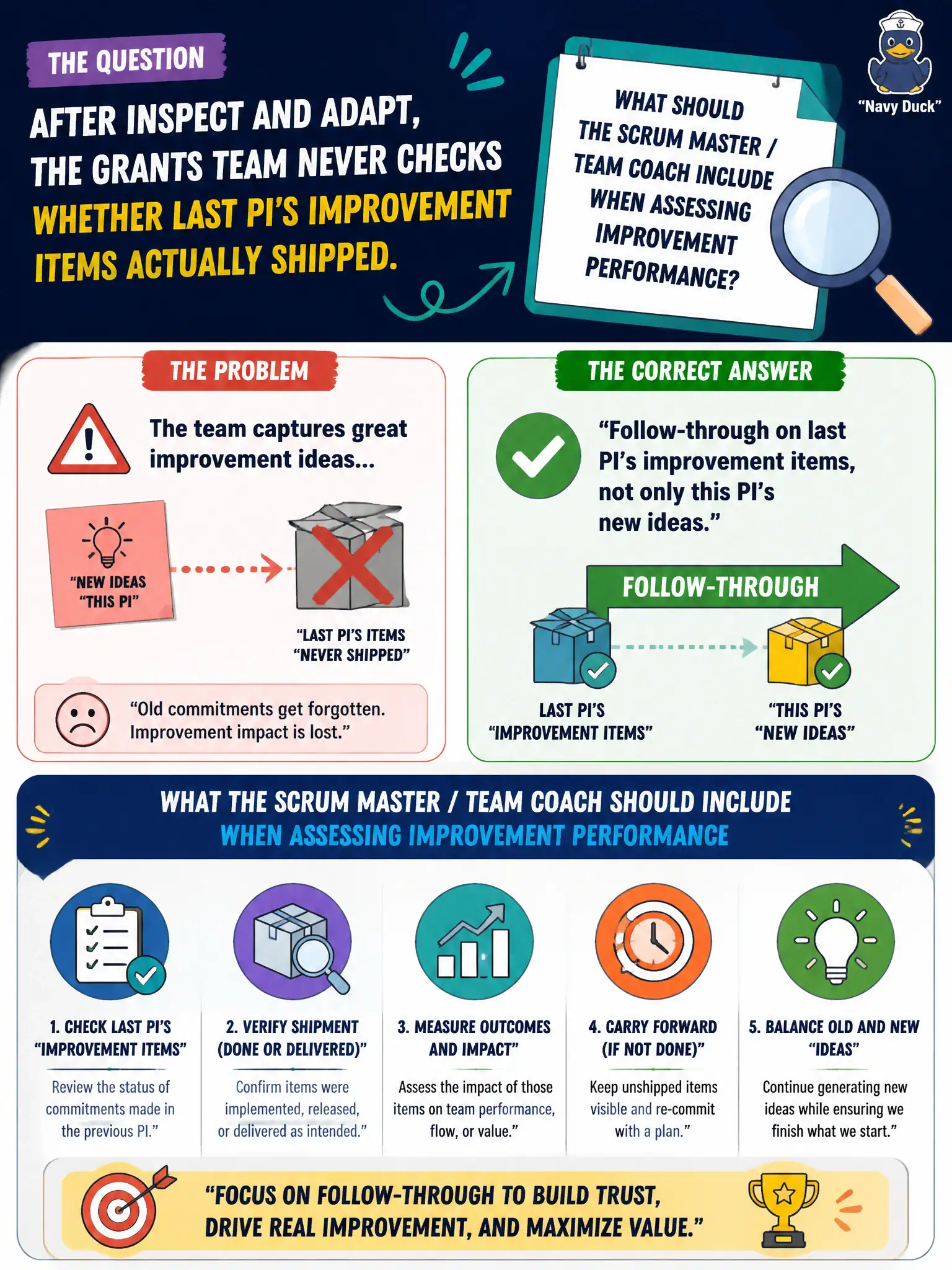
After Inspect and Adapt, the grants team never checks whether last PI's improvement items actually shipped. What should the Scrum Master / Team Coach include when assessing improvement performance?
Select an answer to reveal the explanation.
Short Explanation
A retro that never checks last PI's improvements is a New Year's resolution factory. The grants team already named the work. Assessing improvement means asking whether those items actually shipped.
Full Explanation
After Inspect and Adapt, assessing improvement performance for a grants team must include follow-through on last PI's improvement items, not only this PI's new ideas. Continuous improvement is a closed loop; unshipped prior items mean any claim of an "improvement culture" is hollow theater for municipal grant operations. A fresh list of slogans while last PI's items never moved rewards idea generation without delivery and trains the team to restart every PI. Relying only on the Release Train Engineer's ART-level problem-solving poster may share train learning but does not prove the grants team closed its own actions. Earned-value variance on a grants work-breakdown structure is predictive project control, not Agile improvement follow-through. Exam caveat: SASM assesses whether improvement items actually complete across PIs; slogan refresh, poster-only evidence, and earned-value substitutes are wrong concepts. Operational check: open last PI's improvement backlog in the assessment conversation, mark done versus stalled items, unblock or deliberately drop stalled work, and only then add new improvement experiments. Verify at least one prior civic improvement item shipped before celebrating a long new list at the next Inspect and Adapt.