
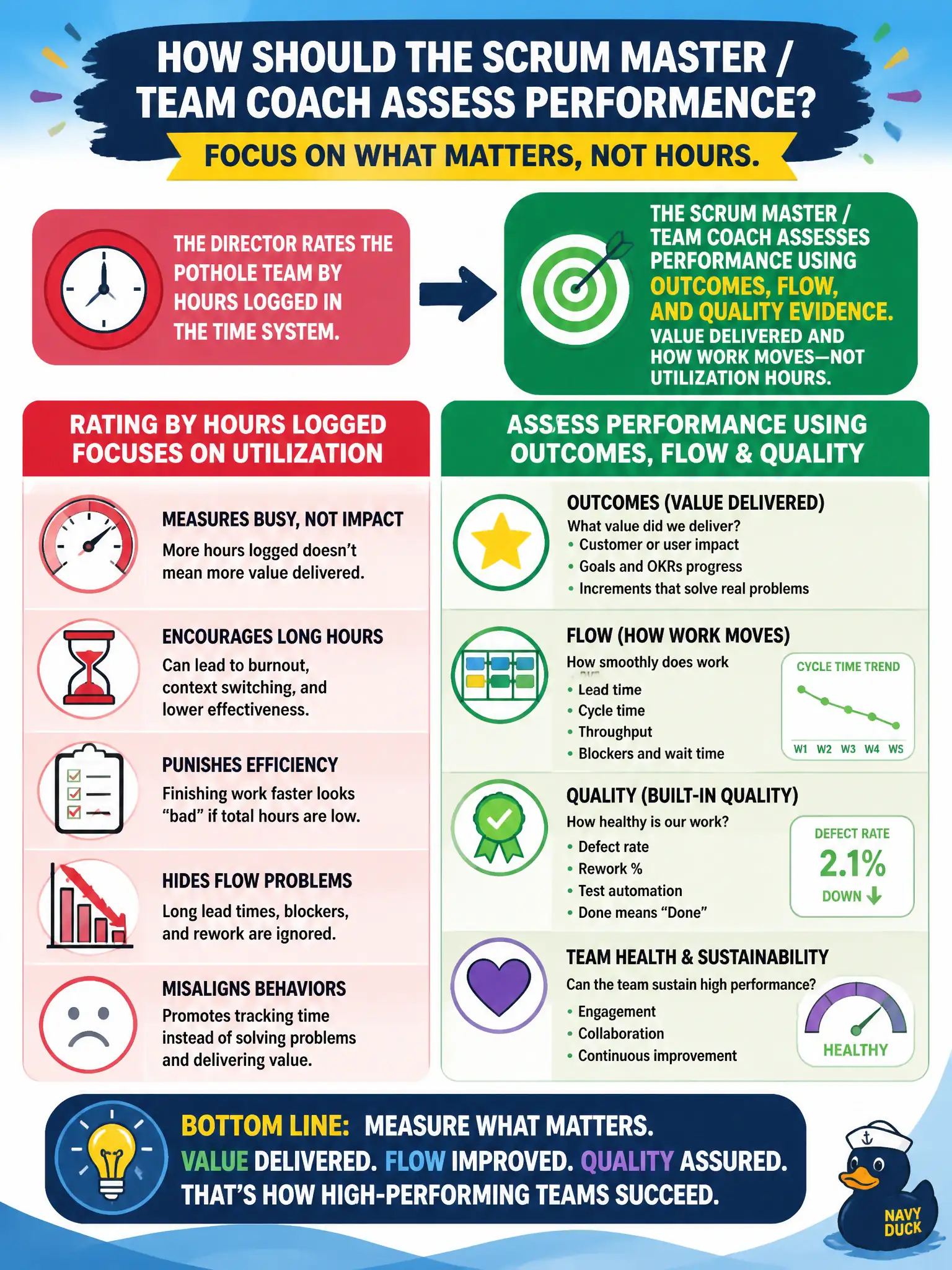
A director rates the pothole team by hours logged in the time system. How should the Scrum Master / Team Coach assess performance instead?
Select an answer to reveal the explanation.
Short Explanation
Hours in a timesheet say the crew was on the clock, not that the street is smoother. Pothole performance is filled holes, flow, and work that stays fixed. Utilization is a payroll report pretending to be a scoreboard.
Full Explanation
Assessing a pothole team by hours logged in the time system measures utilization, not municipal performance. The Scrum Master / Team Coach should assess outcomes, flow, and quality evidence—value delivered and how work moves—rather than hours as the score. Hours are easy to export to council and easy to inflate without improving street repair outcomes for residents waiting on filled potholes. Ranking individuals by weekend hours rewards burnout and heroics over sustainable team delivery and teaches people to optimize the clock instead of the street. Converting hours into story points so the same utilization wears an agile label is cosmetic relabeling, not a conceptual change in what "good" means. Exam caveat: SASM performance assessment emphasizes outcomes, flow, and quality over utilization hours; story-point clothing on hours is still utilization thinking and will mislead civic leadership. Operational check: replace or demote hours as the primary score for the pothole team, introduce a small set of outcome and flow measures (for example request-to-repair time, reopen rate, and throughput of finished repairs), review them with the team in inspect-and-adapt, and show the director how those measures track resident value better than logged hours. Keep individual hour contests out of the civic performance conversation and re-check after the next storm season whether the new measures still guide good trade-offs.