
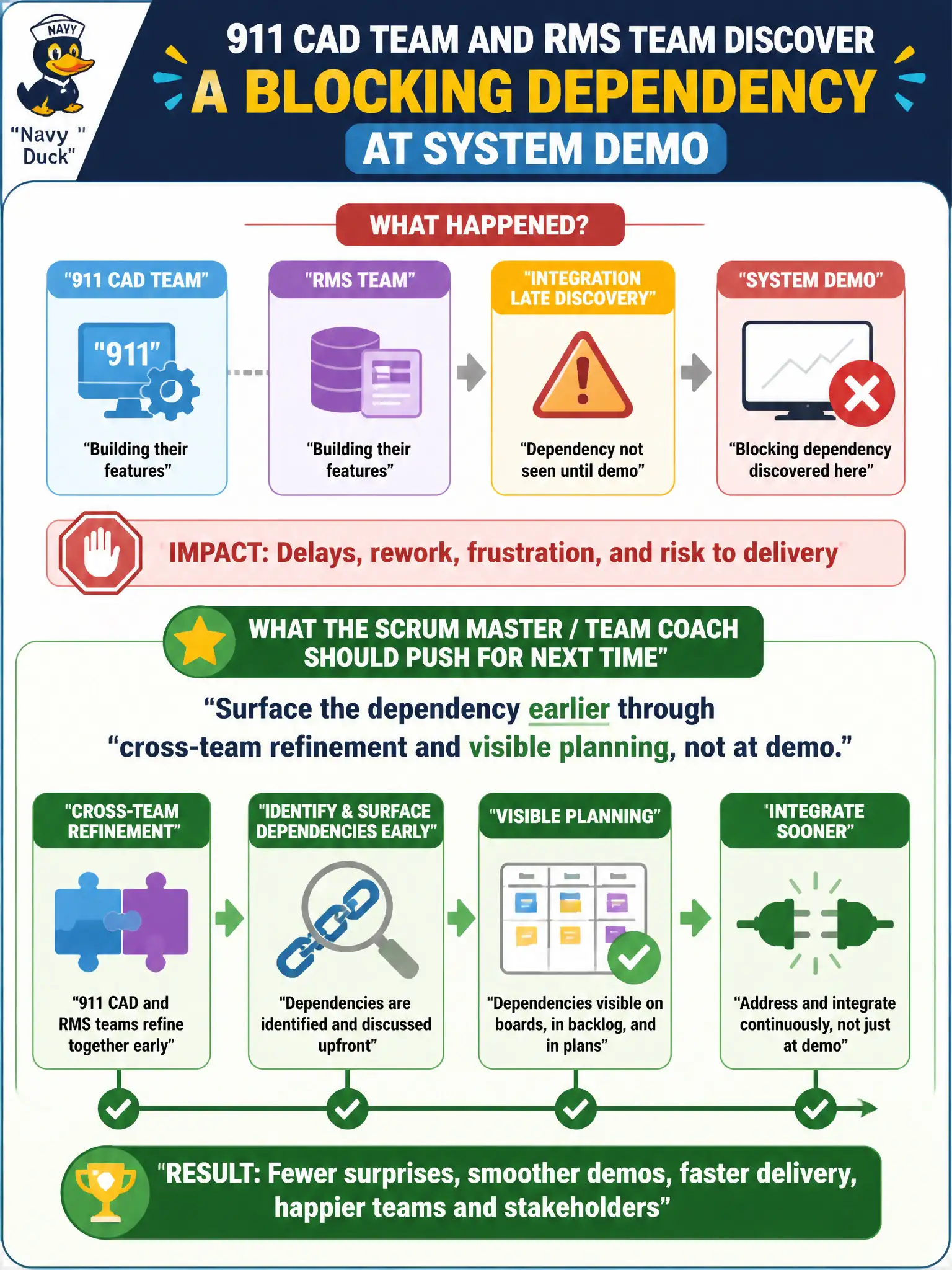
The 911 CAD team and the RMS team discover a blocking dependency at System Demo. What should the Scrum Master / Team Coach push for next time?
Select an answer to reveal the explanation.
Short Explanation
Finding a CAD-to-RMS dependency at System Demo is finding the missing hydrant after the fire. Coaches push that conversation into earlier refinement and a visible plan. Surprise at demo is a collaboration failure, not a feature.
Full Explanation
Cross-team dependencies should be visible during planning and refinement so teams can sequence, spike, or restory before a demo surprise. When the 911 CAD team and the RMS team discover a blocking dependency at System Demo, the Scrum Master / Team Coach should push to surface the dependency earlier through cross-team refinement and visible planning, not at demo. Public-safety dispatch and records integration cannot wait for demo-day drama to reveal coupling.
Keeping discovery at demo so leadership sees the drama fails by concept: spectacle is not a coordination strategy and endangers readiness. Asking the Release Train Engineer to hide the dependency until Inspect and Adapt so the PI looks clean fails by concept by optimizing appearance over safety-system integration. Merging the two backlogs into a predictive work-breakdown structure owned by the coaches fails by concept: predictive WBS ownership by coaches replaces team collaboration with command planning.
Exam caveat: SAFe and SASM stress early dependency management via planning, refinement, and visual boards; demo-time discovery is a symptom to fix, not a feature. System Demo still reveals integration truth—the goal is fewer first-time dependency shocks for CAD/RMS work by then.
Operational check: add cross-team refinement for CAD–RMS interfaces before the next PI boundary, visualize dependencies on planning boards, confirm owners and dates early, escalate only unresolved blockers, and verify System Demo no longer hosts first discovery of known integration needs.