
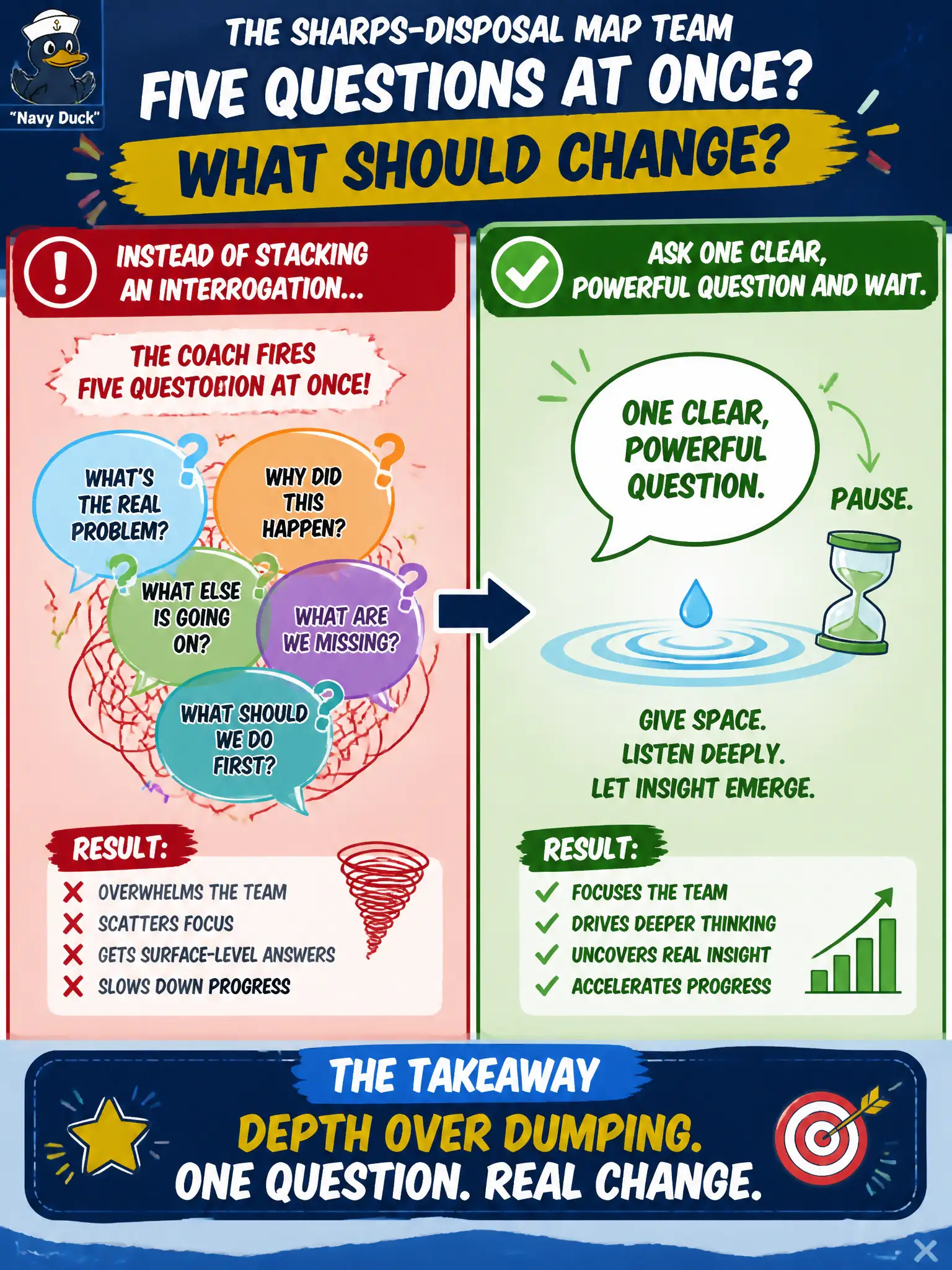
The coach of the sharps-disposal map team fires five questions at once during refinement. What should change?
Select an answer to reveal the explanation.
Short Explanation
Five questions in one breath is a firehose. The sharps-map team will grab the easiest one and ignore the rest. One clear question, then silence, is how thinking actually starts.
Full Explanation
A stacked interrogation overwhelms working memory and looks like a test rather than a coaching move. When the coach of the sharps-disposal map team fires five questions at once during refinement, the practice should change to one clear powerful question and wait time so the team can answer with depth. Public-health mapping quality improves when people can think, not when they are rapid-fired through a quiz.
Adding two more questions so every role is covered in the same breath fails by concept: more simultaneous questions deepen overload rather than inclusion. Emailing the five questions as a quiz and grading answers after the meeting fails by concept by turning coaching into evaluation and killing psychological safety. Having the Release Train Engineer stack the same five questions at ART Sync fails by concept: reproducing the interrogation at train level spreads the anti-pattern instead of fixing facilitation.
Exam caveat: SASM powerful-question technique emphasizes clarity, one question at a time, and silence for thinking; stacked questions are a known coaching failure. A prepared sequence is fine—ask, wait, listen, then ask the next—rather than dumping the whole list on the disposal-map team at once.
Operational check: prepare one primary question for the refinement moment, ask it once, wait at least several seconds, paraphrase the answer, only then ask a follow-up if needed, and confirm team participation depth rises versus rushed multi-question barrages.