
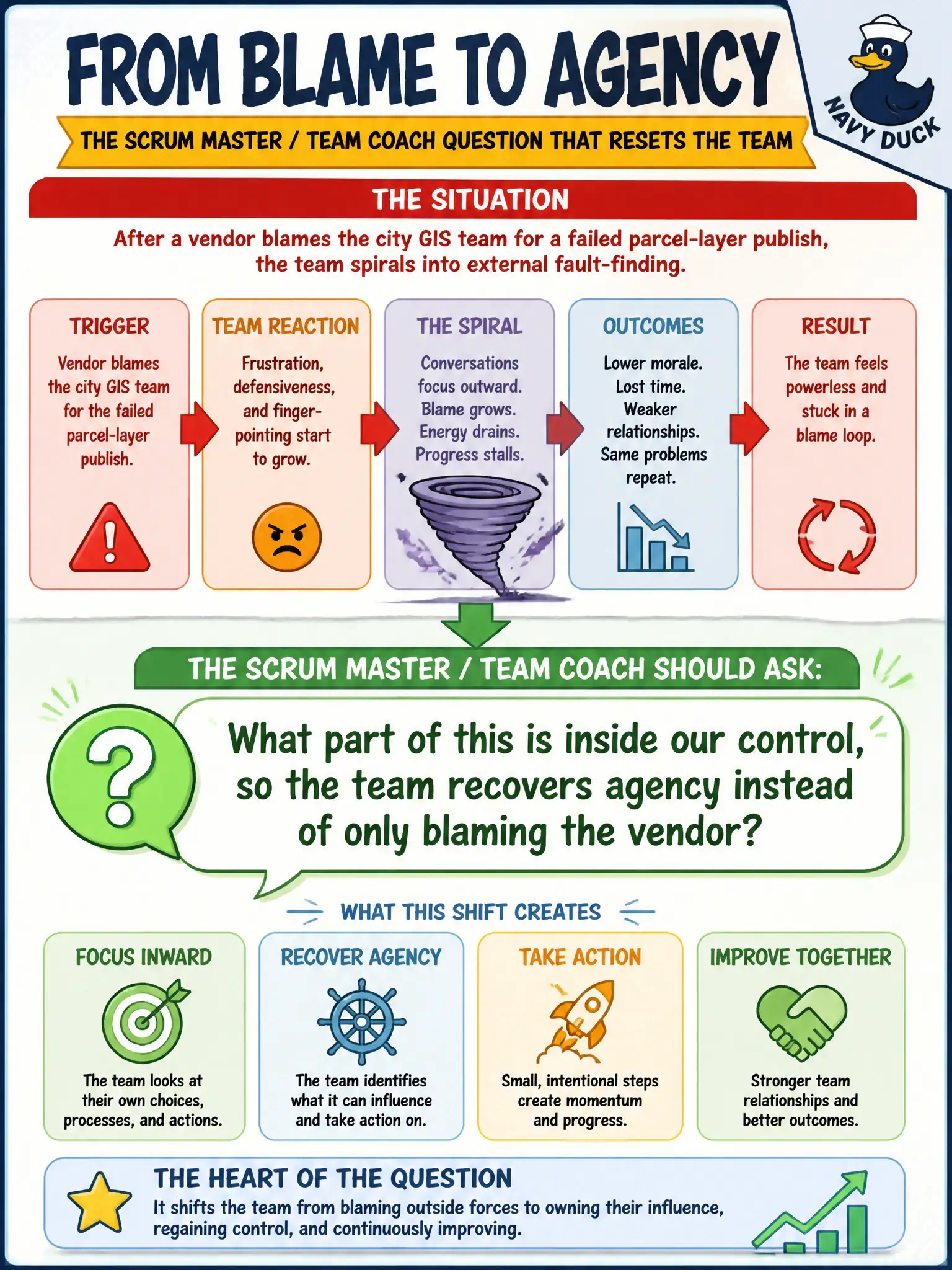
After a vendor blames the city GIS team for a failed parcel-layer publish, the team spirals into external fault-finding. What should the Scrum Master / Team Coach ask?
Select an answer to reveal the explanation.
Short Explanation
Chasing a vendor through a blame spiral is like arguing with the weather—it uses the whole afternoon and the parcel layer still is not published. "What part of this is inside our control?" hands the GIS team the wheel again. Agency beats a perfect villain story.
Full Explanation
When an external party is easy to blame, a powerful question that restores the team's circle of control reopens improvement. After a vendor blames the city GIS team for a failed parcel-layer publish and the team spirals into external fault-finding, the Scrum Master / Team Coach should ask what part of this is inside our control so the team recovers agency instead of only blaming the vendor. The GIS team may still escalate a vendor defect, but it can also inspect local handoffs, acceptance criteria, environments, and publish checks that protect parcel accuracy for assessors and residents.
Asking who on the vendor side to name in a council memo fails by concept: it escalates blame theater without improving publish reliability. Waiting for the Release Train Engineer to rewrite the vendor contract as the iteration goal fails by concept by displacing immediate controllable fixes with distant contracting work. Asking why the city ever accepted GIS work if vendors exist fails by concept: it questions mission rather than recovering agency over the current publish failure.
Exam caveat: SASM conflict and coaching guidance favors restoring agency and learning over pure external blame; escalation can still occur once controllable factors are inspected. Vendor accountability remains valid—it is not a reason to skip the team's own improvement loop on civic GIS publishing.
Operational check: ask the circle-of-control question, list local factors the team can change this iteration, assign owners to those checks, escalate vendor defects with evidence in parallel if needed, and verify the next publish includes stronger local verification before council-facing blame narratives.