
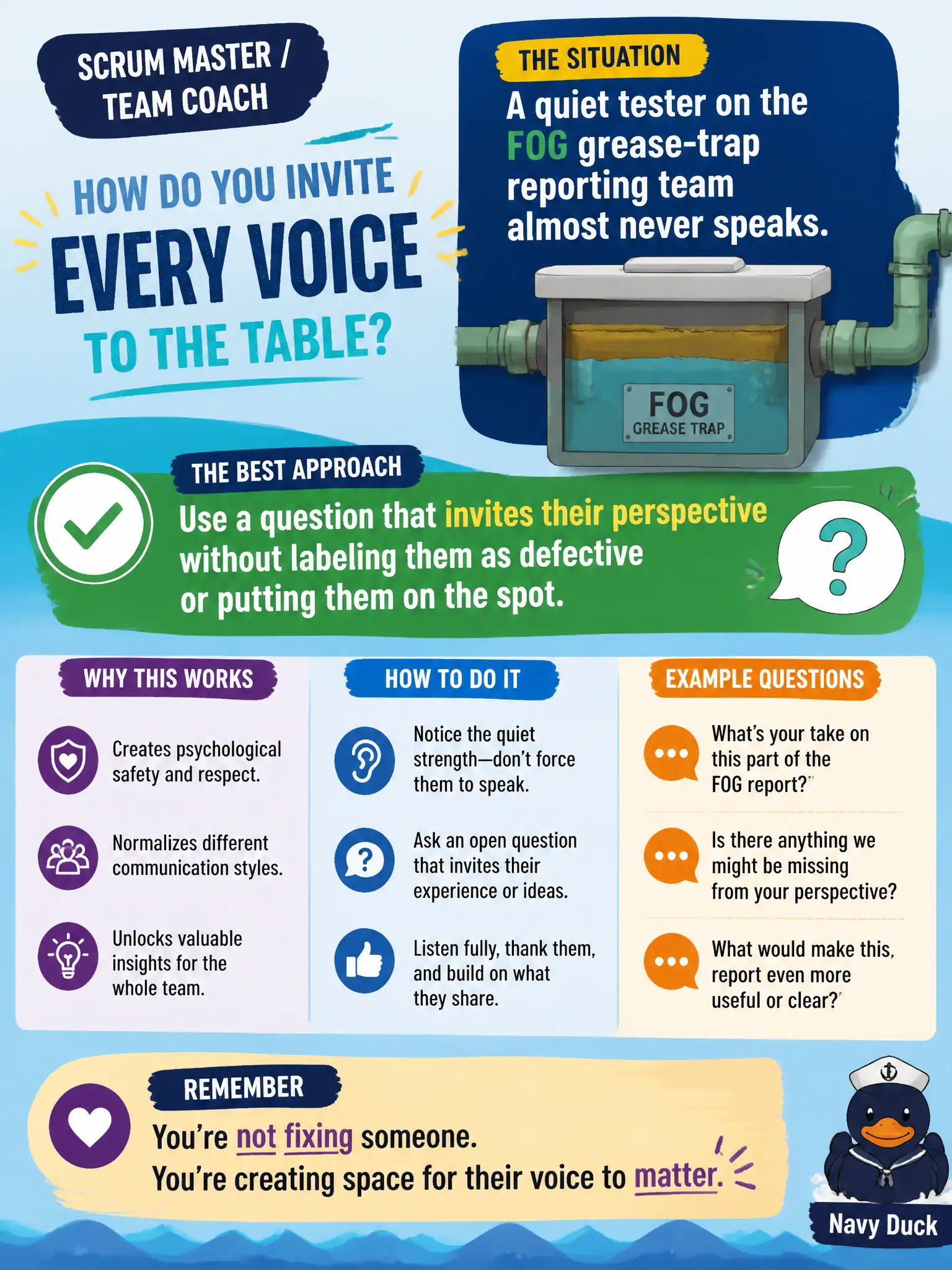
A quiet tester on the FOG grease-trap reporting team almost never speaks. How should the Scrum Master / Team Coach invite that voice?
Select an answer to reveal the explanation.
Short Explanation
Spotlights make people freeze; porch lights let them walk in. The grease-trap tester has a view of quality nobody else has, but calling them "the problem" shuts that view down. Invite the voice; do not put them on trial.
Full Explanation
Invite quiet voices without labeling people defective or putting them on the spot. A quiet tester on the FOG grease-trap reporting team may hold critical quality insight for environmental compliance reporting; silence is not a character flaw to punish. The Scrum Master/Team Coach should use inviting questions—perhaps offering written input first or structured turn-taking—that make contribution safe and useful.
Calling them out as the quiet problem and requiring a status speech at every sync fails by concept: public shaming deepens withdrawal and wastes the forum. Skipping them entirely so they never feel pressure fails by concept by losing their perspective and signaling they do not matter to grease-trap reporting quality. Reassigning testing work to a louder developer fails by concept: it removes a skill voice because of facilitation failure rather than capability gaps.
Exam caveat: Inclusive facilitation is part of building high-performing teams; different participation styles need multiple channels. Invitation differs from forced performance—especially in civic compliance reporting contexts where accuracy matters more than volume of speech.
Operational check: offer the tester a low-pressure invitation such as round-robin, written input, or a direct respectful question; incorporate their testing insight into the plan; and avoid labeling or skipping them in future syncs.