
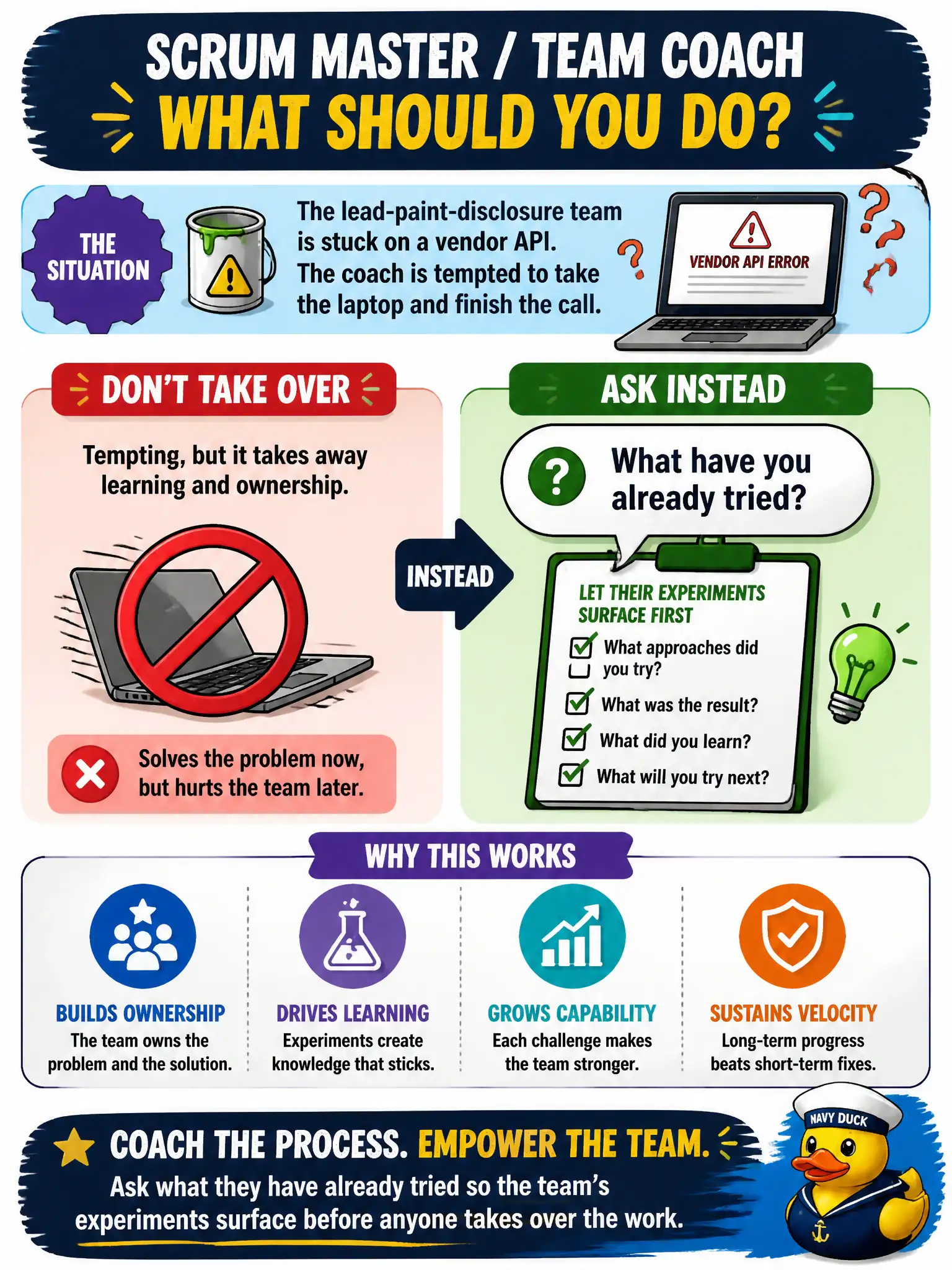
The lead-paint-disclosure team is stuck on a vendor API. The coach is tempted to take the laptop and finish the call. What should the Scrum Master / Team Coach do instead?
Select an answer to reveal the explanation.
Short Explanation
Grabbing the laptop is the civic equivalent of finishing a resident's form for them—fast today, helpless tomorrow. "What have you already tried?" pulls the experiments onto the table so the team keeps the keyboard. Coaches grow problem-solvers, not an audience.
Full Explanation
Before taking over work, ask what the team has already tried so experiments surface. On the lead-paint-disclosure team stuck on a vendor API, grabbing the laptop teaches dependency and hides the team’s learning about a disclosure path that protects families. The Scrum Master/Team Coach should inquire into attempts, blockers, and next experiments—then enable help without becoming the permanent integrator.
Taking the laptop and completing the integration as a masterclass fails by concept: it may unblock once while preventing team capability growth on future vendor issues. Filing a predictive change request that freezes the API until the next fiscal year fails by concept by stopping disclosure progress for bureaucracy. Telling the Product Owner to rewrite the story as a spike owned solely by the coach fails by concept because it transfers ownership away from the team that must sustain the integration.
Exam caveat: Servant leadership and coaching stances favor inquiry and enabling over hero takeovers; occasional pairing to teach differs from permanently doing the civic integration work. Spikes can be team-owned learning devices—not coach pet projects parked off the board.
Operational check: ask the team to list tried steps and hypotheses on the API issue, facilitate the next experiment or paired enablement, keep ownership visible on the board with the team, and confirm they can progress the next vendor obstacle without coach takeover.