
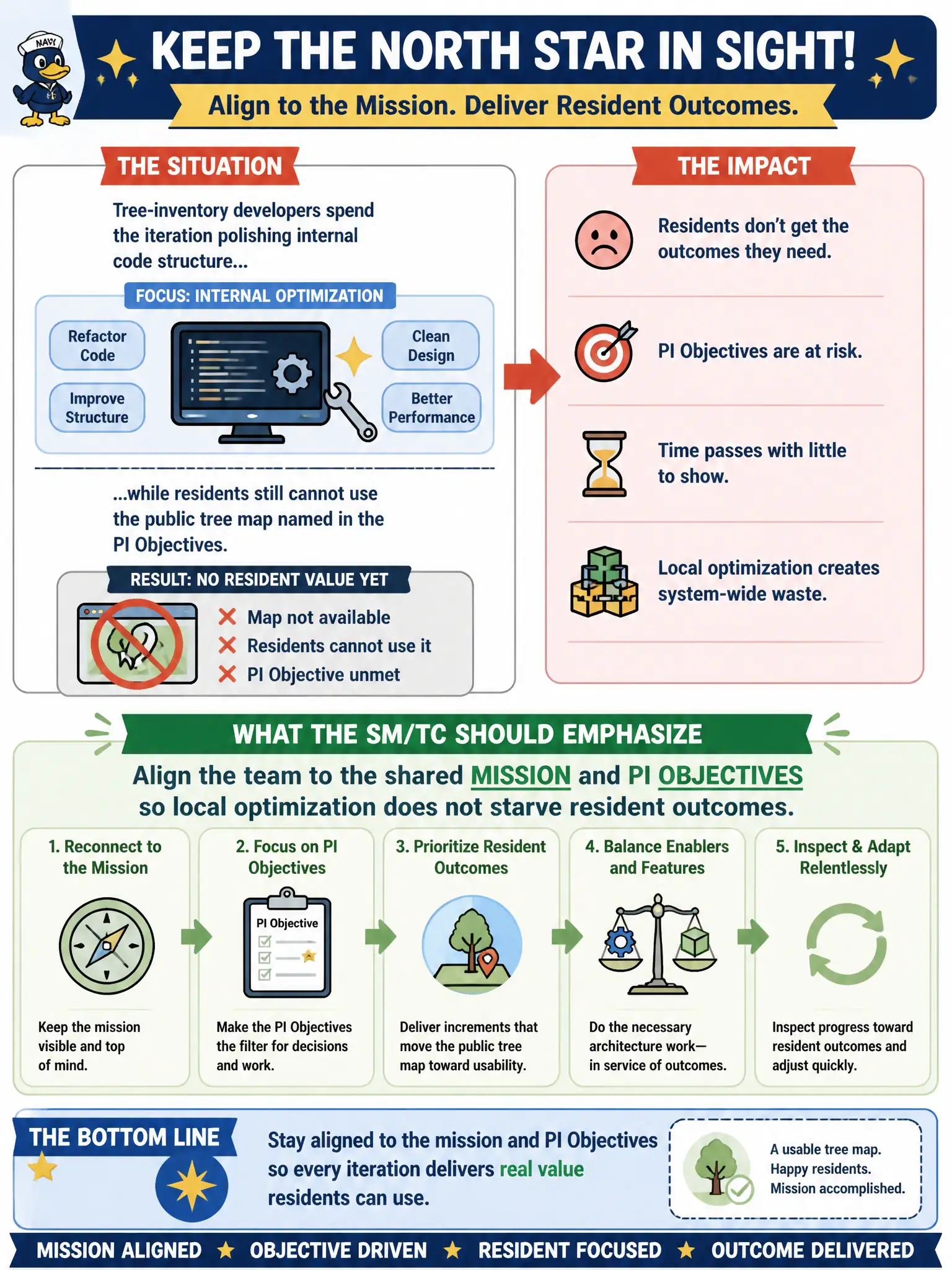
Tree-inventory developers spend the iteration polishing internal code structure while residents still cannot use the public tree map named in the PI Objectives. What should the SM/TC emphasize?
Select an answer to reveal the explanation.
Short Explanation
Polishing the filing cabinet while the park map stays locked in the drawer is local craft, not a mission. The PI already named a public tree map for residents. Point the team at that shared outcome, then improve the internals on the way.
Full Explanation
High-performing teams align to shared mission and PI Objectives rather than local optimization. Tree-inventory developers polishing internal structure while residents still cannot use the public tree map named in PI Objectives are optimizing craft at the expense of civic outcomes. The Scrum Master/Team Coach should emphasize mission alignment so internal improvement supports—not starves—the committed public map.
Protecting the internal refactor as the team’s only measure of craft fails by concept: craft without resident outcomes misses the team’s purpose. Hiding the public map from PI Objectives until the internal model is perfect fails by concept by moving the goalposts to avoid delivery. Rewarding the most elegant module regardless of whether the map ships fails by concept because it incentivizes local optimization over ART commitments.
Exam caveat: SAFe connects team work to PI Objectives and customer value; technical excellence matters as built-in quality enabling those outcomes, not as a substitute for them. Refactors can be valid when they unblock the map—transparency and objective alignment remain required.
Operational check: reconnect iteration plans to the public tree-map PI Objective, timebox structural work that directly enables the map, demo resident-facing progress, and stop treating internal polish alone as success.