
After a 911 outage, operations staff frame the fix as “we need more status meetings.” How should the Scrum Master / Team Coach reframe that request?
Select an answer to reveal the explanation.
Short Explanation
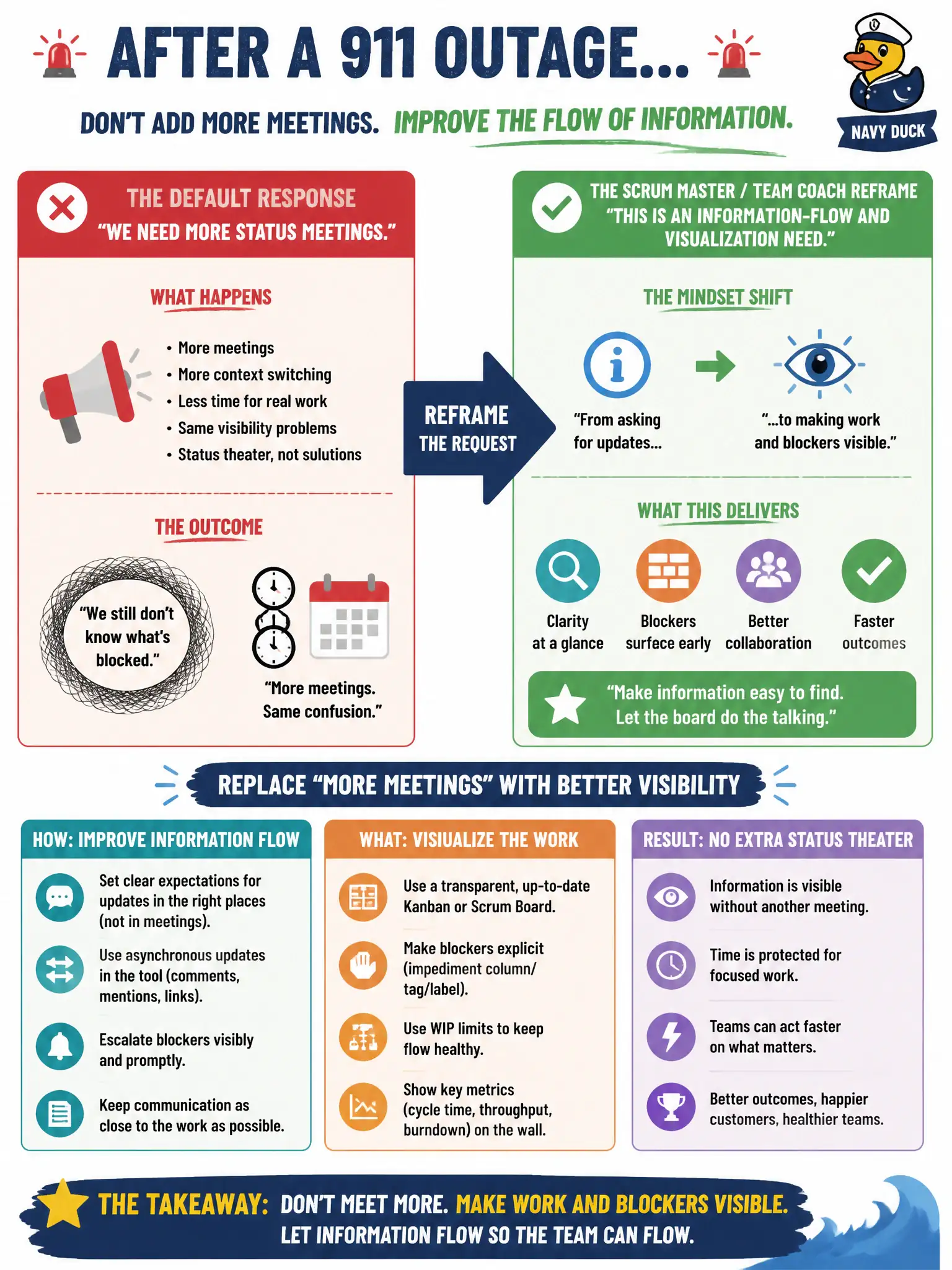
After a 911 outage, “more status meetings” is like adding more people shouting in a dark room. The real need is information flow—see the work and the blockers. Light the board; do not schedule another shout.
Full Explanation
After a 911 outage, “more status meetings” usually signals an information and visualization gap, not a calendar gap. Operations staff need to see owners, blockers, work in progress, and recovery steps without adding ceremony that steals recovery time. The Scrum Master / Team Coach reframes the request toward transparent information flow—visible boards, clear escalation paths, and short coordination focused on impediments—so the emergency team can act on facts instead of reporting theater. Public-safety continuity depends on that clarity more than on extra named reporters in more rooms.
Adding a twice-daily status call creates meeting load without fixing how outage work is visualized or who can remove blockers. Requiring hourly written status emails turns recovery into documentation theater and slows people who should be restoring service. Turning the outage into a predictive critical-path workshop borrows waterfall control language that does not fit empirical recovery and often invents false certainty under pressure.
Exam caveat: coordination during a civic outage is valid; status theater is not the same as making work and risks visible. Operational check: if people ask for more meetings, first ask what they cannot currently see—owners, blockers, or next actions—and fix that visibility before you add another call.