
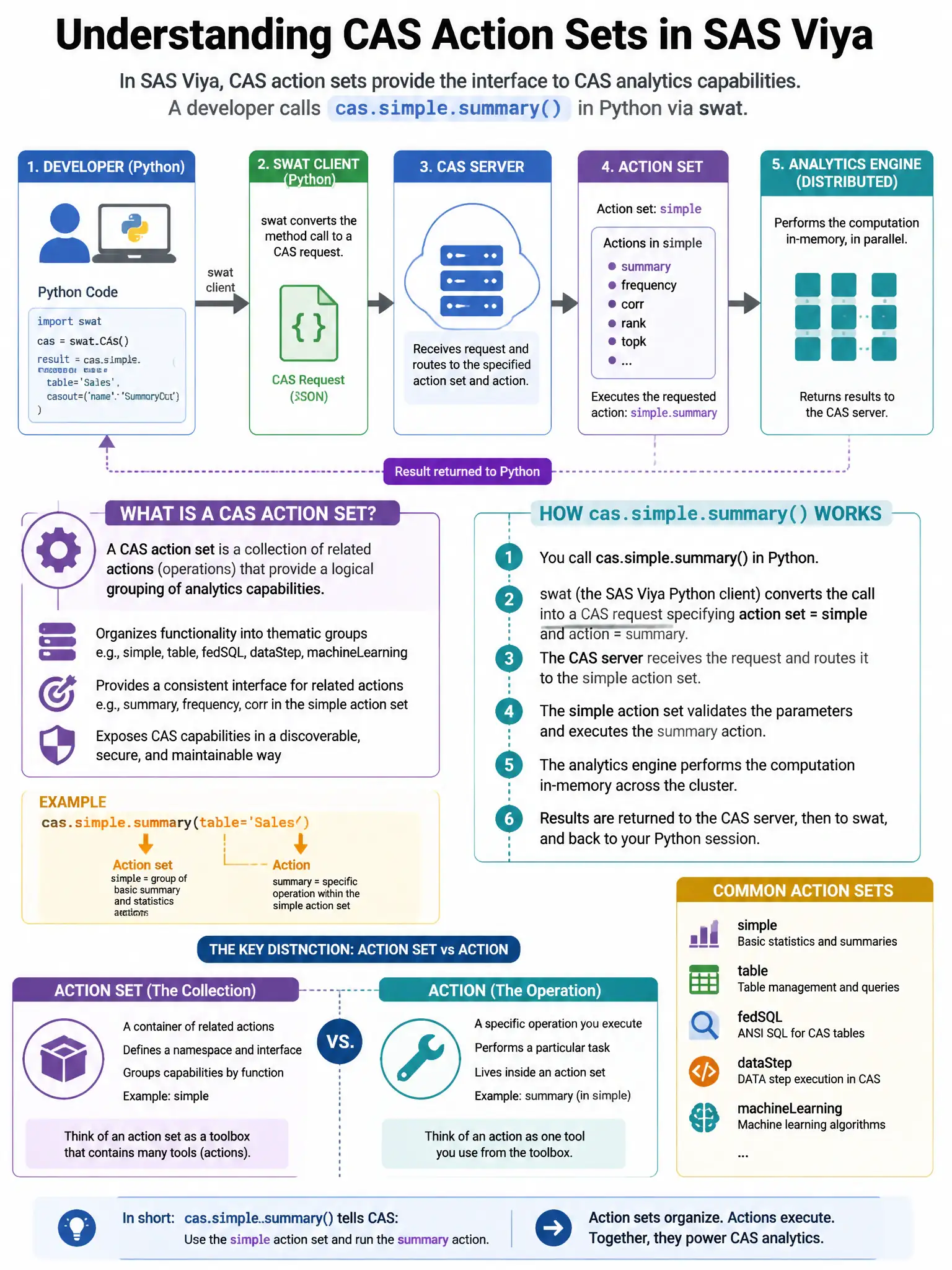
In SAS Viya, CAS action sets provide the interface to CAS analytics capabilities. A developer calls cas.simple.summary() in Python via swat. What is a CAS action set, and how does it differ from a SAS procedure?
Select an answer to reveal the explanation.
Short Explanation
Here's the deal — a CAS action set is a named collection of CAS actions that run distributed, in-memory analytics on CAS worker nodes. SAS procedures run on the SAS compute server and process data sequentially, so they're not the same thing.
Full Explanation
A CAS action set is a named collection of CAS actions, or analytics functions, that execute distributed in-memory computations on CAS worker nodes. Examples include simple, regression, decisionTree, and deepLearn. These server-side libraries run in parallel across CAS workers on in-memory data and can be invoked via CASL, PROC CAS, swat in Python, or the R client. SAS procedures run on the SAS compute server and read data from disk or SAS libraries sequentially. That distributed in-memory execution is the key differentiator enabling CAS action sets to scale to large datasets efficiently. The option describing action sets as SAS macros grouped by topic that run inside the DATA step is wrong; action sets are not macros and do not run in the DATA step. The option saying action sets and SAS procedures are interchangeable and execute identically on CAS in-memory tables is wrong; their execution architecture is fundamentally different. The option describing action sets as Python class wrappers around PROC SQL queries for CAS tables via swat is wrong; action sets are not Python wrappers around SQL.