
PROC HPCLUS is run with NCLUST=5 on a 10-million-row dataset. The IMPUTE option is specified. What does IMPUTE do in PROC HPCLUS?
Select an answer to reveal the explanation.
Short Explanation
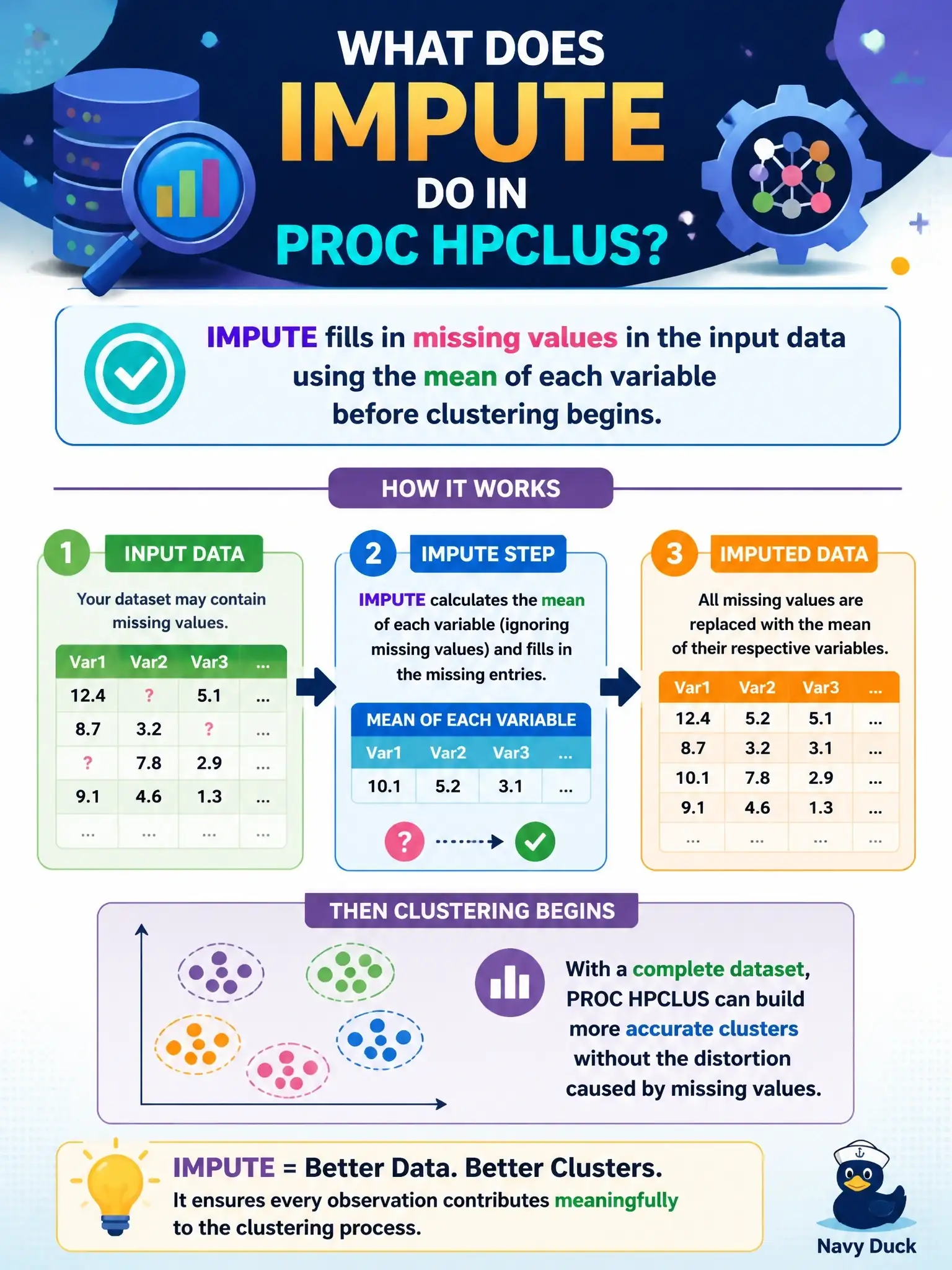
Think of IMPUTE= in PROC HPCLUS as a simple patch job: set it to MEAN and every missing interval value gets filled with that variable's overall mean, so the row can still join the clustering. You're not getting centroid-based or multiple imputation here, and if you leave the default (NONE), rows with missing values just get dropped.
Full Explanation
In PROC HPCLUS, the IMPUTE= option controls how missing values of numeric interval input variables are handled before the k-means algorithm runs. The documented values are MEAN and NONE: IMPUTE=MEAN replaces each missing value with the mean of that variable, so the observation stays in the analysis, while IMPUTE=NONE, the default, excludes any observation that has missing values. A companion option, IMPUTENOM=MODE, does the same job for nominal inputs by using each variable's mode. Assigning incomplete rows to the nearest cluster and filling the gaps from that cluster's centroid is not what the option does; the replacement value is a single overall mean, not a cluster-specific one. Removing every observation with missing values describes the default behavior when no imputation is requested, not the effect of turning imputation on. Running PROC MI internally to build five imputed data sets and averaging the assignments is also wrong, because HPCLUS performs no multiple imputation, and the five in the scenario is the cluster count. On the exam, be wary of answers that sound more sophisticated than the documented option values. To confirm in practice, run HPCLUS with and without IMPUTE=MEAN and compare the number of observations used.