
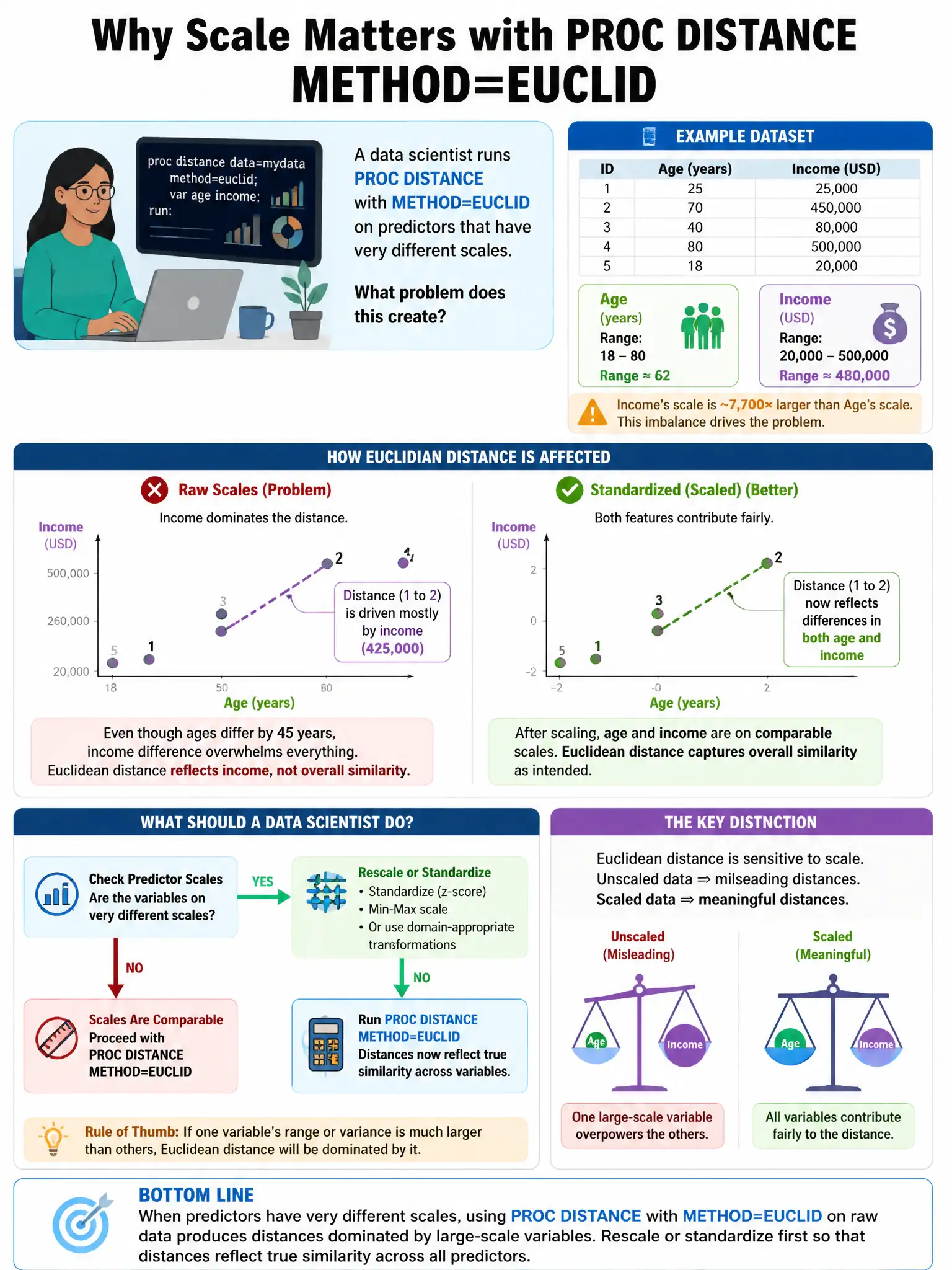
A data scientist uses PROC DISTANCE with METHOD=EUCLID on a dataset where predictors have very different scales (e.g., age: 18-80, income: 20000-500000). What problem does this create for clustering?
Select an answer to reveal the explanation.
Short Explanation
Here's the deal — high-scale variables dominate Euclidean distance because it treats each unit equally, so a one-dollar income difference counts the same as a one-year age difference. Since income's range is much larger, it overwhelms age and can make age irrelevant to cluster membership.
Full Explanation
The correct choice is the statement that high-scale variables dominate Euclidean distance, making low-scale variables irrelevant to cluster membership. Euclidean distance treats each unit equally: a one-unit income difference ($1) equals a one-unit age difference (1 year) numerically. Since income's range is about 25 times age's, income dominates the distance calculation and can ignore age's contribution. Standardize variables (PROC STDIZE) or use Gower distance before clustering. The claim that computation fails with different units is wrong; it does not fail. The claim that it is undefined with negative values is wrong; it handles negatives. The claim that the matrix will not be symmetric is wrong; Euclidean distance matrices are symmetric.