
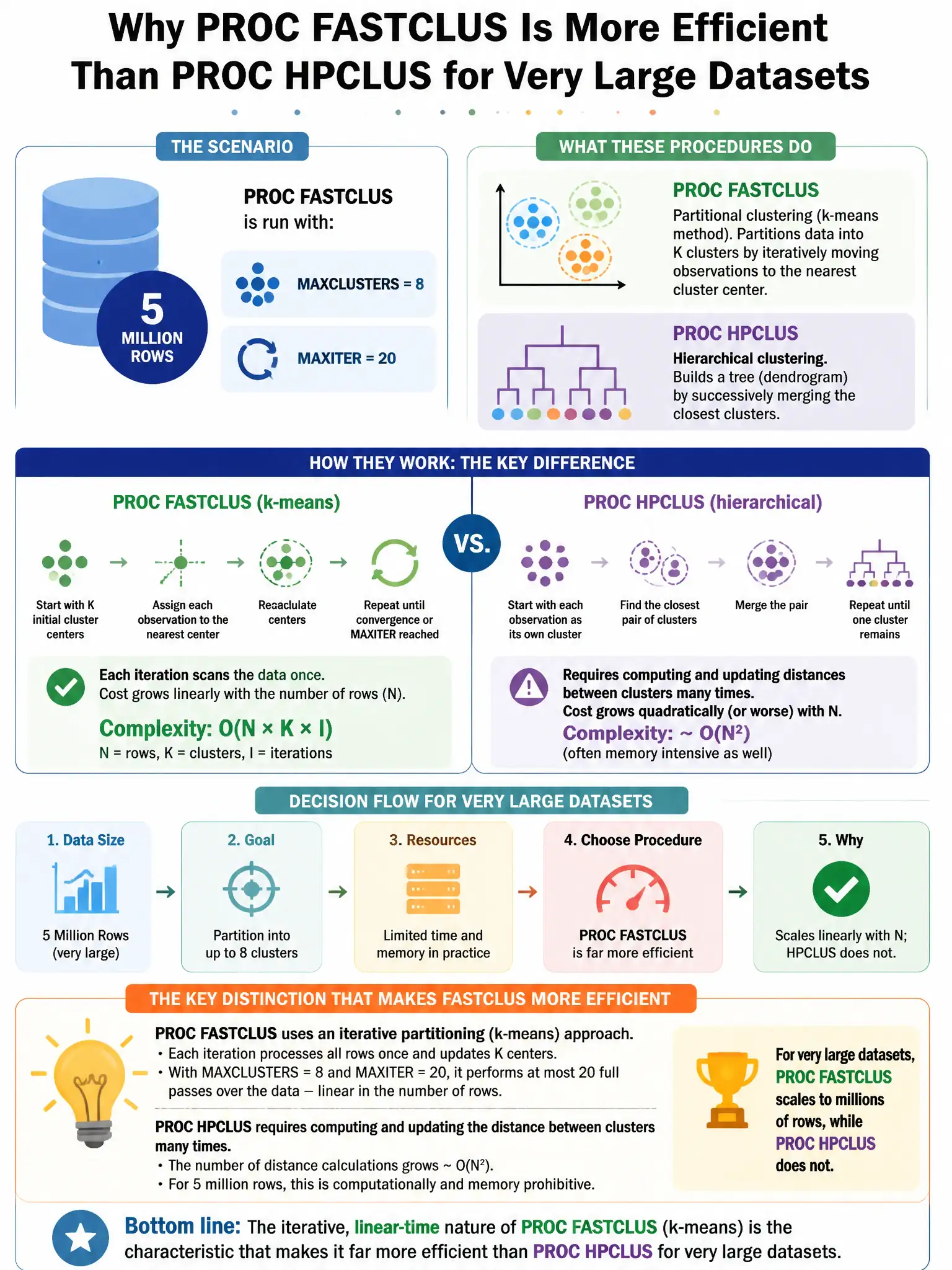
PROC FASTCLUS is run on a 5-million-row dataset with MAXCLUSTERS=8 and MAXITER=20. Which characteristic makes PROC FASTCLUS more efficient than PROC HPCLUS for very large datasets when a fixed number of clusters is required?
Select an answer to reveal the explanation.
Short Explanation
Here's the deal — PROC FASTCLUS is the right fit because it's a base SAS procedure built for single-node, large-dataset k-means work. It uses efficient seed selection and reassignment, plus a single-pass initial assignment step, so you can handle very large data without CAS.
Full Explanation
The correct characteristic is that PROC FASTCLUS is a base SAS procedure optimized for single-node, large-dataset k-means clustering. It uses a single-pass algorithm with efficient farthest-first seed selection and efficient reassignment, then iterative refinement, so it can process very large datasets without requiring SAS Viya's CAS infrastructure. The approximate nearest-neighbor search with random seed selection option is wrong because PROC FASTCLUS uses farthest-first seeding, not random seeding. The CAS parallelization option is wrong because it reverses the roles: PROC HPCLUS uses CAS for parallel processing, while PROC FASTCLUS runs on a single SAS node. The hierarchical pre-clustering option is wrong because PROC FASTCLUS uses direct seed selection, not hierarchical pre-clustering.