
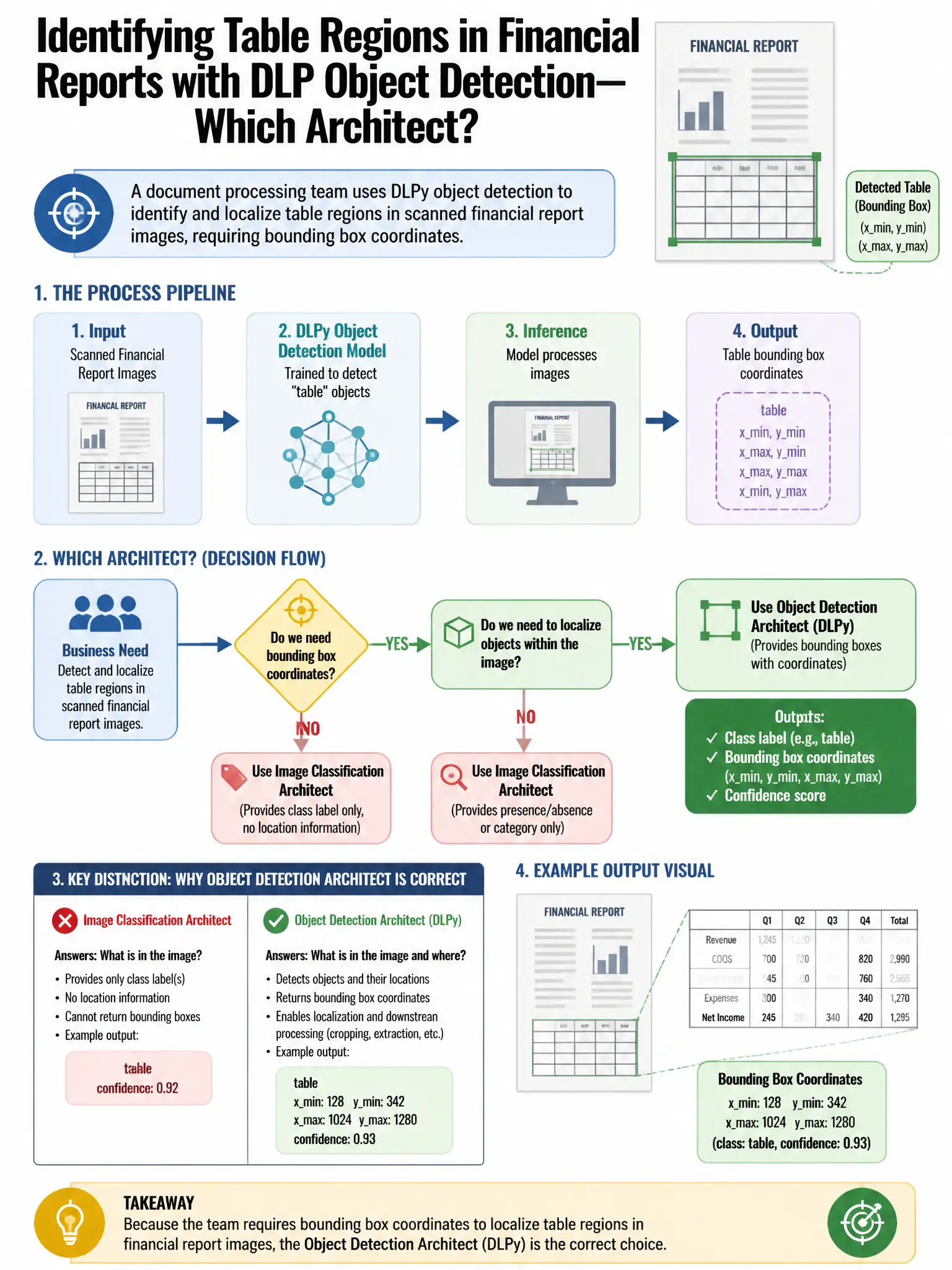
A document processing team uses DLPy object detection to identify and localize table regions in scanned financial report images, requiring bounding box coordinates. Which architecture is most appropriate?
Select an answer to reveal the explanation.
Short Explanation
Here's the deal — you need an object detection model that predicts both class labels and bounding-box coordinates for table regions. A YOLO-based DLPy model configured with a 'table' class is the right fit because it localizes multiple tables in scanned financial report images.
Full Explanation
The YOLO-based object detection model in DLPy configured with a 'table' object class is correct because table detection with bounding box output is an object detection problem requiring architectures that predict both class labels and spatial coordinates (x, y, width, height) for multiple regions within an image. DLPy supports YOLO-style architectures designed for this. The ResNet-50 fine-tuned for binary classification on image patches is wrong; patch-based classifiers cannot efficiently produce bounding box coordinates for the full page. The DLPy TextClassifier applied to OCR-extracted text from scanned pages is wrong; text classifiers operate on text sequences, not images. The sequence-to-sequence DLPy model mapping pixel rows to boundary indices is wrong; sequence-to-sequence models are for text translation/generation, not spatial bounding box regression.