
Which cross-validation approach is specifically recommended for time series data where the relationship between features and target evolves over time?
Select an answer to reveal the explanation.
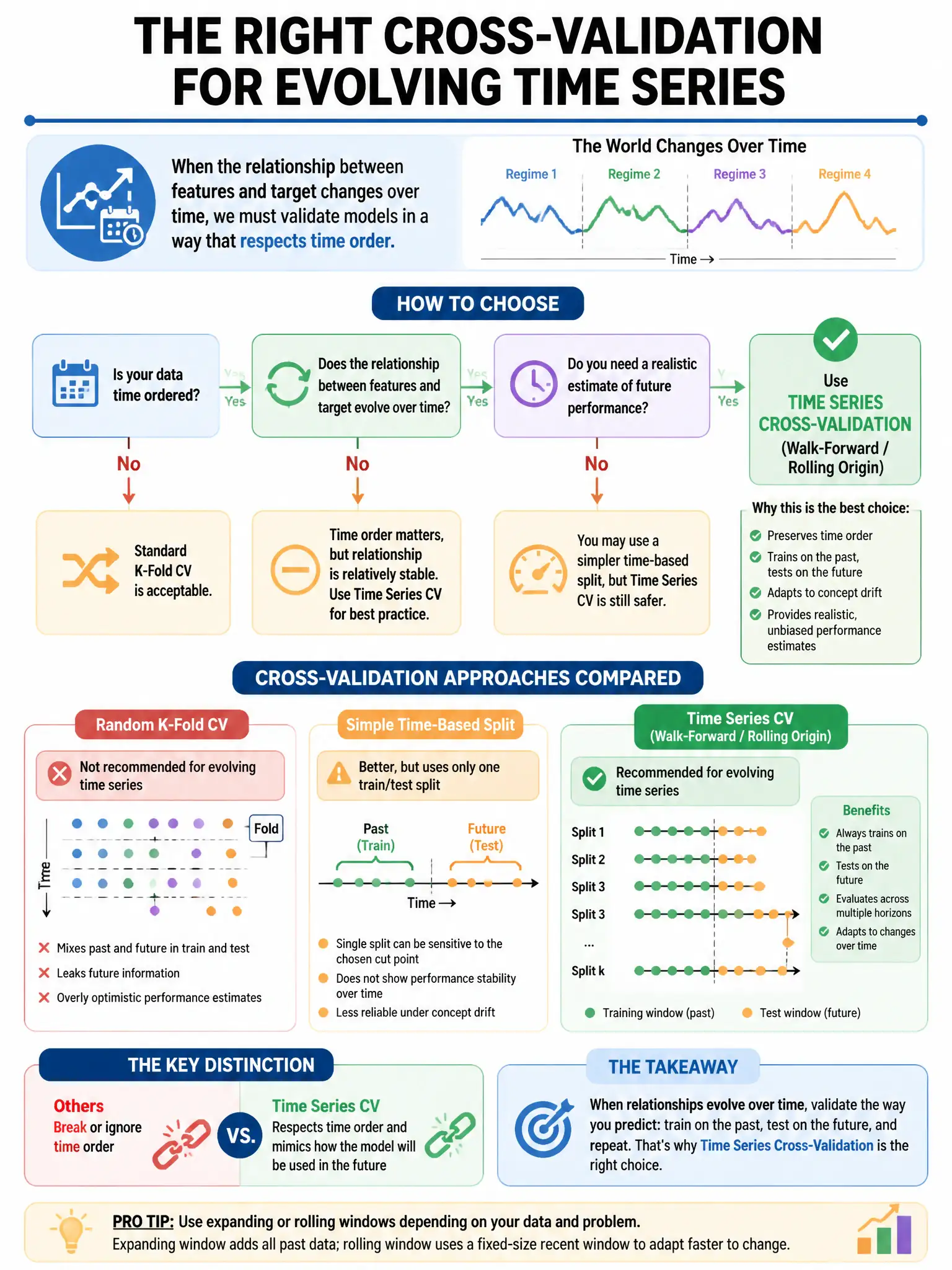
Short Explanation
Here's the deal — you want walk-forward (rolling origin) cross-validation because it trains only on past data and validates on future data, preserving temporal order and blocking future information leakage. Stratified, leave-one-out, and repeated cross-validation approaches shuffle or ignore time, so they can leak future data.
Full Explanation
Walk-forward (rolling origin) cross-validation is correct because it respects temporal ordering: each fold trains on all data before the validation period and tests on subsequent data, preventing future information leakage. Stratified k-fold cross-validation maintaining class proportions across folds randomly shuffles data, destroying temporal structure. Leave-one-out cross-validation to maximize training data per fold also ignores temporal ordering when shuffled. Repeated k-fold cross-validation with multiple random seeds introduces random shuffling incompatible with time-dependent data.