
A data scientist uses the Matthews Correlation Coefficient (MCC) instead of accuracy on an extremely imbalanced dataset where 98% of records are class 0. What is the key advantage of MCC in this situation?
Select an answer to reveal the explanation.
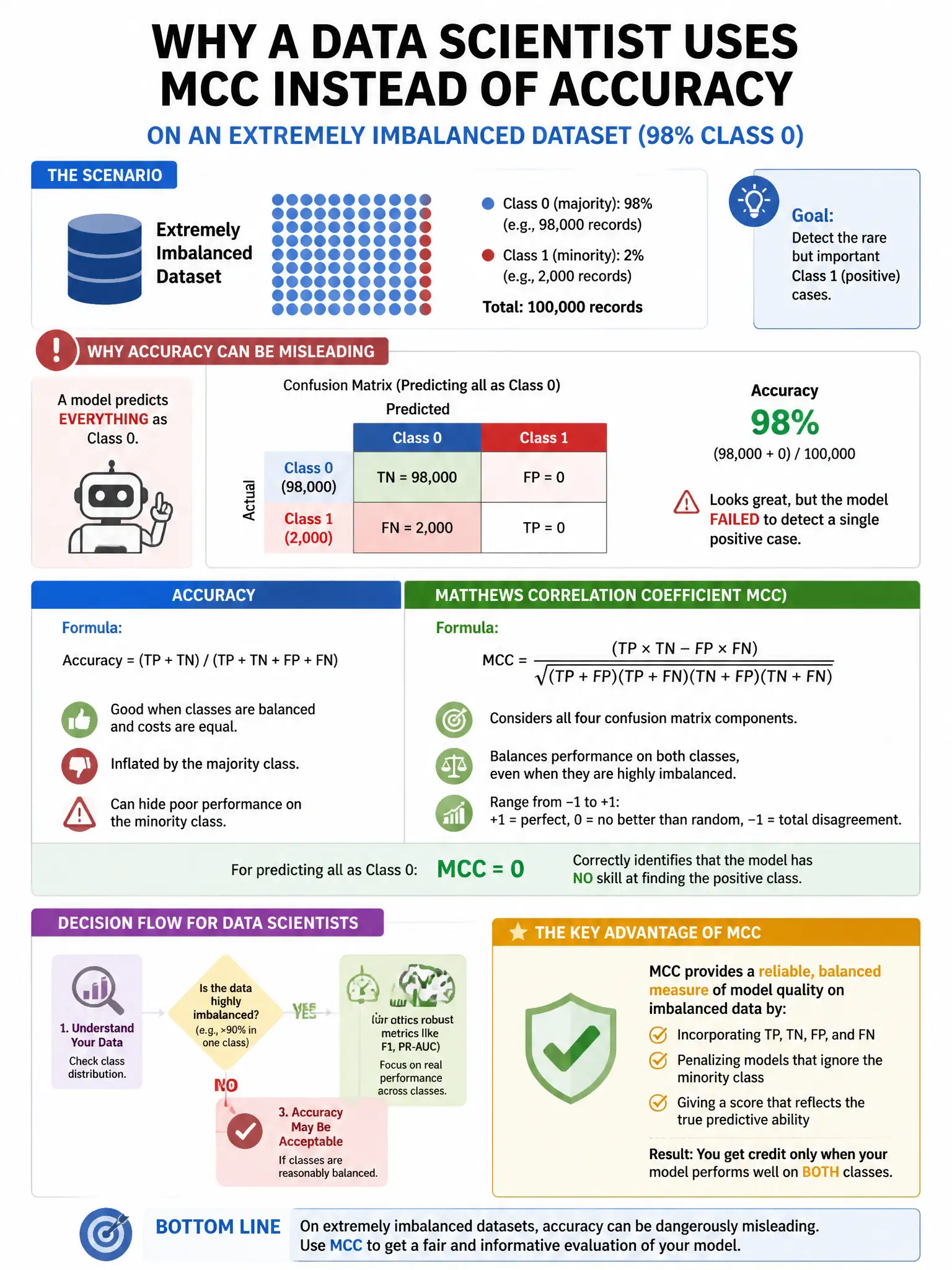
Short Explanation
Here's the deal — you need a metric that uses all four confusion-matrix cells. A model that only predicts the majority class scores near zero instead of 98%, exposing uselessness despite high accuracy.
Full Explanation
MCC uses true positives, true negatives, false positives, and false negatives symmetrically, so a model predicting only the majority class scores near zero instead of 98% accuracy. The 0-to-1 interpretation claim is wrong because MCC ranges from -1 to +1. The macro-averaged F1 equivalence claim is wrong because MCC and macro F1 are mathematically different. The threshold-independent claim is wrong because MCC is computed at a specific threshold from the confusion matrix.