
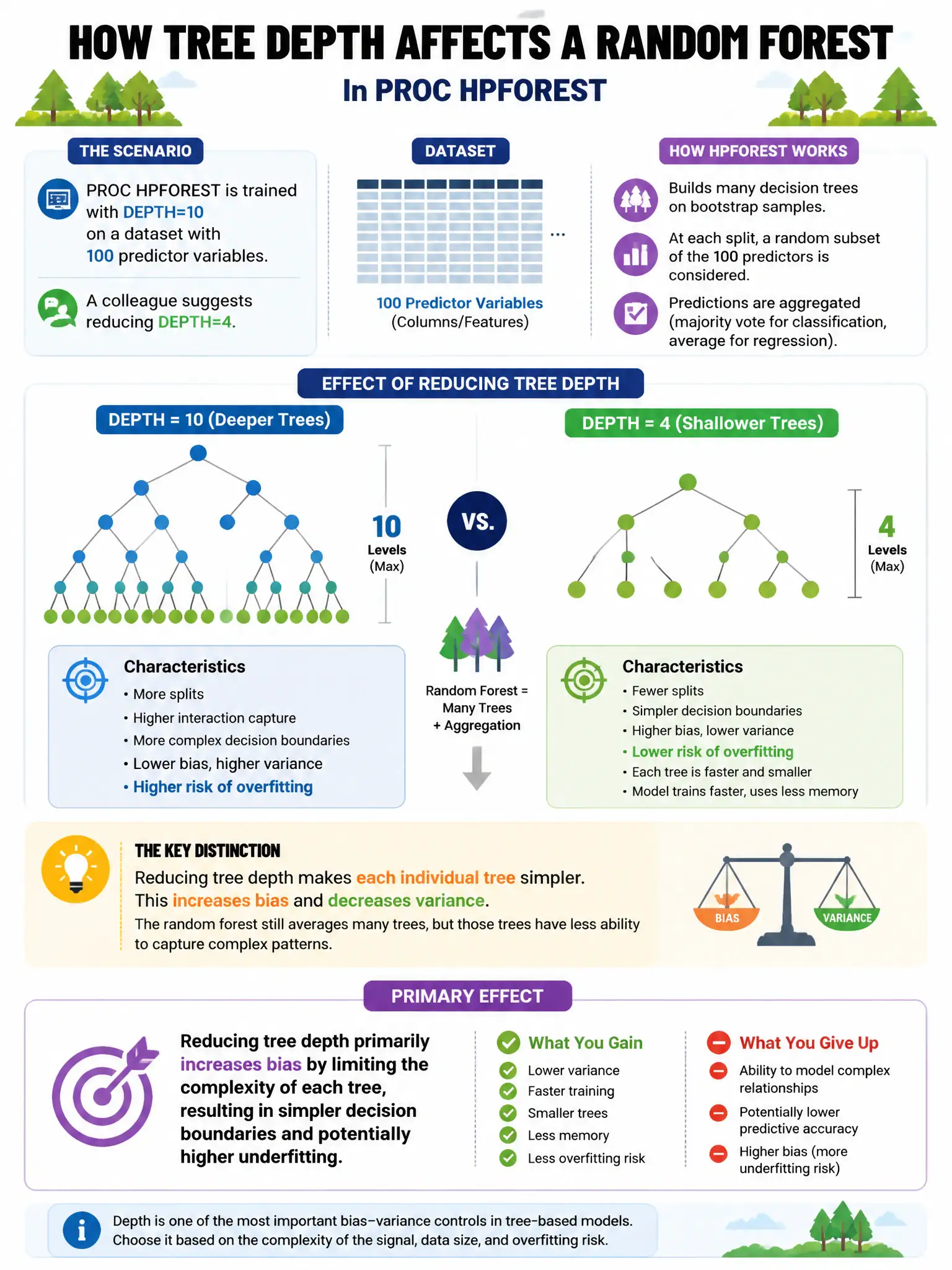
PROC HPFOREST is trained with DEPTH=10 on a dataset with 100 predictor variables. A colleague suggests reducing DEPTH=4. What is the primary effect of reducing tree depth in a random forest?
Select an answer to reveal the explanation.
Short Explanation
You're right to watch depth because it controls the bias-variance tradeoff. Shallower trees underfit each bootstrap sample, but the ensemble often generalizes better, especially on noisy data.
Full Explanation
The correct explanation is that reducing depth increases bias but decreases variance — shallower trees underfit individual bootstrap samples, but the ensemble often generalizes better, especially on noisy datasets. Very deep trees, such as DEPTH=10, have low bias per tree but high variance because they overfit bootstrap sample noise. Reducing depth from DEPTH=10 to DEPTH=4 increases bias because each tree captures less complex patterns, but it reduces variance. The ensemble average then reflects the bias-variance tradeoff of the base trees. The training-time claim is wrong because training time decreases with lower depth. The no-effect claim is wrong because depth affects the ensemble's overall bias-variance balance. The more-variables-per-split claim is wrong because VARS_TO_TRY= controls variables per split, independent of DEPTH=.