
A data scientist runs PROC FACTOR and examines the communality estimates in the output. What does a communality value of 0.25 for a variable named 'age' indicate?
Select an answer to reveal the explanation.
Short Explanation
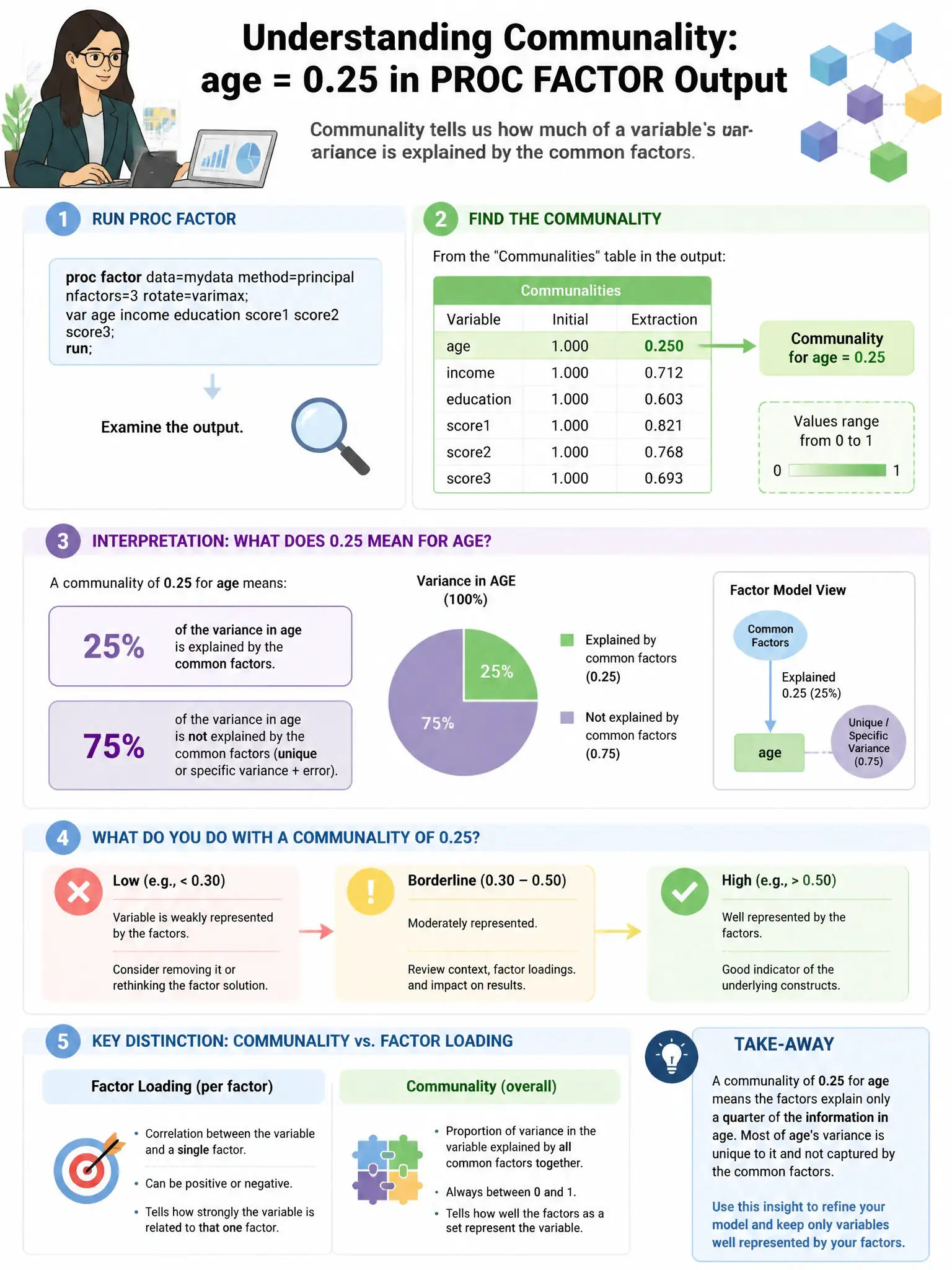
Here's the deal — communality is the share of a variable's variance explained by the retained factors. If 'age' has a communality of 0.25, only 25% of age's variance is captured, so age is poorly represented.
Full Explanation
The correct interpretation is that only 25% of the variance in 'age' is explained by the retained factors, suggesting age is poorly represented in the factor solution. Communality is the proportion of a variable's variance that is explained by the retained factors. A data scientist would either retain more factors, remove age from the analysis, or accept that age does not fit well in the factor structure. The option saying age contributes 25% of the total variance explained by all factors combined confuses communality with contribution to total variance. The option saying the factor loading for age on factor 1 is 0.25 confuses communality with a factor loading. The option saying age has a correlation of 0.25 with the first principal component confuses communality with a correlation coefficient.