
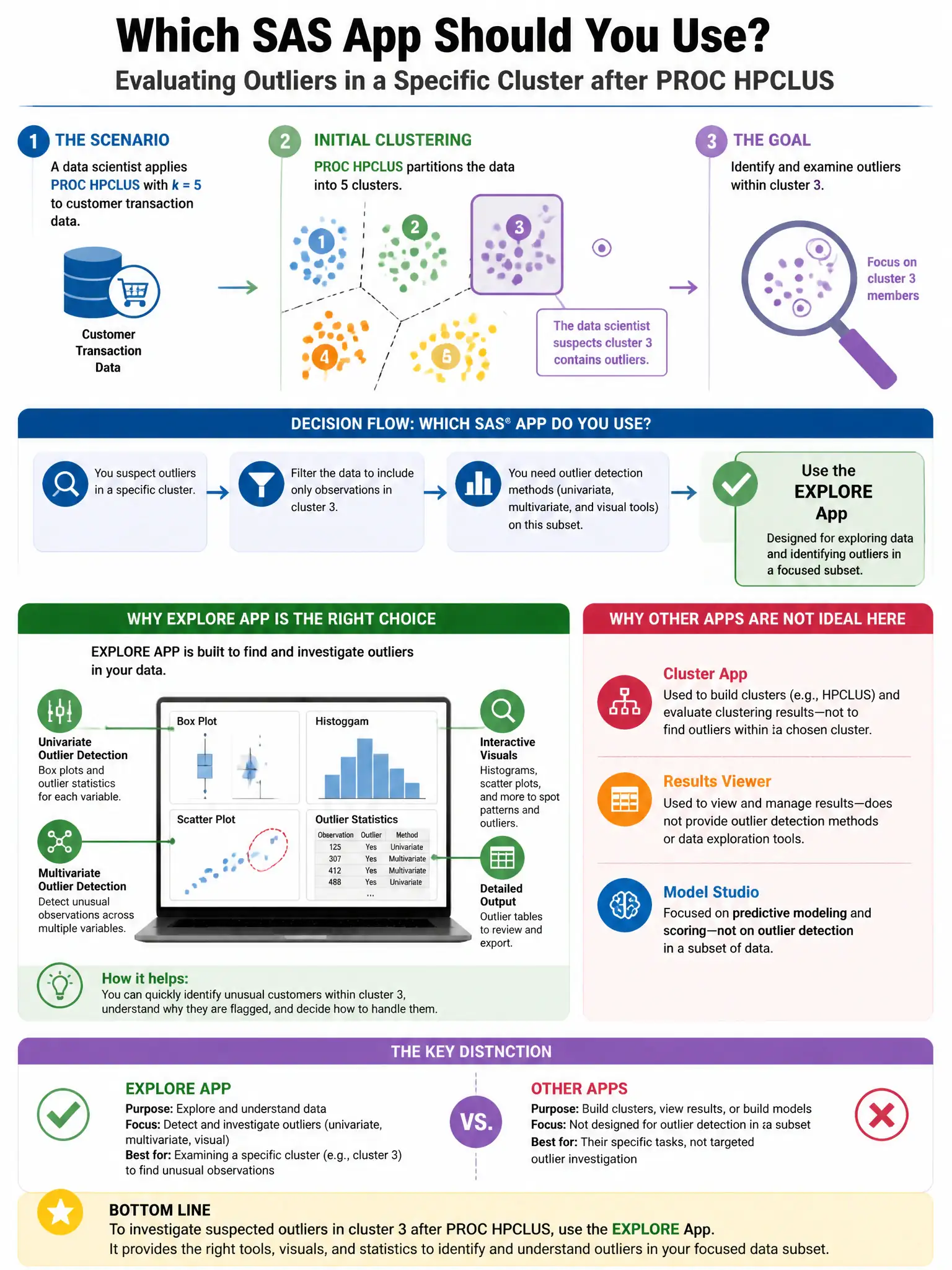
A data scientist applies PROC HPCLUS with k=5 to customer transaction data. After initial cluster assignment, the data scientist suspects cluster 3 contains outliers. Which SAS approach best identifies outlier observations within a cluster?
Select an answer to reveal the explanation.
Short Explanation
Here's the deal — you're looking for points that sit far from their cluster centroid. Compute each observation's distance to its assigned centroid, then flag anything beyond about 3 standard deviations from the mean distance within that cluster. That's the direct cluster-based way to spot outliers.
Full Explanation
Compute the distance from each observation to its cluster centroid and flag observations exceeding 3 standard deviations from the mean distance within the cluster. In k-means, outliers are observations far from the centroid. Computing each observation's Euclidean distance to its assigned centroid and flagging those beyond a threshold, such as mean plus 3 SD of distances within that cluster, is the standard cluster-based outlier detection approach. Re-running PROC HPCLUS with k=6 to split cluster 3 into two sub-clusters may split cluster 3, but it does not identify outliers systematically. Applying PROC HPLOGISTIC to classify observations as outliers versus non-outliers requires labeled outlier data, which is not available here. Using PROC UNIVARIATE on the original variables to identify extreme values identifies variable-level extremes, but it ignores the multivariate cluster membership context.