
A data scientist uses PROC PRINCOMP in SAS with OUTSTAT= to save the component structure. Later, they want to score new data by projecting it onto the saved principal components. Which step applies the saved PCA transformation to new data?
Select an answer to reveal the explanation.
Short Explanation
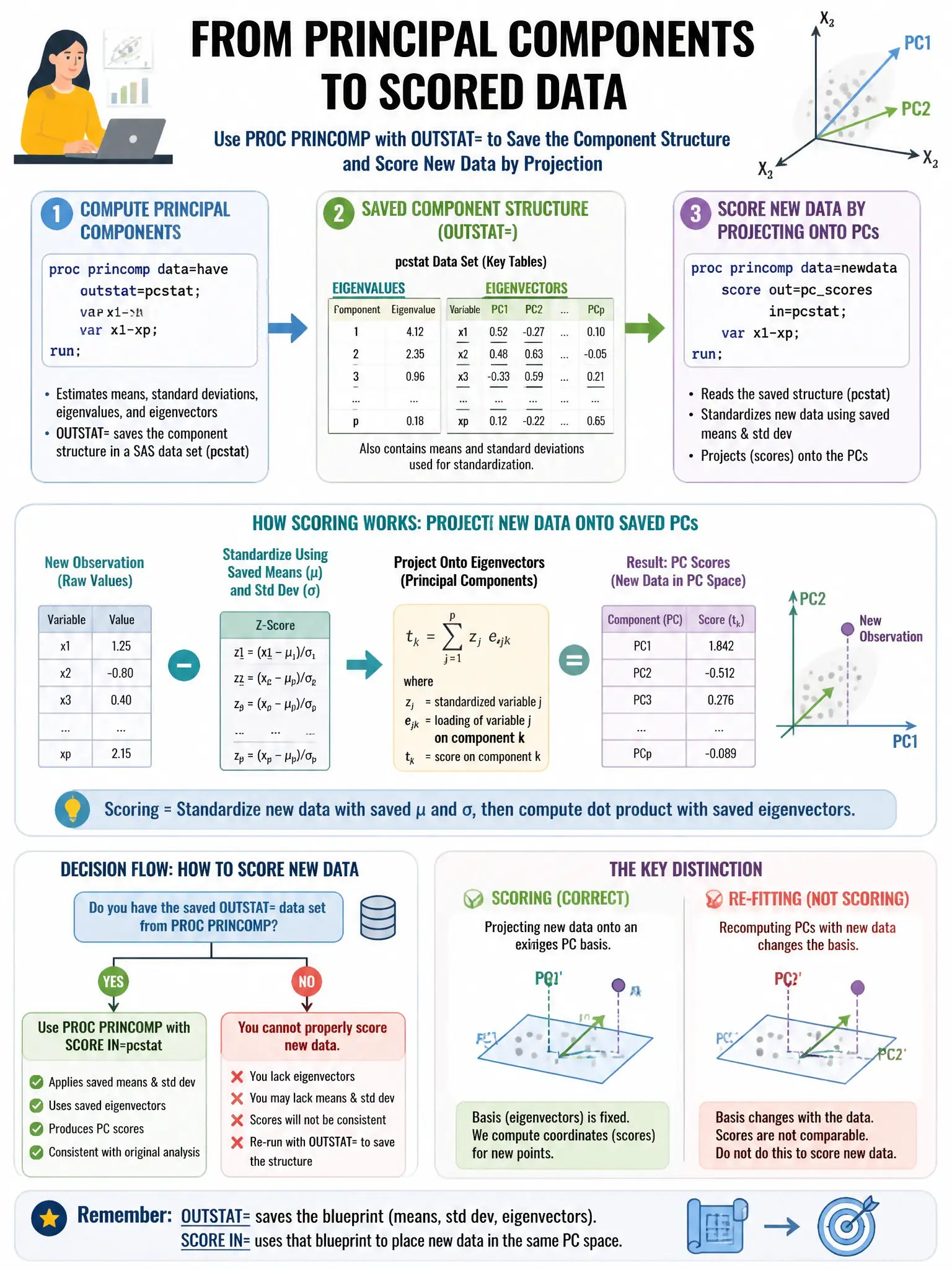
Here's the deal — use PROC SCORE with the saved OUTSTAT= dataset and TYPE=SCORE to project new rows onto the stored principal components. That tells PROC SCORE to read the scoring coefficients and compute the component scores for your new data.
Full Explanation
The correct step is PROC SCORE with DATA=newdata SCORE=pca_outstat OUT=scored TYPE=SCORE because PROC SCORE applies saved scoring coefficients from PROC PRINCOMP's OUTSTAT= dataset to new data. The TYPE=SCORE option tells PROC SCORE to look for scoring coefficient rows in the OUTSTAT dataset and compute linear combinations, which are the principal component scores, for the new observations. The PROC SCORE variant with TYPE=PARMS is wrong because TYPE=PARMS is for regression parameter datasets, not PCA scoring. The PROC PRINCOMP variant with LOAD=pca_outstat is wrong because PROC PRINCOMP does not have a LOAD= option for reading saved components. The PROC FACTOR variant with ROTATE=PRINCIPAL OUTSCORE=scored is wrong because PROC FACTOR does not have a LOAD= option equivalent and OUTSCORE= is not a valid option name.