
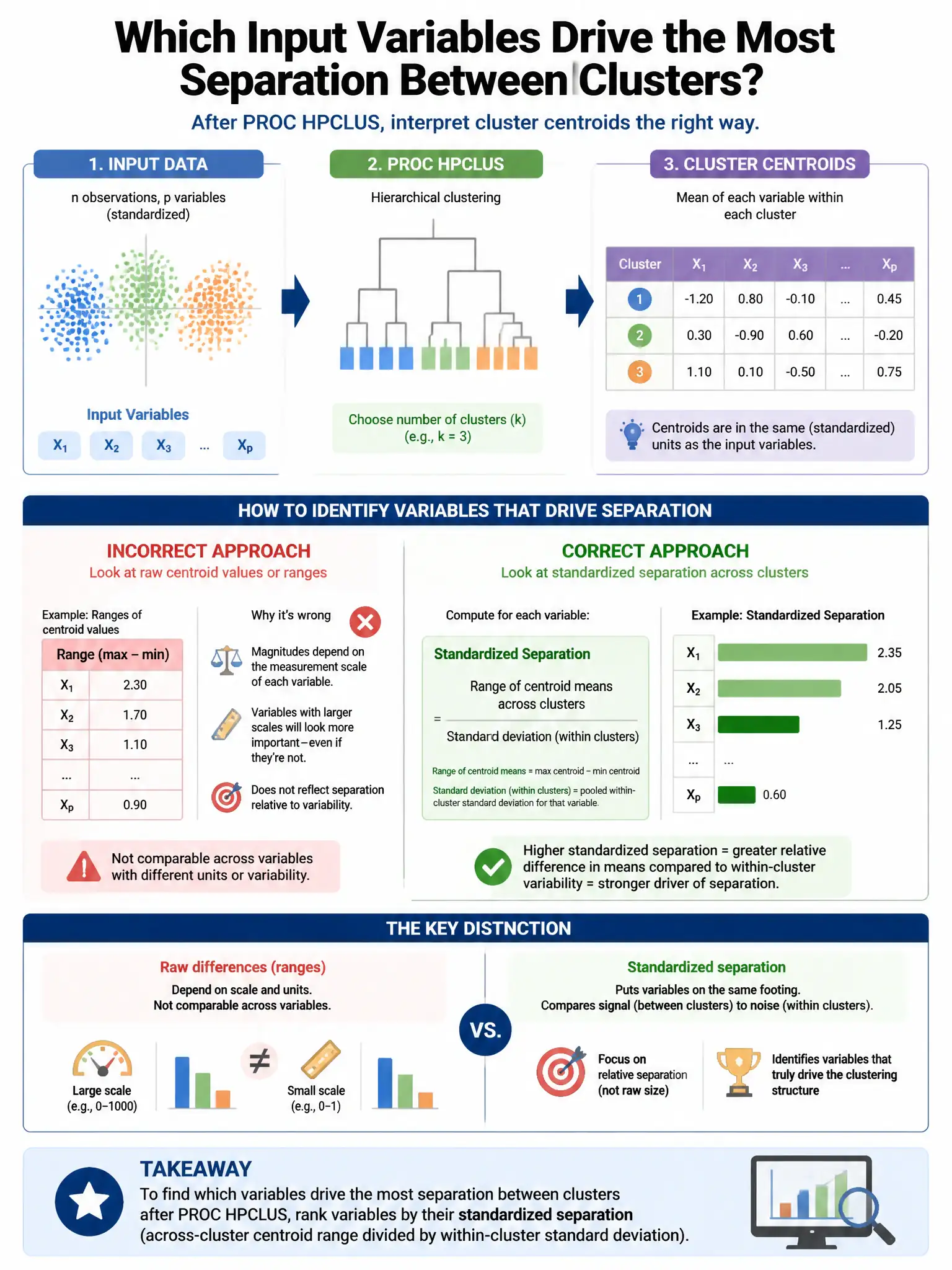
A data scientist applies PROC HPCLUS and obtains cluster centroids. They want to interpret which input variables drive the most separation between clusters. Which approach best identifies the most discriminating variables?
Select an answer to reveal the explanation.
Short Explanation
Here's the deal — you should run PROC DISCRIM after PROC HPCLUS, use the cluster assignment as the class variable, and examine the canonical discriminant structure coefficients. That approach builds discriminant dimensions that separate the clusters and shows which original variables contribute most to that separation. Correlating inputs with the cluster label number treats a categorical label as if it were an ordered number, so it won't reliably identify discriminating variables.
Full Explanation
The best approach is to run PROC DISCRIM after PROC HPCLUS, use the cluster assignment as the class variable, and examine canonical discriminant structure coefficients. Canonical discriminant analysis computes linear combinations of inputs that maximally separate clusters, and structure coefficients show which original variables contribute most to each discriminant dimension. Correlating inputs with the cluster assignment number is wrong because it treats arbitrary categorical labels as continuous ordinal values. Re-running PROC HPCLUS by removing one variable at a time and comparing WCSS is wrong because it is computationally expensive and indirect. Using PROC HPLOGISTIC with cluster assignment as the target is wrong because it predicts assigned labels rather than describing how variables separate clusters, making importance less interpretable for cluster profiling.