
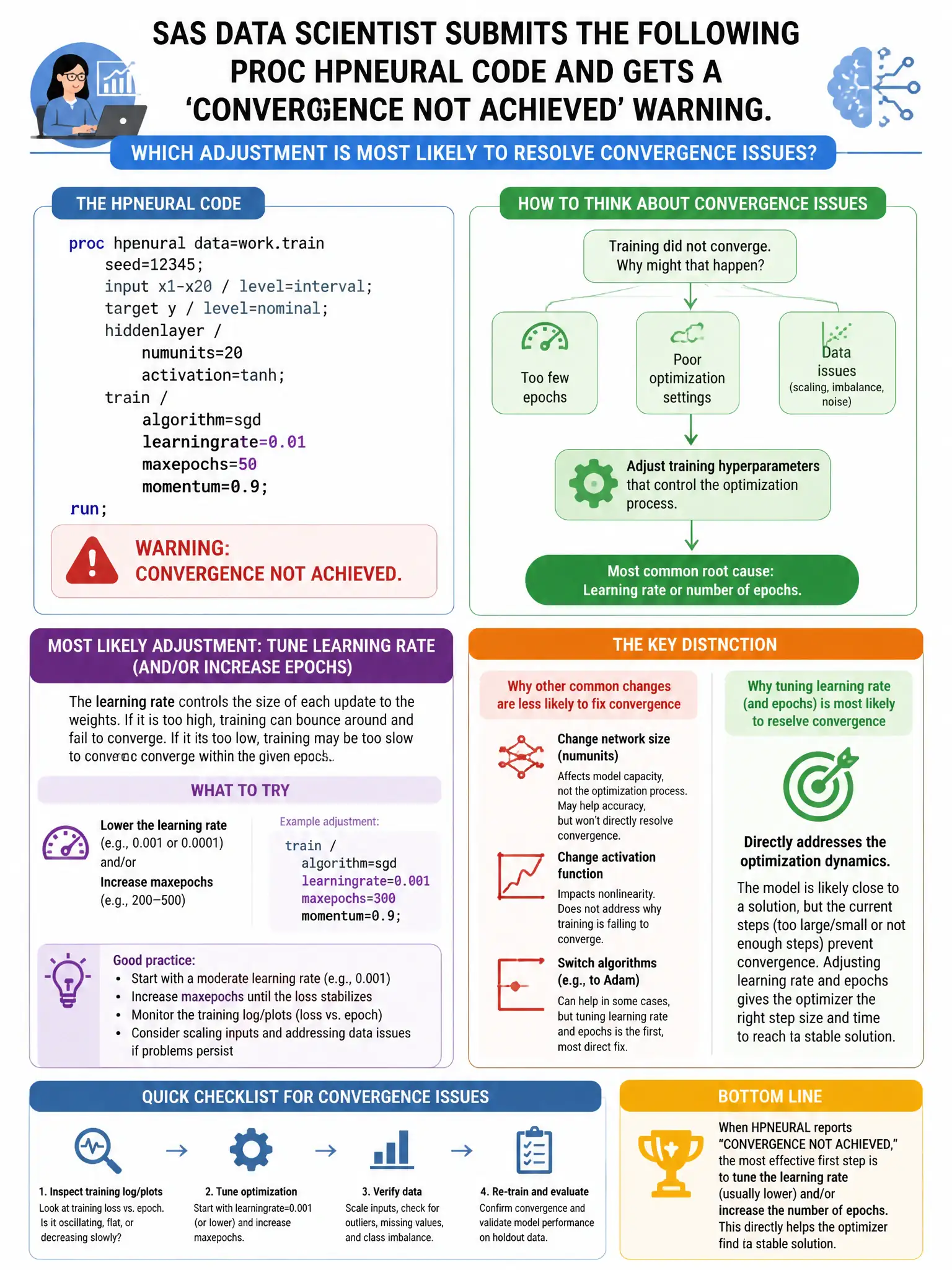
A SAS data scientist submits the following PROC HPNEURAL code and gets a 'CONVERGENCE NOT ACHIEVED' warning. Which adjustment is most likely to resolve convergence issues?
Select an answer to reveal the explanation.
Short Explanation
Here's the deal — convergence failures in PROC HPNEURAL usually mean you need more iterations, better-scaled inputs, and a smaller learning rate. So increase MAXITER=, normalize the inputs, and reduce the learning rate to stop the optimizer from oscillating.
Full Explanation
The adjustment that increases MAXITER=, normalizes input variables, and reduces the learning rate is correct because convergence failures in PROC HPNEURAL are commonly caused by: (1) insufficient iterations, (2) poorly scaled inputs causing erratic gradient updates, and (3) a learning rate that is too large causing oscillation. Decreasing MAXITER= and increasing the learning rate does the opposite — it reduces opportunities for convergence and exacerbates oscillation. Adding more hidden layers adds complexity, which typically worsens convergence rather than improving it. Changing the activation function from TANH to LOGISTIC may help marginally in some cases, but it addresses activation choice, not the primary convergence factors.