
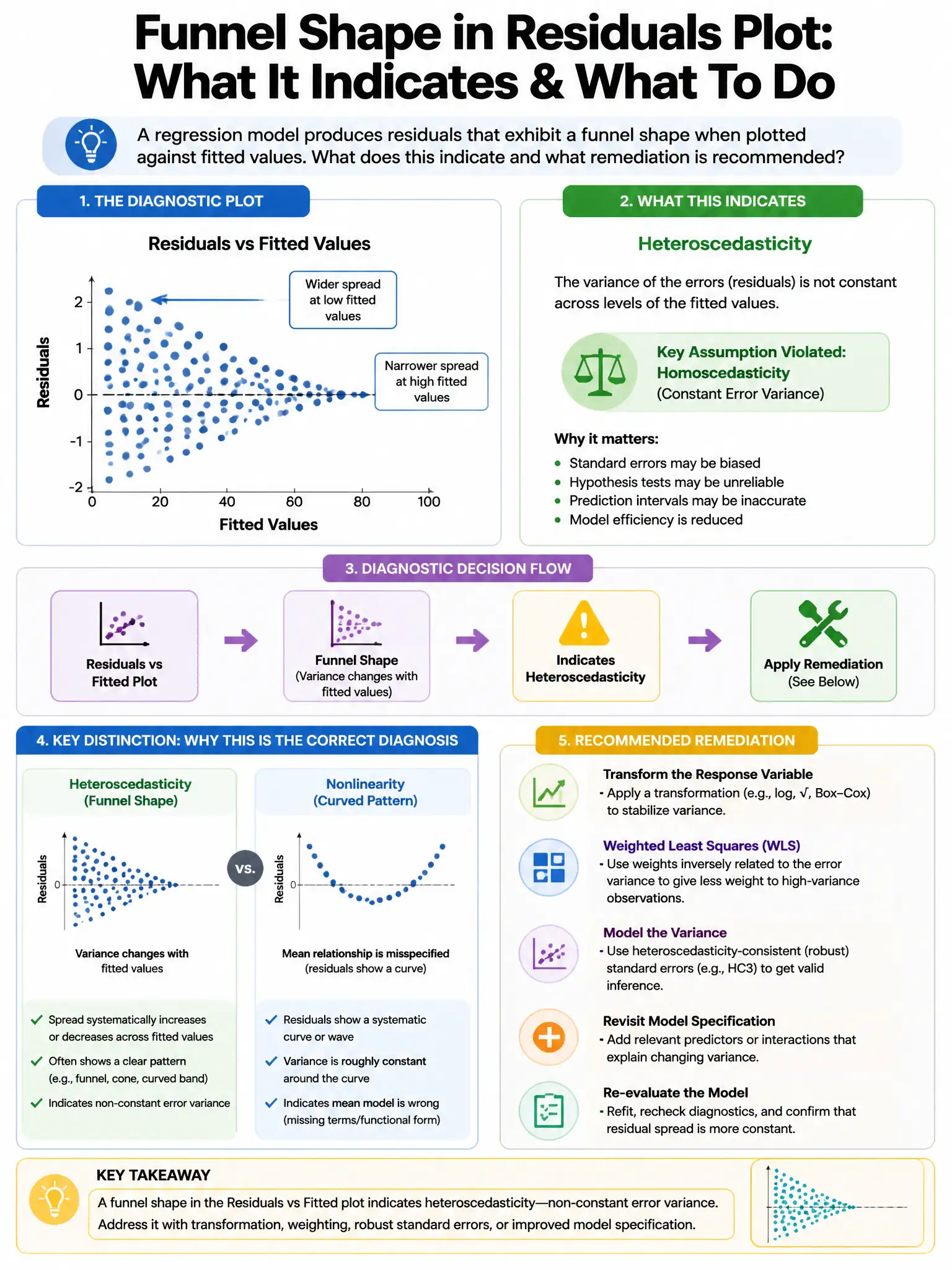
A regression model produces residuals that exhibit a funnel shape when plotted against fitted values. Which diagnostic does this indicate and what remediation is recommended?
Select an answer to reveal the explanation.
Short Explanation
Here's the deal — a funnel-shaped residual plot means the error variance grows with fitted values, which is heteroscedasticity. You fix it with a variance-stabilizing transformation like log or Box-Cox, or weighted least squares.
Full Explanation
The heteroscedasticity answer is correct because a funnel-shaped residual plot, where residual variance increases with fitted values, is the hallmark of heteroscedasticity. Remediation includes a log or Box-Cox transformation of the target, or weighted least squares where weights are inversely proportional to variance. The multicollinearity option, which recommends VIF analysis and removing correlated predictors, presents as inflated standard errors, not funnel residuals. The autocorrelation option, which recommends first-differencing the target variable, appears as patterns in residuals ordered by time, not by fitted values. The high-leverage-points option, which recommends Cook's Distance to identify and remove outliers, identifies individual influential points, not a systematic variance pattern.