
A model selection process uses BIC (Bayesian Information Criterion) instead of AIC. What is the key difference between BIC and AIC in model selection?
Select an answer to reveal the explanation.
Short Explanation
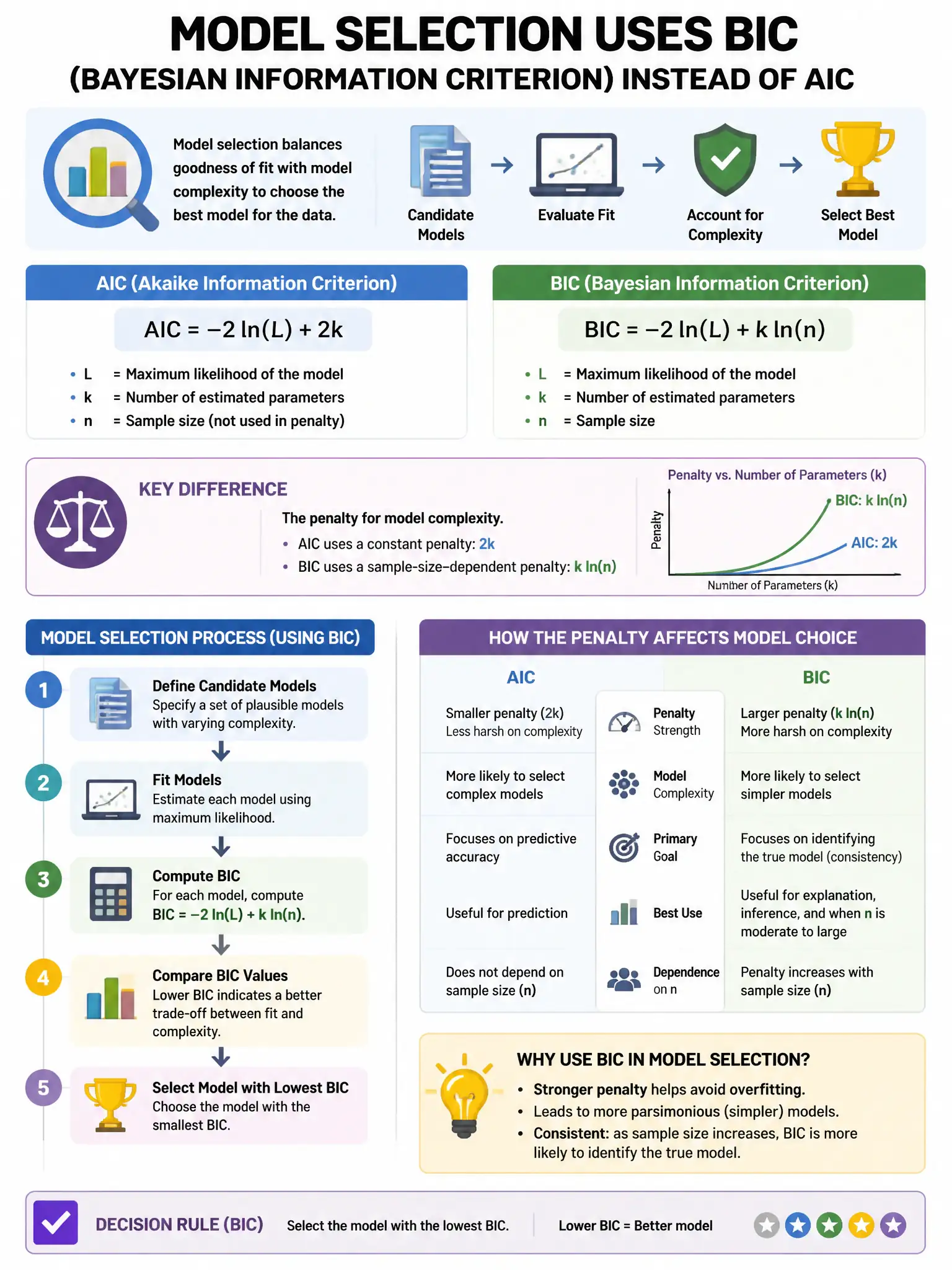
Here's the deal — BIC penalizes model complexity more heavily than AIC when n > 7 because its penalty is k*ln(n) instead of 2k. Once ln(n) tops 2, each extra parameter costs more, so you tend to get sparser models.
Full Explanation
Correct: BIC penalizes model complexity more heavily than AIC when n > 7. BIC = -2ln(L) + kln(n); AIC = -2*ln(L) + 2k. Since ln(n) > 2 when n > e^2 ≈ 7.39, BIC imposes a larger penalty per parameter for most real datasets, tending to select sparser models. The claim that AIC always selects a more complex model than BIC regardless of sample size is wrong because the comparison depends on n and k. The claim that BIC measures out-of-sample predictive accuracy while AIC measures in-sample fit is wrong because both are likelihood-based criteria for in-sample fit adjusted for complexity. The claim that BIC and AIC are identical formulas that produce the same model rankings is wrong because the formulas differ in the complexity penalty term.