
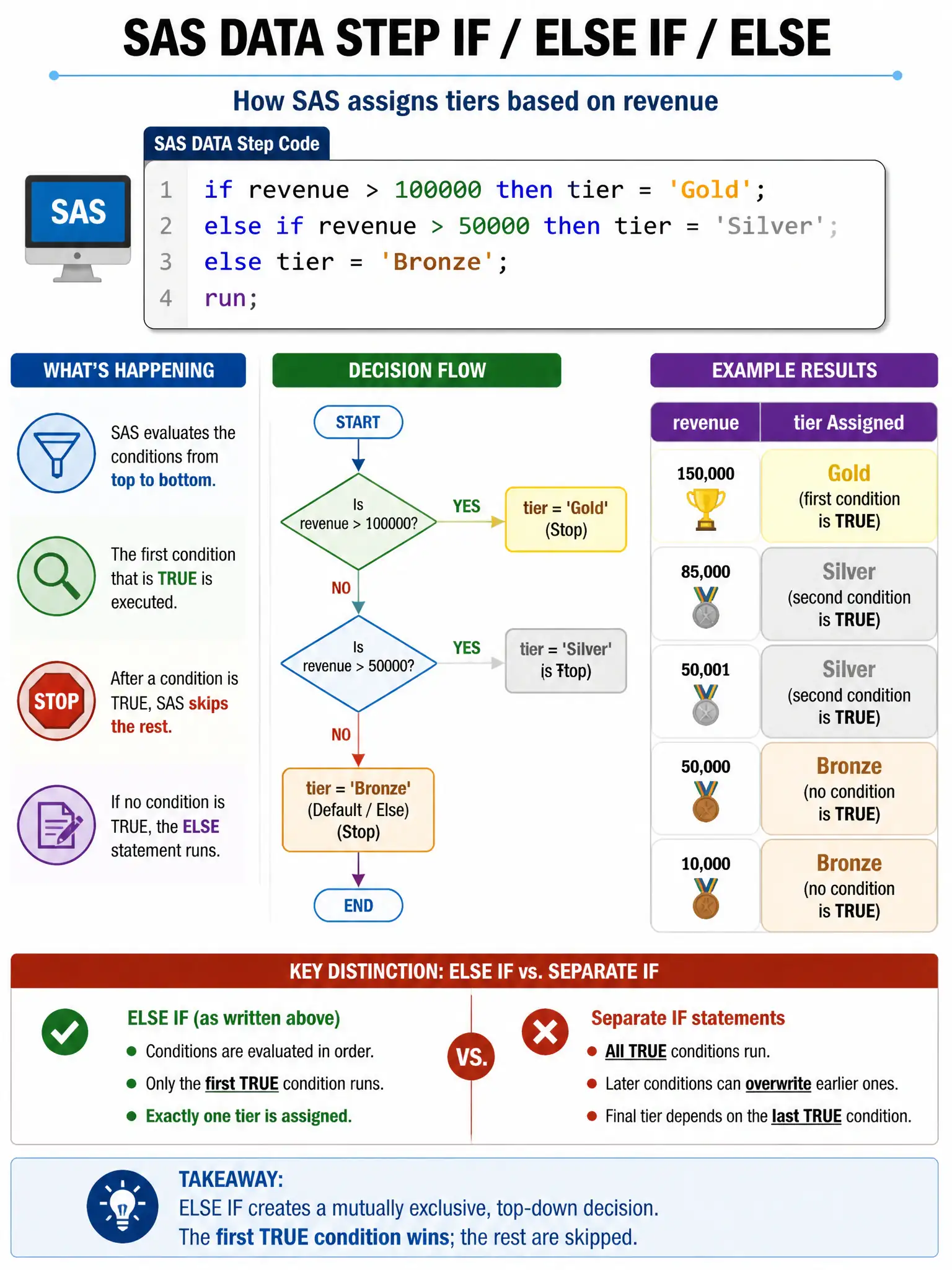
In a SAS DATA step, a programmer writes: IF revenue > 100000 THEN tier = 'Gold'; ELSE IF revenue > 50000 THEN tier = 'Silver'; ELSE tier = 'Bronze'; Which SAS behavior occurs when revenue is a missing value (.)?
Select an answer to reveal the explanation.
Short Explanation
Here's the deal — SAS treats a missing numeric value (.) as smaller than any finite number, so both comparisons fail and the ELSE branch assigns 'Bronze'. You don't get an error just because revenue is missing.
Full Explanation
The correct behavior is that SAS treats a missing numeric value (.) as smaller than any finite number, so revenue > 100000 and revenue > 50000 both evaluate to FALSE and the ELSE branch assigns tier = 'Bronze'. The runtime-error option is wrong because SAS does not error on comparisons with missing values. The largest-value option is the opposite of actual SAS behavior. The missing-character-value option is wrong because SAS assigns 'Bronze' via the ELSE branch, not a missing character value.