
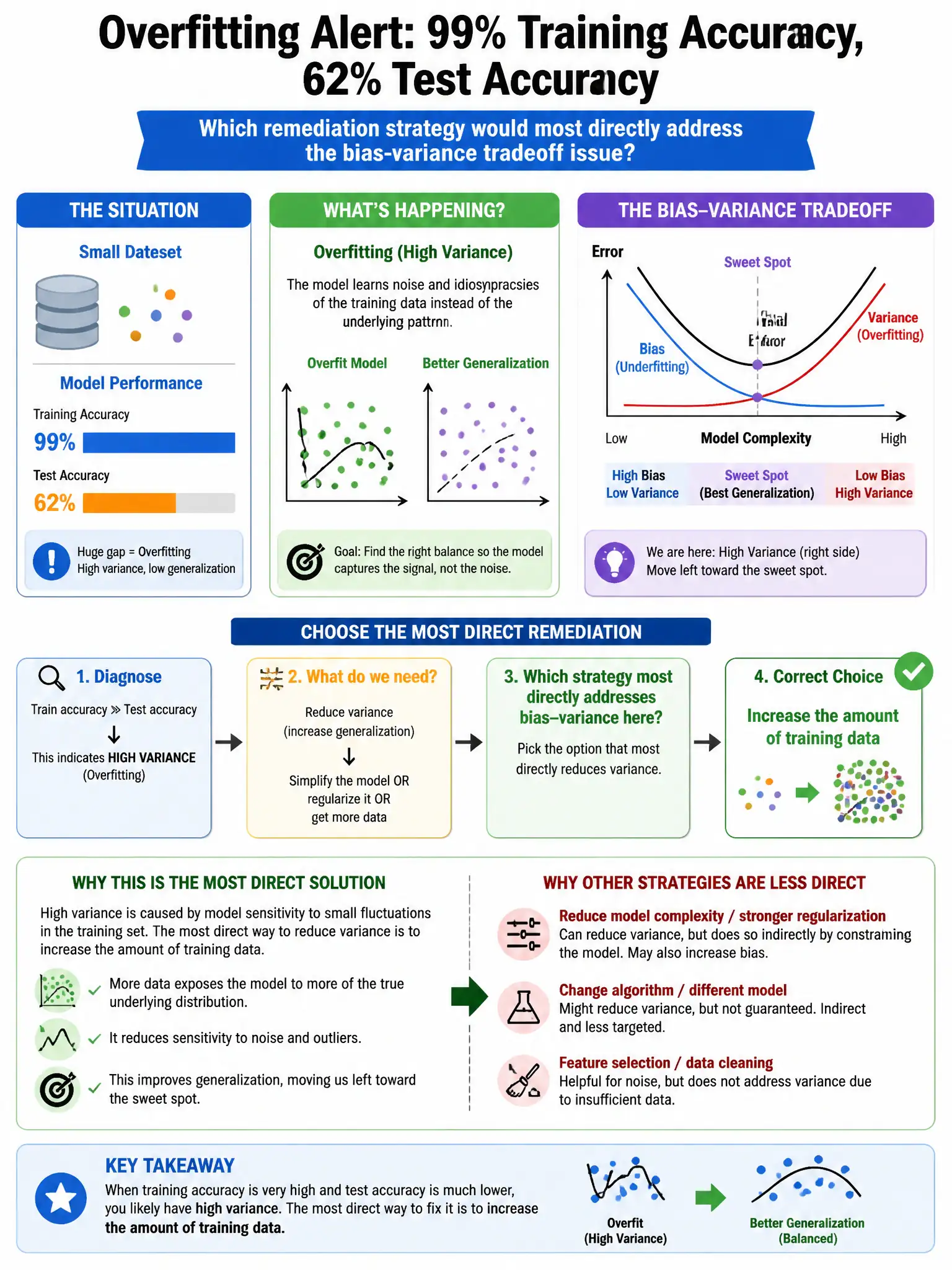
A model trained on a small dataset achieves 99% training accuracy but only 62% test accuracy. Which remediation strategy would most directly address the bias-variance tradeoff issue present?
Select an answer to reveal the explanation.
Short Explanation
You've got overfitting when training accuracy is way above test accuracy. Add more training examples or use regularization to reduce variance and help the model generalize.
Full Explanation
The large gap between training and test accuracy indicates high variance, meaning the model is overfitting. Adding more training examples reduces variance by exposing the model to more patterns, and regularization penalizes complex solutions directly, making it the most targeted remediation for the bias-variance tradeoff issue. Increasing the learning rate to converge faster is wrong because a higher learning rate does not address model complexity. Switching from a decision tree to a linear model to increase bias addresses the symptom but is less targeted than regularization. Removing features to reduce the number of input variables to zero is wrong because removing all features would destroy predictive power.