
When performing k-fold cross-validation in SAS Model Studio, what is the primary purpose of holding out each fold in turn?
Select an answer to reveal the explanation.
Short Explanation
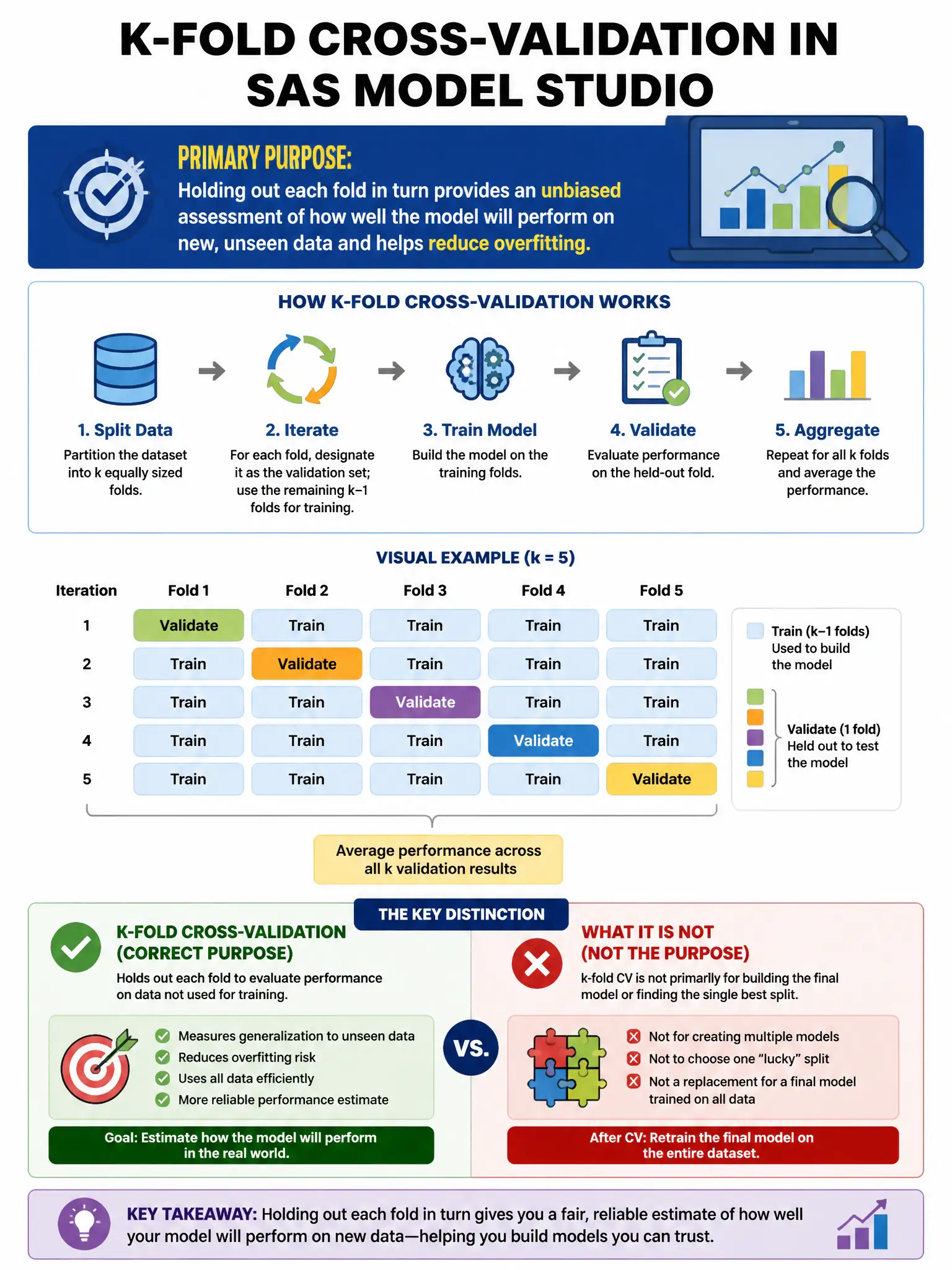
Here's the deal — holding out each fold in turn lets every observation serve as validation exactly once, so you get a low-variance, unbiased estimate of generalization error while still using all data for training. It doesn't reduce the observations used across the cycles.
Full Explanation
The correct purpose is to obtain an unbiased estimate of generalization error using all available data. k-fold cross-validation rotates each fold as a validation set so every observation is used exactly once for validation, yielding a low-variance, unbiased generalization error estimate while still using all data for training. The option about reducing total observations is wrong because k-fold uses all observations across the cycles. The option about increasing model complexity is wrong because complexity is a hyperparameter choice, not a cross-validation outcome. The option about speeding up training by parallelizing is wrong because parallelism is an implementation detail, not the primary purpose.