
A data scientist uses SAS DLPy to build an image classification model. Which deep learning architecture is most appropriate for classifying images of product defects?
Select an answer to reveal the explanation.
Short Explanation and Infographic
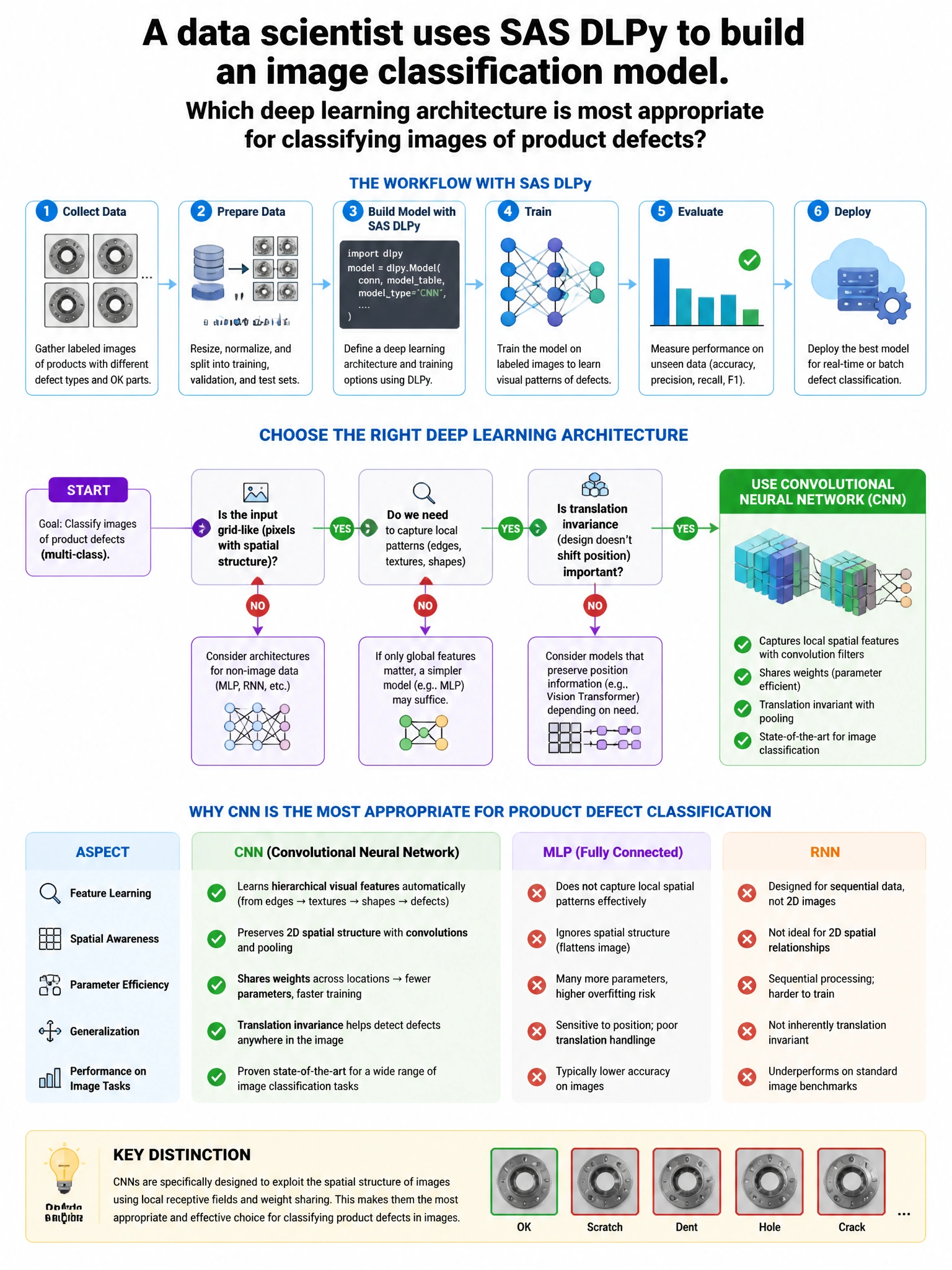
Here's the deal — b is correct because CNNs with architectures like ResNet exploit spatial hierarchies in image data through convolutional layers that detect edges, textures, and shapes, making them the standard approach for image classification tasks including defect detection. A (RNN/LSTM) is designed for sequential data like time series or text.
Full explanation below image
Full Explanation
B is correct because CNNs with architectures like ResNet exploit spatial hierarchies in image data through convolutional layers that detect edges, textures, and shapes, making them the standard approach for image classification tasks including defect detection. A (RNN/LSTM) is designed for sequential data like time series or text. C (fully connected only) ignores spatial structure and is impractical for high-resolution images. D (Transformer on raw pixels) is computationally prohibitive without convolutional preprocessing and is not a standard SAS DLPy workflow.