
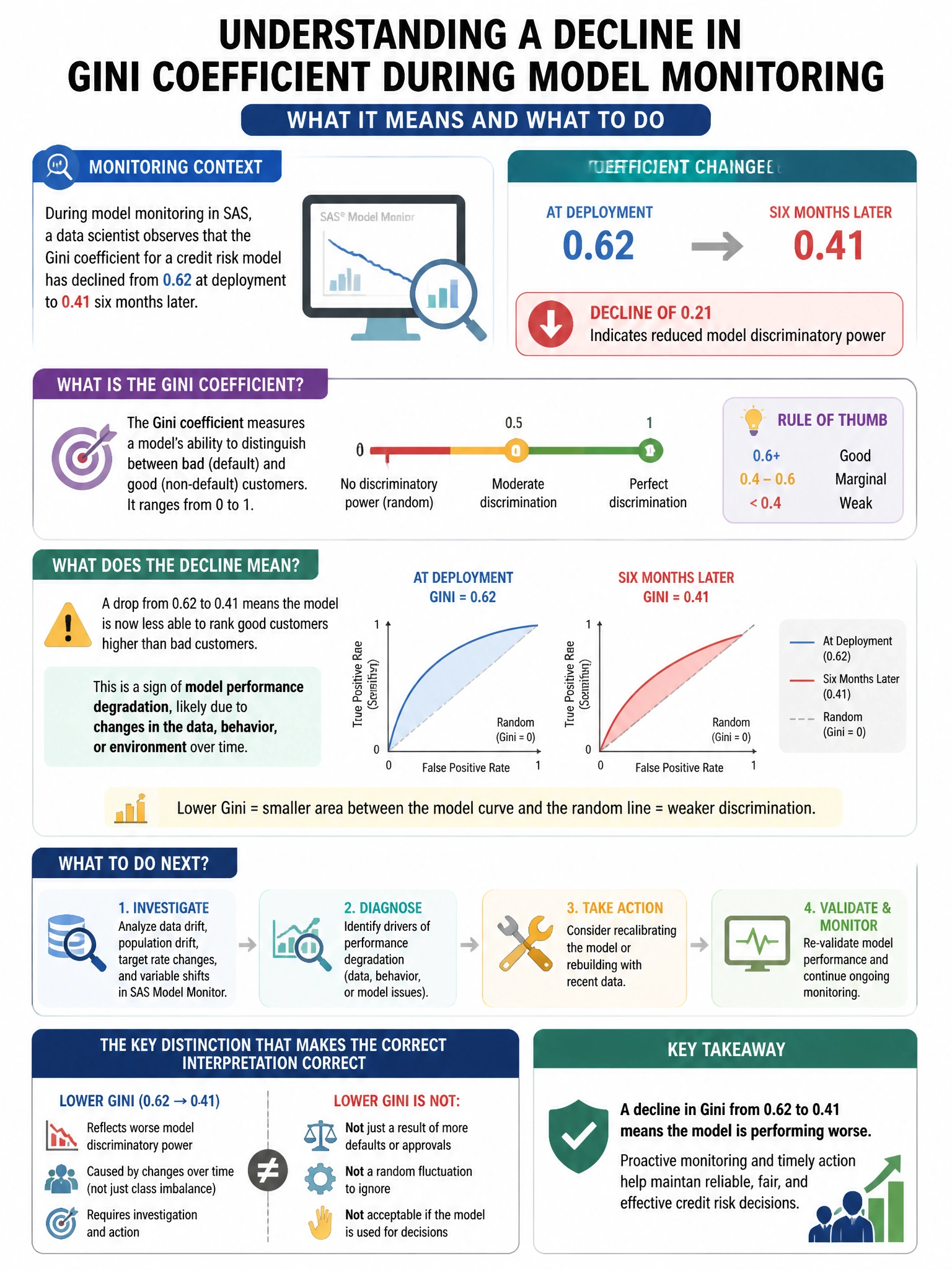
During model monitoring in SAS, a data scientist observes that the Gini coefficient for a credit risk model has declined from 0.62 at deployment to 0.41 six months later. What does this indicate?
Select an answer to reveal the explanation.
Short Explanation and Infographic
Here's the deal — b is correct because the Gini coefficient (= 2*AUC - 1) measures discriminatory power; a drop from 0.62 to 0.41 represents a significant decline in the model's ability to separate good from bad borrowers, indicating performance degradation likely caused by concept drift (relationship between predictors and outcome changed) or data drift (input distribution changed). A is wrong — lower Gini means weaker discrimination.
Full explanation below image
Full Explanation
B is correct because the Gini coefficient (= 2*AUC - 1) measures discriminatory power; a drop from 0.62 to 0.41 represents a significant decline in the model's ability to separate good from bad borrowers, indicating performance degradation likely caused by concept drift (relationship between predictors and outcome changed) or data drift (input distribution changed). A is wrong — lower Gini means weaker discrimination. C is wrong because a 21-point decline is substantial and warrants investigation. D is wrong because reducing variables would not address the root cause of drift.