
A city needs continuous block-level replication and orchestrated failover for lift-and-shifted VMs, not only periodic AMI copies. Which service should the architect select?
Select an answer to reveal the explanation.
Short Explanation
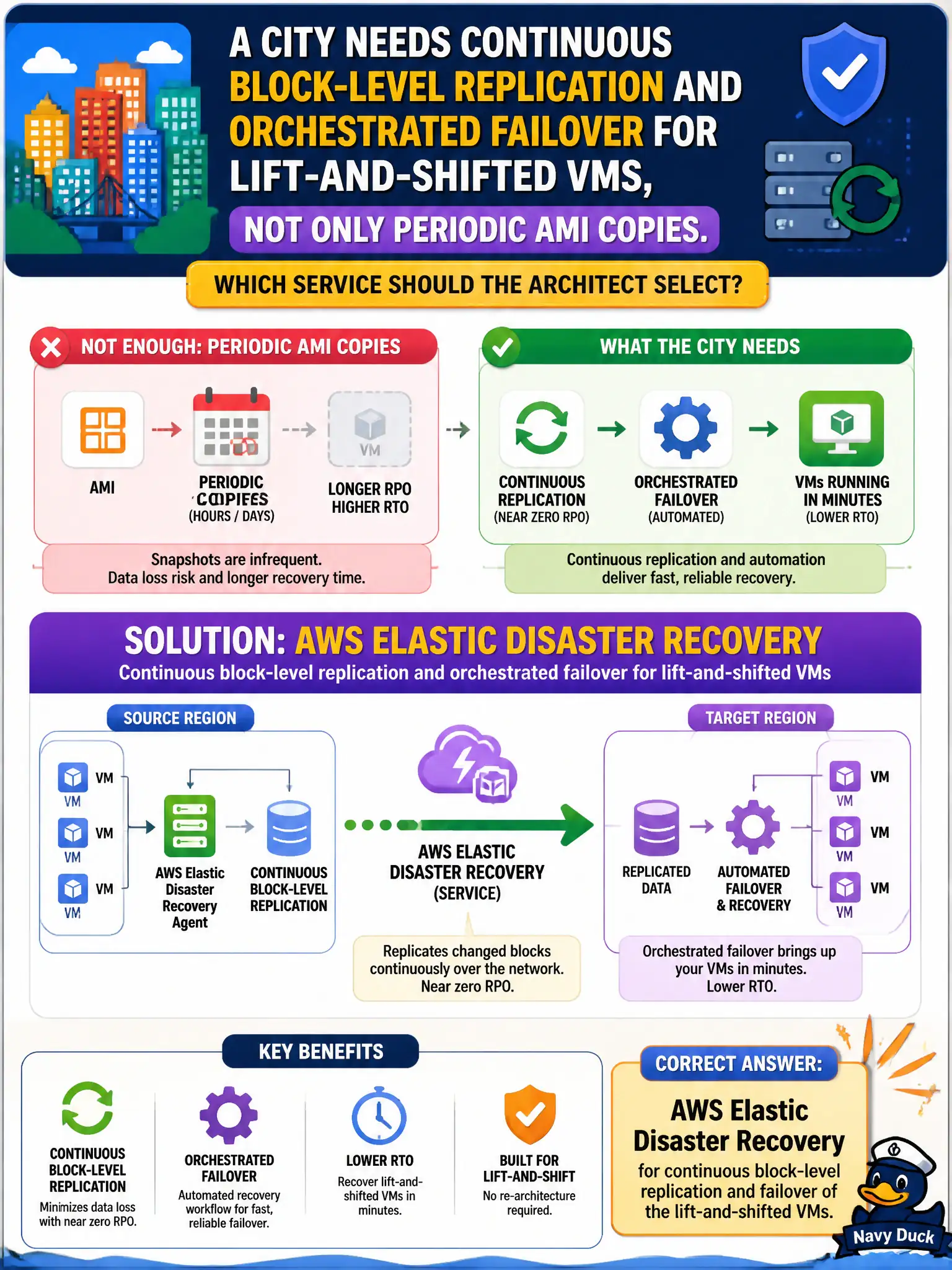
AMI photocopies are snapshots of yesterday’s desk; Elastic Disaster Recovery keeps a live block-level shadow you can fail over. Transfer Acceleration and weekly Snowball crates aren’t a VM DR control plane.
Full Explanation
Lift-and-shifted municipal VMs that need continuous block-level replication and orchestrated failover—not merely periodic AMI copies—should use AWS Elastic Disaster Recovery. Elastic Disaster Recovery continuously replicates source disks to a staging area in AWS and supports failover/failback workflows suitable for rehosted servers when RTO/RPO demand more than snapshot calendars. That service selection matches the stem’s continuous replication and orchestration language.
Manual AMI copies on an ad-hoc calendar lack continuous block-level replication and orchestrated cutover. Amazon S3 Transfer Acceleration speeds object uploads; it is not a VM failover mechanism. Shipping Snowball Edge devices weekly as the only DR path for running VMs cannot provide continuous replication or rapid orchestrated failover for day-to-day DR.
Exam caveat: Elastic Disaster Recovery (successor mindset to CloudEndure DR) is the continuous block-level answer; AWS Backup/AMI copy patterns are periodic; do not pick Snowball for online VM DR. Operational check: install replication agents on pilot VMs, confirm continuous replication lag meets RPO, execute a failover drill into AWS, validate application health, and document failback steps for the city runbook.