
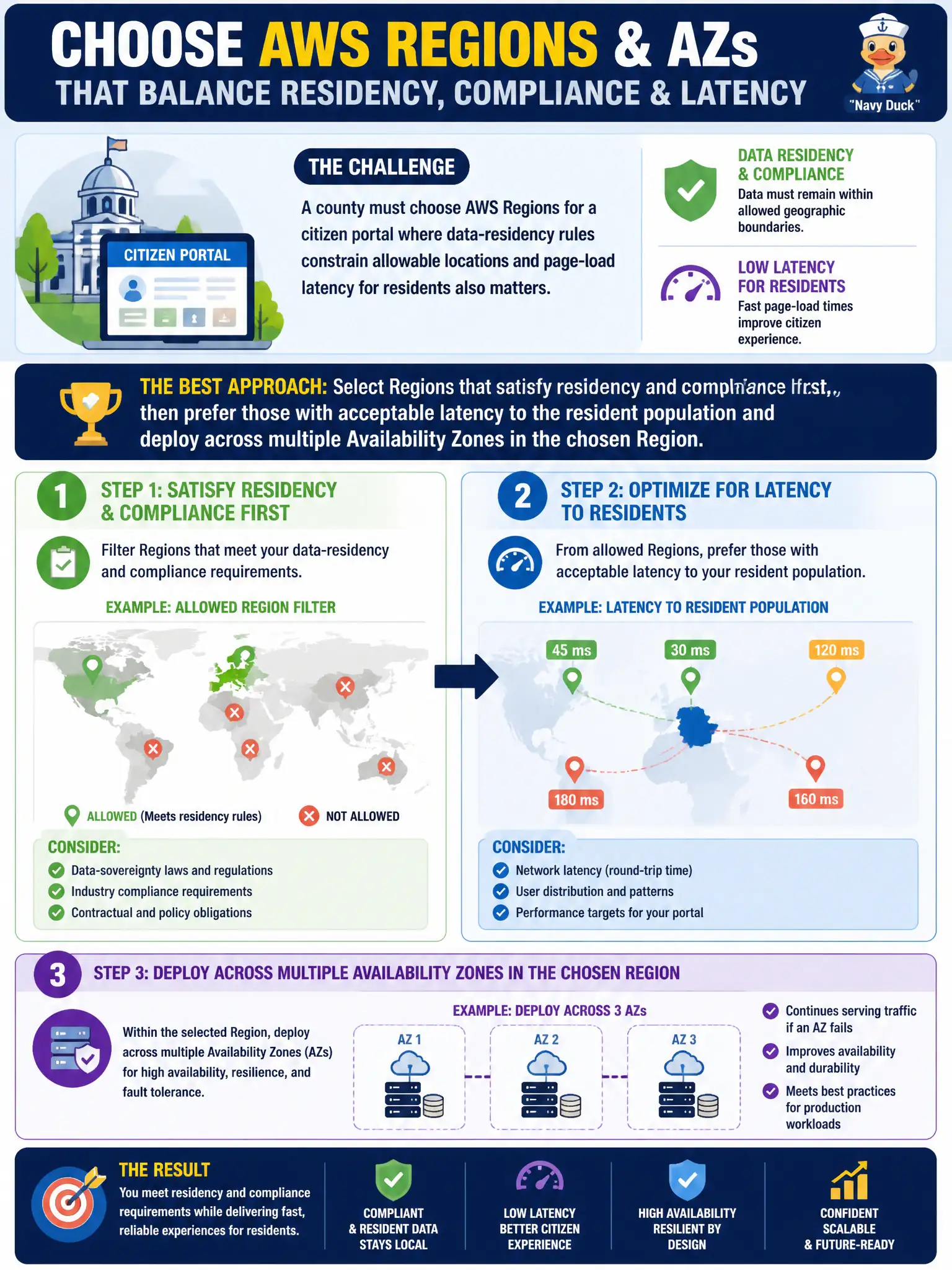
A county must choose AWS Regions for a citizen portal where data-residency rules constrain allowable locations and page-load latency for residents also matters. Which Region and AZ selection approach best balances these requirements?
Select an answer to reveal the explanation.
Short Explanation
Residency rules are the fence line; latency is how long the drive feels inside the fence. Pick legal Regions first, then the ones that feel fast for citizens, and spread across AZs. Cheapest-anywhere or one lonely AZ ignores both compliance and resilience.
Full Explanation
Region selection for a county citizen portal must satisfy data-residency and regulatory constraints before optimizing for price or convenience. Within the set of compliant Regions, architects then evaluate latency to the resident population and design multi-AZ deployments so Availability Zone failure does not take the portal offline. That ordered decision—compliance first, then latency and resilience—matches how public-sector architects defend Region choice to counsel and operations.
Always picking the globally lowest-price Region regardless of residency law or citizen latency can place regulated data outside lawful boundaries and may degrade experience for residents far from that Region. Using a single Availability Zone in a non-compliant Region compounds legal and availability risk: multi-AZ is not optional for a serious public portal, and non-compliance is not excused by architecture convenience. Placing primary data in Regions that violate residency rules because CloudFront sits in front confuses CDN edge caching with lawful primary data location; CloudFront does not legalize unlawful storage Regions.
Exam caveat: CDN or edge services do not override data-residency obligations for authoritative datasets; SAP-C02 expects compliance-constrained Region filters before performance tuning. Operational check: document the residency rule and the shortlist of allowed Regions, measure portal latency from representative resident networks to the chosen Region, deploy the stack across at least two AZs, and verify that primary databases and object stores remain only in approved Regions.