
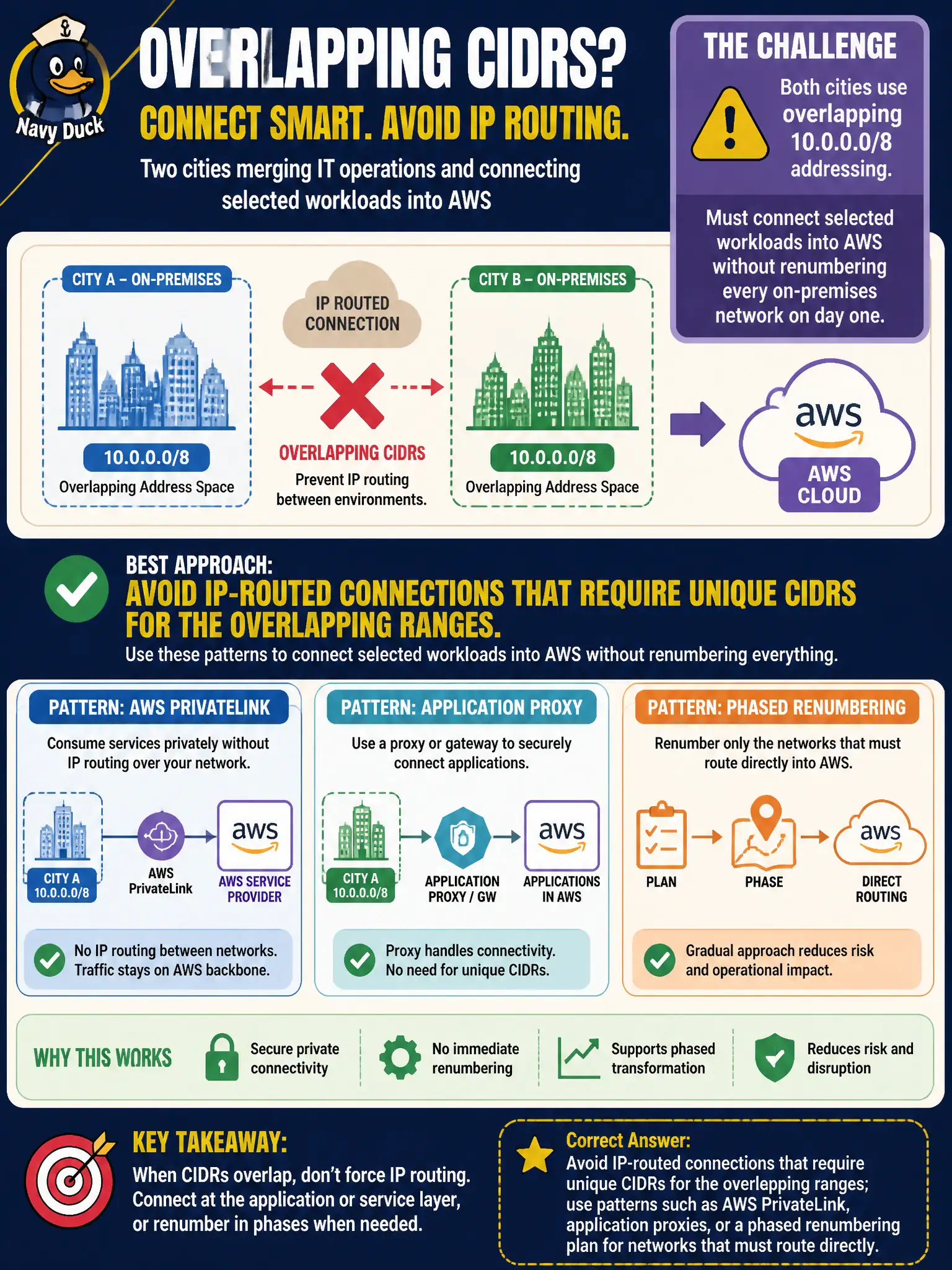
Two cities merging IT operations both use overlapping 10.0.0.0/8 addressing and must connect selected workloads into AWS without renumbering every on-premises network on day one. Which approach best addresses the overlapping CIDR constraint?
Select an answer to reveal the explanation.
Short Explanation
Two towns with the same street numbers cannot share one GPS map without chaos. Overlapping CIDRs break simple routed attachments, so you either hide behind PrivateLink or proxies or you plan a renumbering wave. Peering and Transit Gateway still need unique, routable addresses.
Full Explanation
Overlapping CIDR space between two merging cities breaks classical IP-routed attachments into AWS. VPC peering, Transit Gateway attachments, and many VPN patterns require unique, non-overlapping routes so return traffic has an unambiguous destination. When both cities already use overlapping 10.0.0.0/8 ranges and cannot renumber everything on day one, architects should avoid IP-routed designs that demand uniqueness for those colliding ranges. Patterns such as AWS PrivateLink (service endpoints without exchanging full overlapping CIDRs), application-layer proxies, or a phased renumbering plan for networks that truly must route directly are the professional responses.
Creating VPC peering despite overlap fails because peering and routing cannot reconcile identical address spaces; peering does not “ignore” conflicts. Attaching both overlapping on-premises ranges to the same Transit Gateway route table and hoping longest-prefix match invents uniqueness does not fix two equally specific colliding summaries advertising the same space. Assigning identical CIDR blocks to two VPCs in the same Region and peering them is invalid and proves the opposite of support for overlap. Those distractors keep trying to force IP routing where the address plan forbids it.
Exam caveat: overlapping CIDRs are a classic SAP-C02 trap—PrivateLink and proxy patterns appear when renumbering is deferred; do not pick TGW or peering as if duplicate routes were harmless. Operational check: inventory colliding prefixes, decide which workloads need PrivateLink versus which can renumber first, validate that consumer/provider endpoint connectivity works without installing the overlapping CIDR into the consumer route tables, and track a renumbering backlog for any remaining routed attachments.