
Planning wants OCR on uploaded permit plans and image moderation on public 311 photos, but these are adjacent enhancements to existing S3-based intake—not a new AI product line. Which approach should architects take so the core architecture stays on integration?
Select an answer to reveal the explanation.
Short Explanation
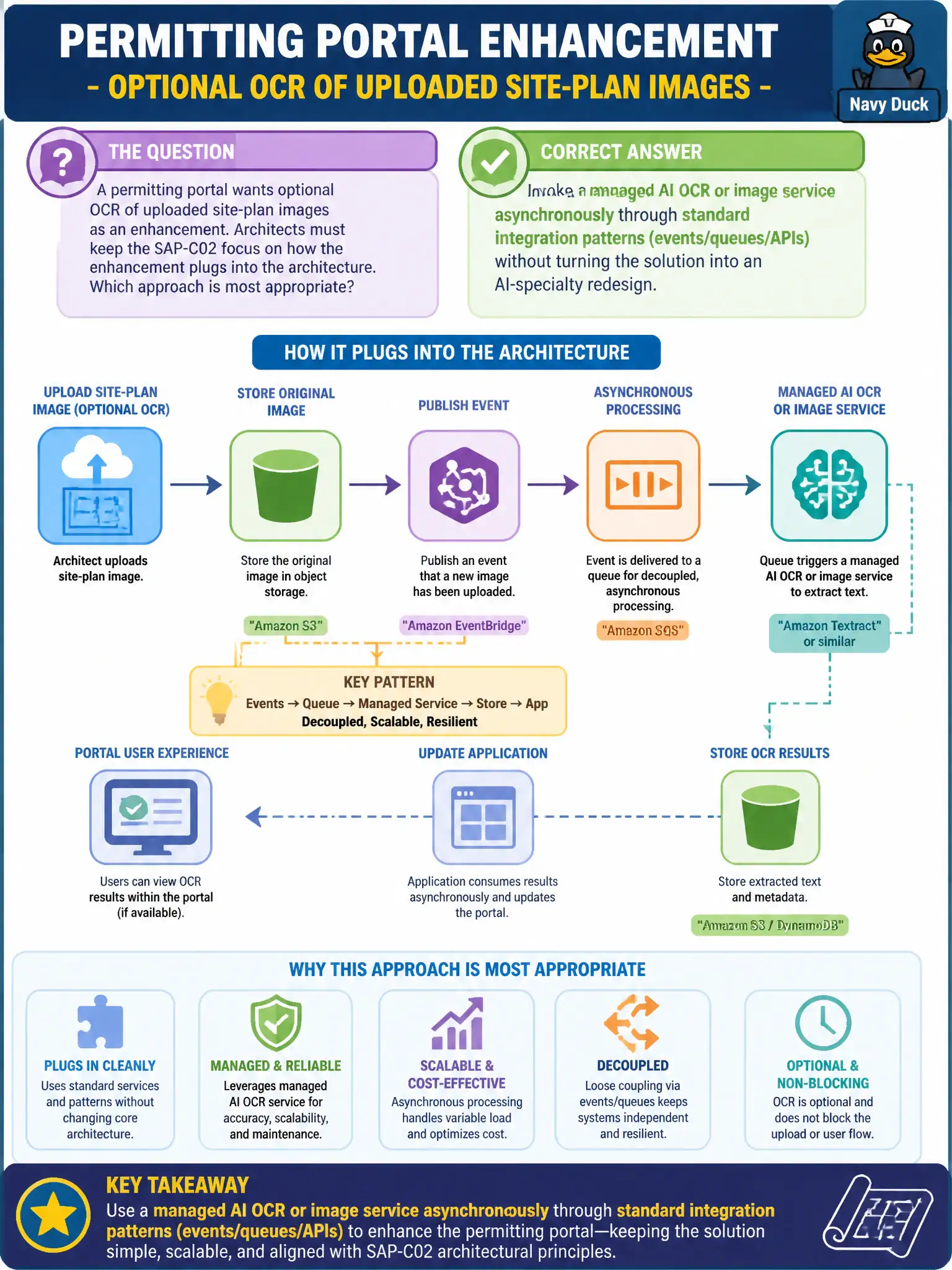
OCR is a side window, not a new city hall. Keep the S3 intake, fire EventBridge, and call the managed OCR or moderation API when a file lands. Don't turn a permit upload into an AI research program.
Full Explanation
Planning wants OCR on uploaded permit plans and image moderation on public 311 photos as adjacent enhancements to existing S3-based intake—not a new AI product line. Architects should invoke managed OCR or moderation APIs asynchronously from the existing S3, EventBridge, and Lambda intake path so AI is an enhancement, not a rewrite, keeping the core architecture on integration. Redesigning the permitting domain around foundation-model application design as the scored core fails scope—the stem says adjacent enhancement. Embedding a custom training cluster in every department account before any PDF can be stored fails proportionality and cost. Blocking all image uploads until a multi-year computer-vision program finishes fails citizen service delivery. Exam caveat: managed AI APIs on existing event paths beat AI-centric rewrites for adjacent features. Operational check: add EventBridge rules from S3 uploads to Lambda calling Textract/Rekognition (or equivalents), store results beside objects, handle failures with DLQs, and keep human review for contested moderation. Document the decision in the municipal architecture decision record and re-verify controls after the first production wave so auditors see continuous improvement, not one-time tribal knowledge.