
A parks-and-recreation registration database is quiet most of the year and spikes around summer-camp enrollment, currently over-provisioned on a fixed RDS instance in a departmental account. Which purpose-built database modernization fits?
Select an answer to reveal the explanation.
Short Explanation
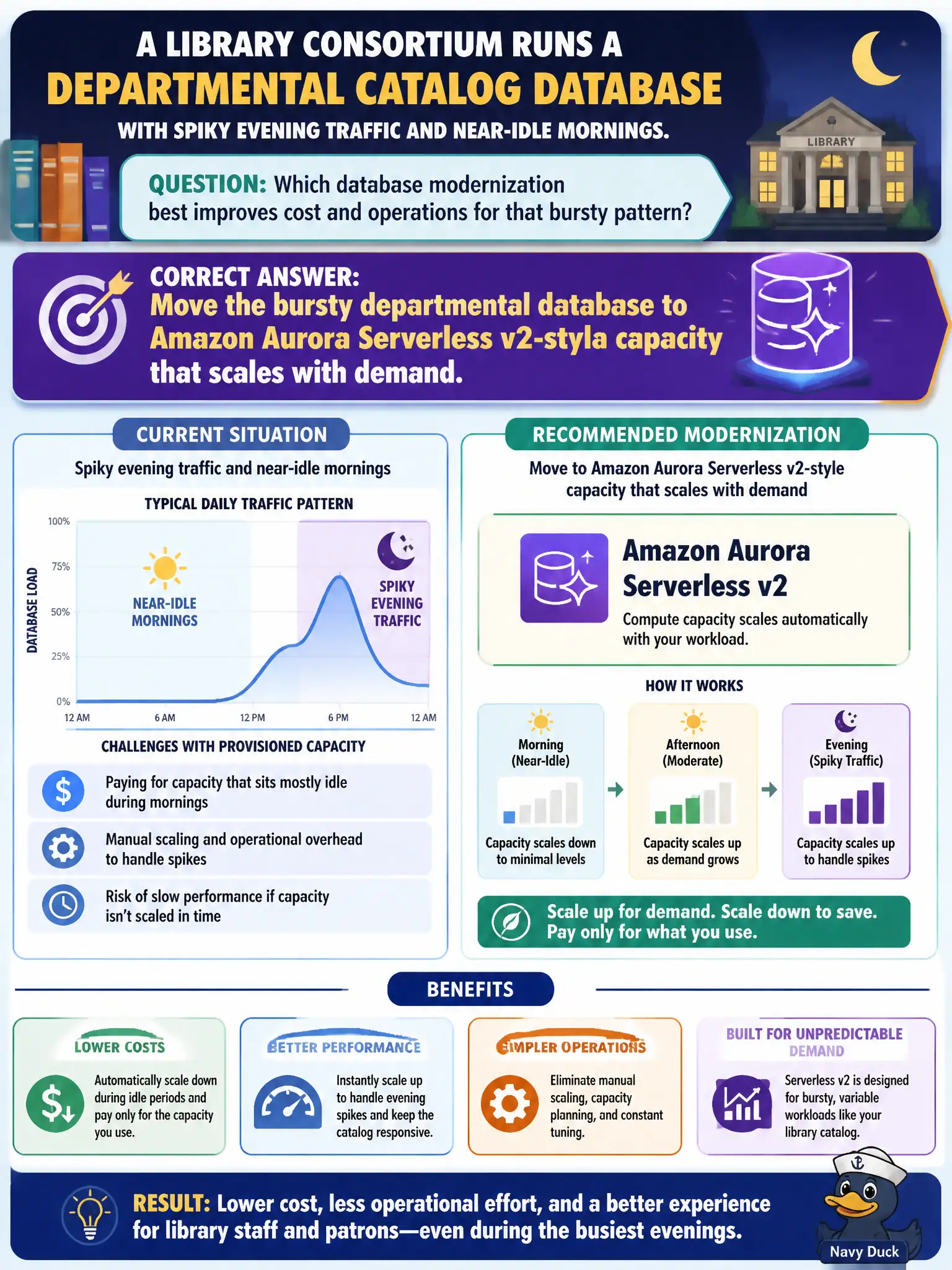
Summer camp is a stampede; January is a ghost town. Aurora Serverless v2 turns the capacity up when families enroll and down when they don't. A year-round peak box is a parking garage heated for one busy weekend.
Full Explanation
A parks-and-recreation registration database that is quiet most of the year and spikes around summer-camp enrollment—currently over-provisioned on a fixed RDS instance—should move to Amazon Aurora Serverless v2 so capacity scales with enrollment rather than staying peak-provisioned all year. That purpose-built modernization matches seasonal civic demand. Keeping a peak-sized Multi-AZ RDS instance running at enrollment capacity all year fails cost during quiet months. Relocating the relational schema into Amazon CloudWatch metrics as the system of record fails data-store purpose. Sharding the database across unmanaged MySQL on Spot instances without a failover story fails reliability for camp registration payments and seats. Exam caveat: seasonal bursty departmental DBs fit Aurora Serverless v2. Operational check: migrate to Aurora Serverless v2, set capacity ranges from off-season and enrollment peaks, load-test registration week, monitor ACU and latency, and retire fixed peak RDS sizing. Document the decision in the municipal architecture decision record and re-verify controls after the first production wave so auditors see continuous improvement, not one-time tribal knowledge. Document the decision in the municipal architecture decision record and re-verify controls after the first production wave so auditors see continuous improvement, not one-time tribal knowledge.